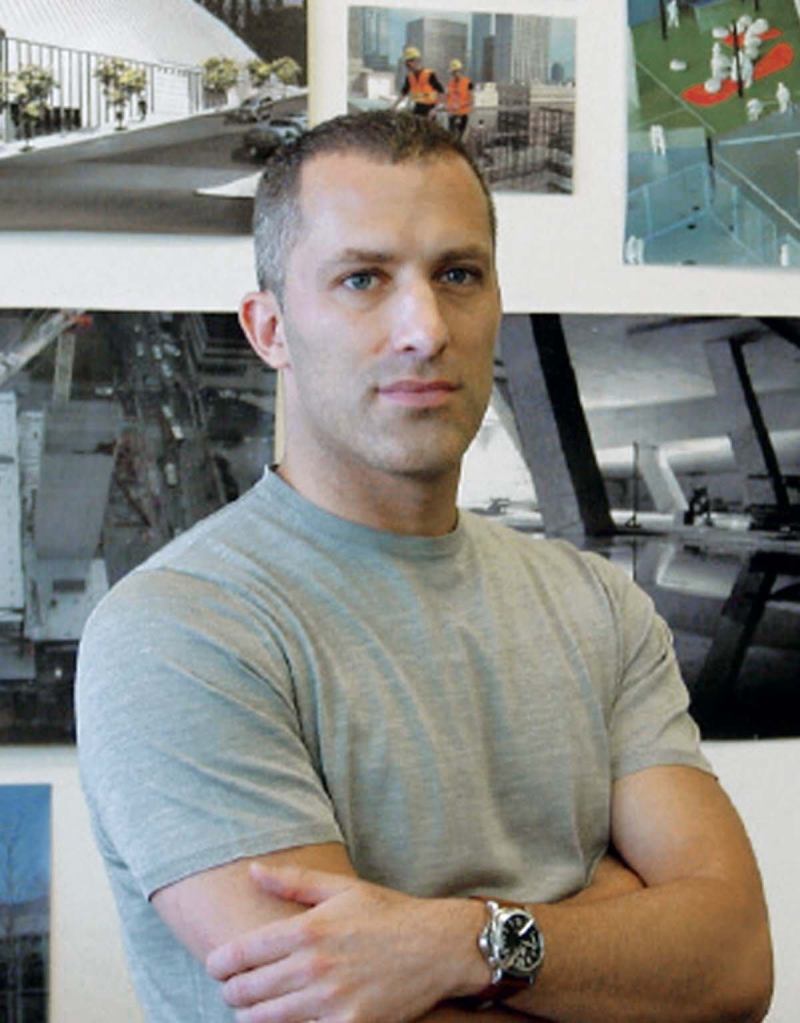
Last November, at a press opening held at New York’s Museum of Modern Art (MoMA), Dutch architect Rem Koolhaas stood outside the architecture and design gallery chatting into his cell phone and staring detachedly into Yoshio Taniguchi’s modernist atrium. Inside, in full swing, was the junket for OMA in Beijing: China Central Television Headquarters—an exhibition on the Chinese media and cultural complex designed by Koolhaas’ Office for Metropolitan Architecture (OMA). Journalists and VIPs added to the visual cacophony of photographs, building models, and drawings of the Forbidden City. OMA partner Ole Scheeren worked the crowd, answering questions and posing for photographs.
As director of the Rotterdam and Beijing offices, the 36-year-old is responsible for the nearly 2-million-squarefoot project. Scheeren, who studied at the Architecture Association in London, joined the firm in 1995 and gained some public recognition leading the design of the Prada stores in New York, Los Angeles, and San Francisco. His role as spokesperson challenges the easy equation that OMA=Rem.
In a media climate devoted to celebrity, it can be easy to miss, but firms branded by star architects are actively priming fresh talent. Recently, avant-garde architects Elizabeth Diller and Ricardo Scofidio added longtime collaborator Charles Renfro to their moniker to form Diller Scofidio + Renfro. And the MoMA exhibition is just one example of Koolhaas giving his lieutenants autonomy and a place in the public eye. Before he left to found his own practice with Erez Ella, Joshua Prince-Ramus, former head of OMA’s New York office, was the go-to guy for the Seattle Central Library.
As signature practices grow and age, it becomes impossible to maintain a model devoted to a founder’s virtuosity. Global projects, new technologies, and design trends face off against what Prince-Ramus deems the “genius sketch.” Although his firm, Ramus Ella Architects (REX), is just a year old, Prince-Ramus is keenly aware of the pressure from both clients and the press to present a Howard Roark face to the public. He actively resists. “It isn’t possible any longer to practice in the older mode. You can’t operate in the star architect model. It will lead to its doom,” he ominously intones. “We are not the only ones who think the profession is changing. There is a lot of frustration among young architects about the choices offered to them: You can be a stylist or a project manager.”
Instead, Prince-Ramus strategically sets up ways of working in his office to avoid singular authorship. Collaboration and debate are required from all members of the staff. In return, they all get publicly recognized. “On all of our press releases, everyone is listed alphabetically. As an owner, I don’t take first billing,” he says.
Even though REX advocates a nonhierarchical structure, there are still young architects out there vying to be Top Designer. It is an ambition generally not achieved—very few are singled out and given that kind of creative freedom.
Those on the more common track gain rank by taking on the nuts and bolts of project management and construction. This is hardly a career path to snub: For most architects, it defines the practice of architecture. (Both associates and partners can be on this side of the design divide.) At the same time, it doesn’t have the same glamour quotient. That may explain why The Business of Architecture: The 2003 AIA Firm Survey reports that nearly one-third of all licensed architects are sole practitioners. If you don’t get the brass ring at a larger firm, why not try for it on your own?
Even as the profession’s status quos remain entrenched, established firms are tweaking the older figurehead (or Fountainhead) model, making some changes that should influence the next generation. Arquitectonica’s Bernardo Fort-Brescia keeps a masterful hand in each of the projects his firm embarks upon, yet the practice’s expansion from its Miami headquarters to offices in 11 other cities, including New York, Hong Kong, and Sao Paulo, mandated changes. Business was booming, but design resources were strained.
“We are an unusual firm. We are 400 people, but we’re not a multipartner firm. The firm is owned and run by the original principals,” says Fort-Brescia, who founded Arquitectonica in 1977 with Laurinda Spear. “Having said that, yes, there is a new generation inside the firm that we are grooming. There are people that we like a lot that we are bringing into the design discussions. They are advancing within the firm … some of them are younger than some of the more senior project managers.”
Bringing in up-and-comers is Arquitectonica’s concerted effort to redefine the firm’s future and keep its architecture current. Fort-Brescia stresses that all offices are stocked with top designers working collaboratively, but the newest “laboratory” in Cambridge, Mass., is a unique case: Not only does it delve into conceptual design, materials research, and completions with vigor, but one member of its small team is the principals’ daughter, designer Marisa Fort. A recent graduate of Harvard University’s Graduate School of Design, Fort spent some time at OMA in Rotterdam before joining the family business.