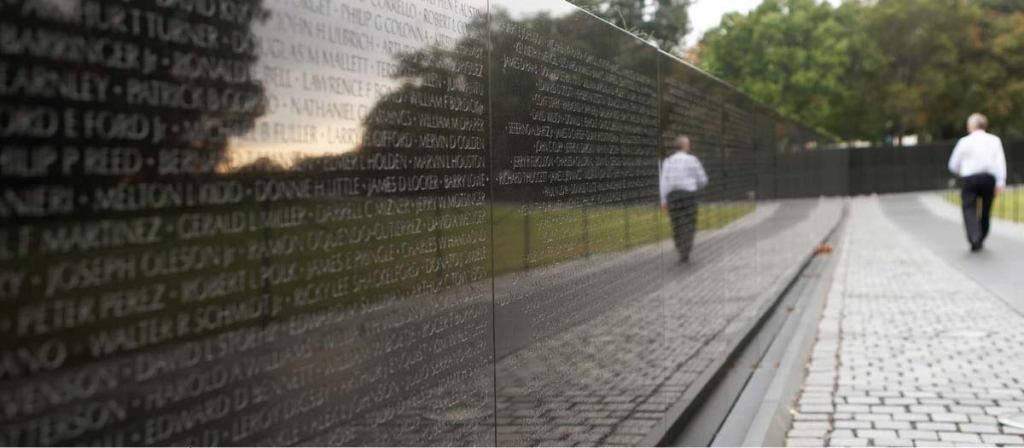
Ranked No. 10 on the AIA's 2007 list of America's Favorite Architecture, Maya Lin's Vietnam Veterans Memorial will likely have an adjacent visitors center in 2012.

Ranked No. 10 on the AIA's 2007 list of America's Favorite Architecture, Maya Lin's Vietnam Veterans Memorial will likely have an adjacent visitors center in 2012.

Credit: Getty Images


If everything goes according to plan, sometime in 2012 the Vietnam Veterans Memorial Center will open in Washington, D.C., on a 5.2-acre site just west of Maya Lin's famous black granite wall.

Designed by Polshek Partnership Architects with exhibits by Ralph Appelbaum Associates—the same team that did the recently opened and much-lambasted Newseum, at the other end of Constitution Avenue—the center will be the latest, and likely the last, addition to the increasingly crowded National Mall. (Along with approval for the center, Congress passed a moratorium on future projects, citing a lack of space.)

While some Washington landmarks have visitors centers, the center as planned is unprecedented in its size and scope: more than 25,000 square feet of public space, buried partially underground, featuring 75-foot-high plasma screens with rotating images of the war's dead, a timeline of Vietnam-era events, and a selection of the medals, fatigues, and letters that are left at the memorial each year.

The goal, as retired Gen. Colin Powell says in a promotional video produced and distributed to donors by the Vietnam Veterans Memorial Fund, the nonprofit responsible for building and maintaining the memorial, will be to “enhance the Vietnam Wall experience”—to add depth and context to a trip made by 4 million people each year.

It's a laudable aim. But given the power of Lin's design, why does the memorial need enhancing in the first place? Asked more directly, is the center an indictment of “the wall” itself? And if so, what does it say about American culture that we need something more at the site?

With its massive panels cutting a broad gull wing into the northwest corner of the Mall, the Vietnam Veterans Memorial diverges abruptly from the studied classicism of most Washington landmarks. Its stark minimalism set off controversy when the design was first unveiled in 1981—one critic called it a “shameful degrading ditch.” But time has proved otherwise: Since its opening 26 years ago, the wall has clocked 20,000 visitors a day, making it the most frequented monument in the country.

And it's more than just a tourist attraction; as an entire cottage industry of cultural theorists has documented, the wall and its 58,195 names have changed the very way we look at war. “The memorial has been the center of a debate on precisely how wars should be remembered,” wrote New York University media studies professor Marita Sturken in the journal Representations, “and precisely who should be remembered in a war—those who died, those who participated, those who engineered it, or those who opposed it.”

It has even altered the way we interact with memorials themselves. Despite—or perhaps because of—its cool abstraction, visitors have rendered the memorial an active space; every day, hundreds of people make rubbings of the names of lost relatives and friends, while some 110,000 items have been left at its base. Today it is less a memorial than a ritual space.

And since 1996, people don't even have to leave home to see it. “The Wall That Heals,” a half-size replica of the memorial in Washington, has visited 250 towns and cities—including a trip to Ireland—bringing with it a “comprehensive educational component to enrich and complete visitors' experiences,” according to the Memorial Fund, which now promotes education about Vietnam and the wall. Add that to the dozens of imitation memorials—black granite, list of names—that have gone up around the country, and the actual wall begins to take a back seat. In its place, we have the Vietnam Veterans Memorial: The Branded Experience.

The wall isn't alone. From the Oklahoma City National Memorial to the plans for the World Trade Center site, monuments are no longer objects but environments—we can stand in a Depression-era breadline at the FDR Memorial, and we can trudge along the Chosin Reservoir with weary soldiers at the Korean War Veterans Memorial.


Vietnam Veterans Memorial Center

Vietnam Veterans Memorial Center

Credit: Polshek Partnership Architects

Part of this trend toward interactive memorials is thanks to the wall's influence, but there is also a larger cultural shift at work. Experience is everything today. Architects, chefs, and casinos no longer design buildings, cook food, or run the tables; they produce living, dining, and gambling “experiences.” News is no longer just read to us by a gray-haired man behind a desk, but constructed online as bloggers grab nuggets of information, mix them together with a dash of opinion, and pass them on to other bloggers. While music and movie sales plummet, video game sales are growing at nearly 30 percent annually.

As architect David Rockwell said recently, “The most valuable thing about place, events, or a building is the way it puts the viewer in the center of the experience”—a notion that he has built into W Hotel interiors and the theater for the Academy Awards.

What lies beneath contemporary America's love of experience is a discomfort with abstraction and the contemplation it requires. The thing in itself has never been our thing. We want action, we want narratives, and we demand that our cultural objects fit within them—all the more so in an increasingly fluid and complex world, where meanings and connections multiply and blend daily.

And when we aren't given an experience, we create one. That's the ironic success of the Vietnam Veterans Memorial: Like a piece of sand in our collective oyster, we've polished and layered its abstraction with a thick patina of experience, converting its frustrating ambiguities into a pleasantly smooth pearl. Maybe once we could let our minds chew over an enormous obelisk or a low granite wall. These days, who has the time?

Which brings us back to the Memorial Center. As Memorial Fund president Jan Scruggs points out, today some 40 percent of visitors are too young to remember the war. Increasingly, teachers tell him that “their kids would come to visit the memorial, and though they would find it interesting, they would not have much knowledge about the war itself, so the visits were not as poignant as one would hope.”

Thus the limits of abstraction: The experience of the wall only works when we know how to approach it. Baby Boomers know, as do their children, raised on a diet of Platoon and China Beach. But for anyone under 30, Vietnam is a hip vacation spot, not a painful cultural memory—let alone a lodestone for war and remembrance.

This may be why the center is less about Vietnam than, as Scruggs puts it, “a larger national purpose, to teach values, values of loyalty, respect, integrity, courage, the values that people learn when they're in the military. … There's a universal message to all this. Think about the kids over in Iraq right now.”

But with that in mind, there is a good chance that the center will succeed too well, that over time it will render an official interpretation of the wall, and of the war—and perhaps of wars in the plural. Respect and courage are important values, but allowing others to define how we view military service runs the risk of handing the wrong people a powerful propaganda tool.

Particularly in an age of diminished civil liberties and oligopolistic control of the media, we should be worried each time the potential arises to fix definitions and limit interpretation. As much as Americans may resist, plurality of meaning is a critical part of modern democratic society. Abstraction is not just an aesthetic; it is a civic value. It allows different people with different identities to see something their own way, and through it give expression to their own ideas.

And that is the singular achievement of the Vietnam Veterans Memorial. It can be read in multiple ways: As a gash in the earth it symbolizes the pain of war, while as a work of art it improves the earth, symbolizing the value of sacrifice. The challenge it presents to us is that of weeding through its many meanings—one we should not forget once the interpretive center opens.

Clay Risen is the managing editor of Democracy: A Journal of Ideas. He has written about architecture for Metropolis, The New Republic, and Slate.

Clay Risen is the managing editor of Democracy: A Journal of Ideas. He has written about architecture for Metropolis, The New Republic, and Slate.