When the United States last occupied an embassy next to Berlin's Brandenburg Gate, in 1941, the diplomat George Kennan watched from its windows as Hitler passed by en route to the Reichstag to declare war on Washington. Nowadays, at the resurrected U.S. Embassy on the same site, diplomats peering out of the blast-resistant windows are likely to spot hostile German architecture critics lining up to denounce the building's design.
The Berliner Tagesspiegel newspaper called the building a "triumph of banality." The Süddeutsche Zeitung dubbed it "a Fort Knox at the Brandenburg Gate." The Tageszeitung compared one façade to a "social housing building" with an entry like "a prison courtyard."
The Frankfurter Allgemeine Zeitung was the harshest. "There is hardly a modern building in existence — aside from bunkers and pesticide-testing centers — that is so hysterically closed off from the public realm as this embassy," the paper's architecture critic, Niklas Maak, wrote. "The embassy gives the image of a country traumatized by 9/11 and the effects of globalization" and might as well be "on the route to the Green Zone in Baghdad," he added. One windowless expanse, Maak suggested, "must be home to the 'wellness and water-boarding' area."
Few U.S. government commissions have been as vexed by controversy. But is the new embassy really that bad?
THE OLD EMBASSY BUILDING, housed in the 19th century Blücher Palace, was severely damaged in the final days of World War II. At the start of the Cold War, its shattered remains were torn down, and the plot ended up on the no-man's- land fronting the Berlin Wall.
After the Wall came down, the State Department recognized the importance of the commission to erect a new building there. In 1995, it organized its first competition for an embassy since the contest Eero Saarinen won to design the U.S. Embassy in London four decades earlier. Thirty entrants were winnowed to six: the offices of Venturi, Scott Brown; Kevin Roche John Dinkeloo; Robert A.M. Stern; Bohlin Cywinski Jackson; Kallmann McKinnell & Wood; and Moore Ruble Yudell. In deference to German sensitivities, the jury included former West Berlin Mayor Klaus Schütz, who dissuaded the panel from Stern's approach. (Neoclassicism is problematic in Germany, due to Hitler's overblown versions of the temples of antiquity.)
Dozens of new diplomatic outposts were built in Berlin after the Federal Republic of Germany completed the move of its government seat from Bonn in 2000. These included an intriguing enclave of Nordic embassies housed behind a single, curved green copper façade and drawn up by an array of architects, Oslo-based Snøhetta among them. Elsewhere in unified Berlin, the Netherlands hired Rem Koolhaas, Austria called on Hans Hollein, and Mexico looked to Teodoro González de León, all of whom had leeway to fashion unconventional showcase structures.
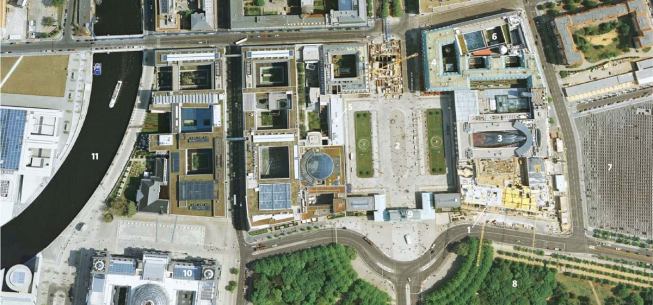
By contrast, the U.S. Embassy site on Pariser Platz—the rebuilt square facing the Brandenburg Gate that Berliners like to call their city's gute Stube, or front parlor—was subject to tight city regulations specifying building height and setbacks, as well as window size and symmetry, and requiring stone façades. The parcel off the square's southwest corner is a complicated one, with Pariser Platz at the northern end, the leafy Tiergarten park on the west, and the vast, somber Holocaust memorial by Peter Eisenman to the south. The winning embassy design, by Moore Ruble Yudell Architects & Planners (MRY) of Santa Monica, Calif., sidestepped any unified aesthetic in favor of what principal John Ruble calls "an assemblage of many parts."
The original design mutated considerably before U.S. diplomats finally moved in this past May. After the winner was announced in 1996, the project was put in deep freeze as the State Department grappled to come up with financing. Then, in August 1998, truck bomb explosions outside U.S. embassies in Kenya and Tanzania left 301 people dead and injured more than 5,000. In response, the State Department drastically tightened security restrictions for new embassies. Already, a 1983 bombing outside the U.S. mission in Beirut, Lebanon, had brought a 1985 mandate that embassies be set back 100 feet from the street.
Such requirements were difficult to meet at Pariser Platz because of the German desire to re-erect the square according to its original plan, and led to a protracted clash between the U.S. government and the city of Berlin, which was still adjusting to its post-Cold War sovereignty. So when then U.S. ambassador John Kornblum asked Berlin authorities to either move a street behind the embassy or eliminate a lane of traffic to create the required buffer zone, it turned into a test of wills. Relations were strained to the point that Berlin's mayor at the time, Eberhard Diepgen, publicly taunted Kornblum, suggesting "he should just go ahead and build a McDonald's restaurant on Pariser Platz instead of a United States Embassy."
The ambassador, a seasoned diplomat devoted to cultivating U.S.-German ties, was incensed. "It was seen as some kind of imperialistic demand to move the street a few feet," Kornblum remembers. At one point, Berlin officials pressed the Americans to give up their central site altogether and move to a plot in the Tiergarten behind the Japanese Embassy, locating the U.S. mission at the singularly awkward address of Hiroshimastrasse. "They wanted to get rid of us," Kornblum says.
A compromise was eventually reached whereby then secretary of state Colin Powell partially waived the setback requirement, in exchange for the Berlin government removing one lane of traffic in the street to the south and moving another street slightly to the west.
In the process, the architects had to pull in the footprint of their original design on two sides. The building lost one wing when it went from a rectangle to a U shape, with the outer wall of an adjacent Frank Gehry-designed bank flanking the east side of the inner courtyard. Complicating MRY's task even further, Congress slashed $50 million off the original $180 million budget, forcing still more modifications to a project that finally broke ground in 2004. Only 80 percent of the embassy's 500 staffers can fit into the new building, with the remainder now posted in what was previously the U.S. Consulate in West Berlin.
In the original competition guidelines, architects were urged to create a "public face that portrays an open, accessible government while accommodating security measures in an unobtrusive manner." The gleeful vengeance with which German critics have savaged the building for its failure to fulfill that brief is testament to something other than a discerning eye. Schadenfreude is, after all, a German concept.
WITH THE BERLIN EMBASSY, MRY has done little to burnish America's image. Its design is a confused and uninspired jumble—largely due to countless compromises made over the project's 13-year gestation—yet it's not quite the architectural calamity critics have deemed it. In truth, the embassy is a vast improvement on the gargantuan, bunker-like U.S. diplomatic complex just built in Baghdad's Green Zone. Rather than be handed the easier option of designing the embassy in a restricted area or outside the heart of the city (like the new U.S. Embassy in Beijing), the architects worked with the difficult, prominent site, which highlights the continuity of U.S.-German ties as well as the centrality of America's role in the creation of the postwar German republic.
The new French Embassy across the square and the new British Embassy around the corner are hardly stellar landmarks, yet the German media subjected them to markedly less opprobrium. Security needs affected the architecture of both. The street fronting the British mission, which was designed by Michael Wilford with ill-fitting colorful Pop elements meant to project an image of "Cool Britannia," has been blocked to vehicular traffic by heavy bollards. At the French Embassy, Christian de Portzamparc touted a public passageway on one side that would provide access from Pariser Platz to nearby Wilhelmstrasse. But security constraints have forced this to be sealed off.
The overall plan for the American Embassy was determined by Berlin's historic street pattern, which the city's recently retired chief planner Hans Stimmann vowed to resurrect. When the MRY design was first chosen in 1995, Pariser Platz was still tabula rasa. But by the late '90s, the square had re-emerged according to its 18th century layout, with the luxurious Hotel Adlon at one end, a collection of banks and the French Embassy at the northern side.
Josef Kleihues designed a pair of classical structures to flank the gate, while directly next to the U.S. Embassy site, Gehry demonstrated to colleagues like Philip Johnson, who loudly bewailed the city's stringent requirements, that it was indeed possible to work within the regulations and achieve design excellence. His project for DG Bank deftly weaves concrete and glass together (tucked inside is a more typically exuberant, biomorphic auditorium) while complying with municipal code.
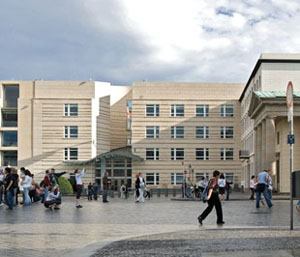
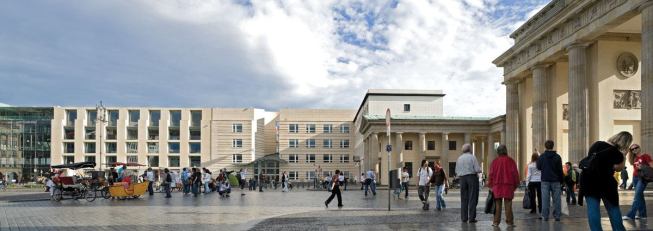
The U.S. Embassy's four-story elevation on Pariser Platz lacks the compositional elegance of Gehry's façade; so intent is it on avoiding preening gestures, it achieves only reticent blandness, with beige limestone accented by thin, horizontal bands of darker limestone. The asymmetrically placed entrance is marked by a slit in the façade and a curving glass canopy meant to echo the fluttering of the American flag overhead—but it ends up looking oddly like an eyebrow arched at the French just across the way.
From the Pariser Platz, unappealing security doors hamper views into one of the few elements of openness—a glass-roofed rotunda—in a building that members of the general public will probably never experience from inside. The rotunda gives on to what—after the ambassador's own offices—is the most successful aspect of the building. A tranquil inner courtyard, meant to recall the majesty of America's national parks, is a relaxed space within the tightly controlled diplomatic enclave. "With an embassy, you're striving for a certain kind of formality," Ruble explained while showing me around the project, "whereas for most people, the most characteristic American thing is a kind of informality—being on a first-name basis and things like that. How do you put that feeling into a government building? It's a tricky, interesting problem."
The open-roofed courtyard features that fetish of every American homeowner, a pristine green lawn. In its midst stands an Ellsworth Kelly sculpture, a totem of pearly gray stainless steel that draws a vertical line from the garden to the sky. The courtyard landscaping by the Olin Partnership uses American species like pine, dogwood, and cypress. A stone-paved outdoor terrace with a high Colorado sandstone fireplace and walls makes this an inviting space for the embassy's annual July 4 barbecue.
Inside there is a communal dining area, with another stone hearth that recalls a Western lodge or the interior of a Neutra house. George Nelson "bubble lamps" and molded plywood chairs by Charles and Ray Eames lend an air of ease within a diplomatic fortress built to withstand assault from the outside. Ruble declined to discuss security features of the blast-resistant building and asked me to move away when I began to examine the thick steel window frames in a conference room facing the Pariser Platz.
The building's most prominent element—a round tower housing the ambassador's offices—is not visible from Pariser Platz. But it looms large when one looks at the embassy from the other side of the Brandenburg Gate. The tower, topped in the competition scheme by a rounded copper cupola that harkened to the lamp atop the Statue of Liberty, has ended up encased in a rectangular steel trellis that lends it more the aura of a battleship plowing full steam ahead. According to Ruble, the trellis is intended to relate to the classical lines of the gate.
Only higher ranking visitors will ascend via elevator to this rarefied precinct. The ambassador's office has views out over the Tiergarten and is furnished with Bauhaus pieces, in tribute to the host nation. The most spectacular interior space is the adjoining round "stateroom," where 20 Brno chairs encircle a massive round table that is embedded with a compass to imply the charting of a course for diplomacy. Curved glass walls open onto a rooftop terrace with a parterre garden of American grasses. The stateroom looks out onto the dome of the Reichstag and the top of the gate, with its bronze quadriga statue of a winged goddess driving a four-horse chariot.
This vista will make Germany's chancellor, whose own offices are on the other side of the parliament building, green with envy. "I want you to give me the best place to have lunch in Berlin," Charles Redman, who served as ambassador when the embassy design was chosen, asked Ruble and his partners. Redman's successors certainly have that coveted spot in this jaw-dropping room.
Providing such a spectacular spot for official entertaining is a praiseworthy goal for an embassy architect, but so is providing an enticing image for the building as a whole. Relatively few Germans will ever enjoy the spectacular view from the tower; many will experience the dull exterior façades, which rely on white brise soleils poised over aluminum window frames to provide detail.
In their assessment of this thorny commission, German critics were clearly blinkered by antipathy to the current U.S. government. Still, while it's unfair to condemn this building as an emblem of American decline in the era of George W. Bush, devising secure U.S. embassies of architectural distinction is not yet a mission accomplished.
Critic Michael Z. Wise is the author of Capital Dilemma: Germany's Search for a New Architecture of Democracy.