


John Peterson, founder of the nonprofit Public Architecture, is a busy man. He spent last year as a Loeb Fellow at Harvard University, immersed in the intricacies of social entrepreneurship. This year, he's running his own four-person San Francisco firm, Peterson Architecture, and traveling around the country to promote public-spirited design. And this month, at the AIA national convention, Public Architecture receives the 2007 Institute Honor for Collaborative Achievement.
When I talk to Peterson, he's in San Francisco and in a reflective mood. “There is a current interest in merging a more progressive attitude toward design with a progressive social agenda,” he says. “Previously, there was a reluctance to combine those two—they ran from each other. Those wearing the clothes of the socially progressive did not want to be associated with the avant-garde because it was seen as trite. On the other hand,” Peterson continues, “preaching a social agenda was seen as not being serious about design.”
Established in 2002, Public Architecture goes beyond simply mending that ideological rift. While the organization's output takes many forms—research, advocacy, and education; collaborative projects; a pro bono initiative called the 1% Solution—it consistently encourages architects be proactive, asking them to tackle issues of public interest with the same vigor and analytical insight generally reserved for high design.

John Peterson, the founder of Public Architecture.
Credit: Mendu Design
“Public Architecture mobilizes designers to take on this role—identifying the problem rather than waiting to be engaged,” says Cynthia Smith, a curator at the Cooper-Hewitt National Design Museum in New York, which features the group's work in “Design for the Other 90%,” an exhibition that opens this month. “This [approach] holds the potential for new forms informed by the voices once silent, moving beyond traditional architecture,” Smith says.
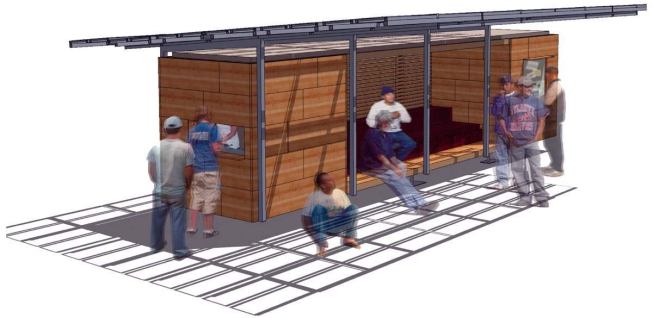
Day Labor StationAccording to the 2006 study “On the Corner: Day Labor in the United States,” published by the Center for the Study of Urban Poverty at the University of California, Los Angeles, more than 100,000 laborers cluster on street corners and in Home Depot parking lots across America every day. These are informal employment centers: A pickup truck draws to the curb, several men pile in the bed, and the truck speeds off to a construction site or odd manual job. On a good day, the worker gets paid a low wage for filling an economic niche. On a bad day he waits, exposed to the elements, lacking bathroom facilities and a place to sit down.
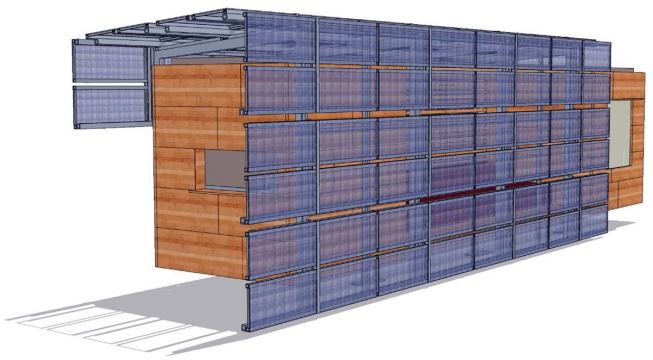
Public Architecture's Day Labor Station offers a design solution to what is generally seen as a political or economic problem. The flexible structure (designed in-house by Peterson and colleagues) provides a seating area, which can also be used as a classroom, and it offers shade—all-important in hot weather. It is equipped with a kitchen and a restroom and is powered primarily by an array of photovoltaic panels. In fact, the steel-and-photovoltaic grid serves triple duty: Aside from generating energy, it forms a canopy during the day and, at night, folds down to secure the station.
General contractors Ryan Associates teamed with Public Architecture on the project, streamlining the design and redlining the drawings so that the station can actually be erected by the day laborers who will use it. The hope is that municipalities nationwide will install the semipermanent units where needed. Additionally, the construction company built, pro bono, the partial prototype that is on view, with a video and portraits of the laborers, May 4–Sept. 23 at the Cooper-Hewitt.
“As a company, we believe that involvement in our community is a socially responsible thing to do,” explains Jim Friedman, co-founder and owner of Ryan Associates. “[The day labor station] institutionalizes what is already an institution. If these things wind up dotting the landscape, it is a step in a great direction.”
TAF Community Learning CenterIn 2005, Public Architecture coordinated the ScrapHouse project—a green demonstration home installed in San Francisco's Civic Center Plaza. A team of architects, designers, artists, contractors, and fabricators took six weeks to design and build the structure out of reused materials. Although temporary, the innovative house, shingled in recycled traffic signs, received press coverage and eventually caught the eye of county executive Ron Sims in King County, Wash.
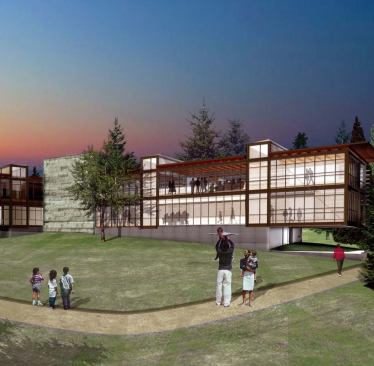
King County wanted to build a new headquarters for the Technology Access Foundation (TAF), a nonprofit that develops after-school programs for underserved students in the Seattle area. TAF needed a building with technology-capable classrooms, labs, and community meeting rooms. The result is the 21st Century Community Learning Center, a collaboration between Public Architecture and Miller|Hull Partnership, a Seattle-based firm noted for its expertise in sustainable construction.
Both offices worked pro bono on the conceptual phase of the project. Miller|Hull is now under contract as the center moves into design development, with Public Architecture taking a consulting role. The $13 million cost of the building is being underwritten in part by a $2 million capital grant from the King County Council and a $1 million capital challenge grant from the Bill & Melinda Gates Foundation.
When completed in 2008, the center, like the ScrapHouse, will be a model of construction with recycled materials. “We are constantly on the hunt for materials and buildings being deconstructed,” says Public Architecture project manager Liz Ogbu. Recently, the architects salvaged 230 Douglas fir floor beams from a demolished housing project and are incorporating them into the design for the 105-foot long pedestrian bridge that will lead to the center's main entrance.
The center, located in Seattle's Lakewood Park, is intended not only to educate residents in technology and green architecture, but to revitalize the economically depressed area.
The 1% Solution: Homeless Prenatal ProgramFollowing the lead of the legal and medical professions, Public Architecture encourages firms to pledge 1 percent of their billable hours to pro bono work—about 20 hours per year per employee. The 1% Solution program, supported in part by a grant from the National Endowment for the Arts, is provocative, says Peterson—a challenge to architecture and design professions to put their expertise in the service of social responsibility. “I think we miss an opportunity to play a more important role in our world by sitting on the sidelines,” he says. “We need to use our abilities to directly address the unhealthy or underserved aspects of our built environment and urban culture.”
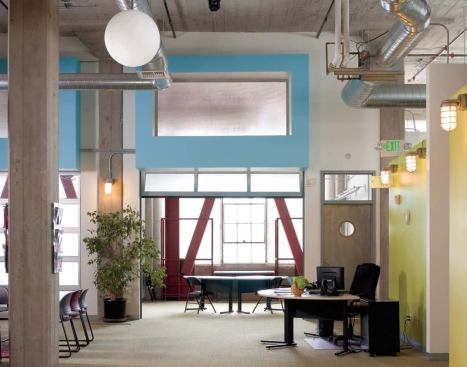
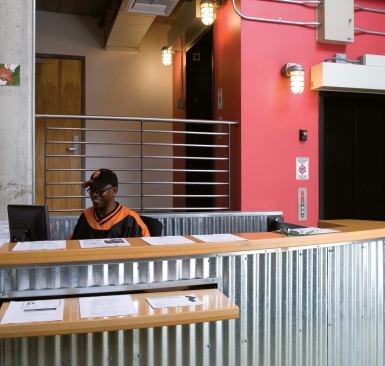
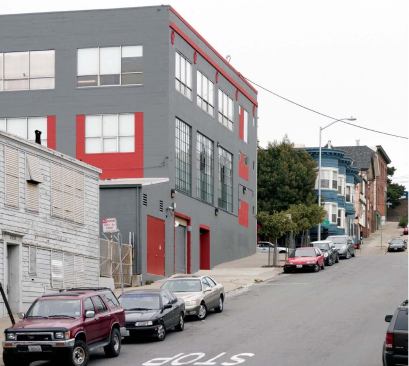
Peterson's own practice is one of 130 firms currently signed on to the program. Putting its skills to work for a local nonprofit, the Homeless Prenatal Program (HPP)—which offers health education and other services to homeless families—the firm helped it purchase a historic warehouse and transform it into a new, light-filled facility.
Located in San Francisco's Mission District, the 27,000-square-foot headquarters houses case-worker offices, a technology lab, an art room, kitchens, classrooms, and a day-care center. The architects spent much of their pro bono time learning HPP's needs rather than developing an elaborate design scheme. “We went against our nature and acted as a strategic partner,” explains Peterson. “The design work that we did tailored the building: We hemmed the pants and shortened the sleeves. It is a very powerful design tool to understand the financial and political issues and use them to help the client.”
The architects' analysis saved the nonprofit a lot of money: Martha Ryan, HPP's executive director, had budgeted a new ground-up structure at $8 million, whereas the warehouse cost $4.65 million, plus approximately $200,000 in construction costs. For Ryan, the project's success goes beyond the price tag.
“The space is open, beautiful, and welcoming,” she says. “When clients come in, they see that it is beautiful and they see that it's for them, so they are able to relax.”
Brooklyn, N.Y.–based Mimi Zeiger is the author of New Museums: Contemporary Museum Architecture Around the World.