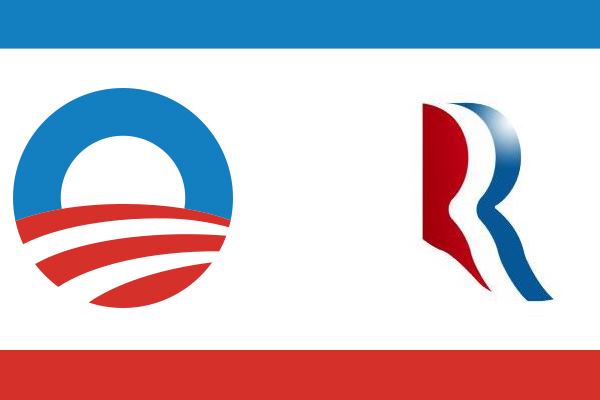
I write this the day after the election, and I say Gov. Mitt Romney lost because of design. Most evidently, he lost because the Obama campaign devised the cleverest design of polling and get-out-the-vote, and perhaps because he actually deserved to win (though I will refrain from political statements). But in an election this tight, I would say design of a visual kind also had something to do with it.
There was, first of all, that logo, which Obama was wise to hold over from the last election. There have been few political campaigns that have produced an image as iconic and clear as this. Designed by Chicago-based Sender, it is so simple, and so full of meaning. The round shape stands for the first letter of his name, thus reinforcing his identity; but it is also a mandala, an emblem of a universe in balance. Within that surround, we see an abstracted version of the road forward that moves towards the sun—reminding me of Reagan’s “Morning in America” theme. It is also an American flag, giving a sense of the candidate’s and president’s patriotism.
Against this emblem, Romney offered one of the most whimpish signs I have seen in recent years. I can’t even find anyone who will admit to having designed it. It consisted of an serifed typeface whose first letter is larger. Ryan’s name nestles underneath, sandwiched within a red and a blue band to make a kind of flag. In another version it is just gray with a hint of red. The most abstract version is a triple R, turned into a hint of the American flag. It says very little about who Romney is or what he stands for. There is nothing I can mine for meaning here.
The Republicans also put together a stage set for their convention that was as unclear and without affect as anything you can imagine. It was anonymous as a television study, consisting of forms whose main power came from strong lighting. The Democrats reinforced the idea that their man was the president in the same manner as they pushed the notion that he was going to be four years ago: by evoking the White House’s neo-classical architecture.
The one thing Republicans have going for them on the design front is their color. For some reason, they wound up with red—even though in most of the world that is the color of the political left. I was born a red-diaper baby and then grew up as a kid in the Netherlands, where red meant social democrats. Yellow was for the right wing, green for the center, and nobody was blue. Blue is sad or neutral. Blue is cool, which might be great for governing, but not for campaigning. In this country, the Republicans get the hot, warm color. I saw some campaign signs this year in which local candidates went all-red and all-blue, and it helped clarify what party they belonged to, but nobody has figured out how to elaborate on that base in the manner, say, of the red rose social democrats have adopted as their world-wide symbol.
Nevertheless, Democrats have used the blue to their advantage, making them seem less threatening and more capable of coolness than their the red-meat adversaries. If branding in part led to the Republican Party’s defeat—among non-white, non-male voters—design played its role in that defeat.
Aaron Betsky is a regularly featured columnist whose stories appear on this website each week. His views and conclusions are not necessarily those of ARCHITECT magazine nor of the American Institute of Architects.