Blaine Brownell
This fall, I had a chance to visit the Lakewood Cemetery Garden Mausoleum in Minneapolis, designed by Joan Soranno and John Cook, FAIA, of HGA and featured in the October issue of ARCHITECT. As a project type, the mausoleum is a relatively uncommon commission, and presents an unusual set of conditions to architects who typically focus on commercial, institutional, or residential work. In my conversation with Soranno, she described the mausoleum as a building with an eternal lifespan. It is a structure that signifies sacred ground, and which should never be town down.
Based on this daunting yet captivating design problem, Soranno and her team set about conceiving an architecture that would be timeless—in both literal and symbolic senses. Interestingly, the team’s early schemes for the project did not satisfy Soranno. “Everything looked like a museum or corporate office building,” she says. The initial design directions were typical of the firm’s modernist sensibilities, and the team employed a steel frame in these schemes to create delicate, light-filled volumes. “I didn’t make the connection at first,” Soranno says. However, she soon encouraged the team to explore an architecture informed by “the wall, mass, poché, and shadow.”
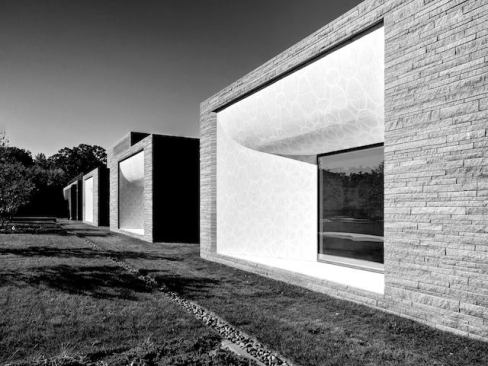
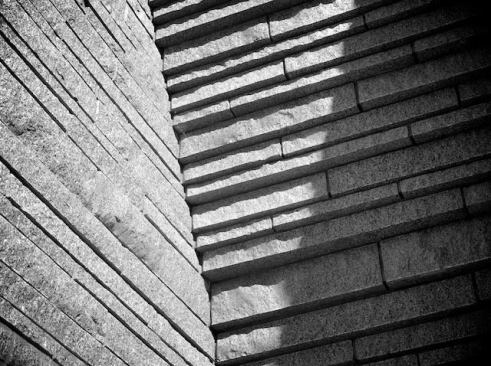
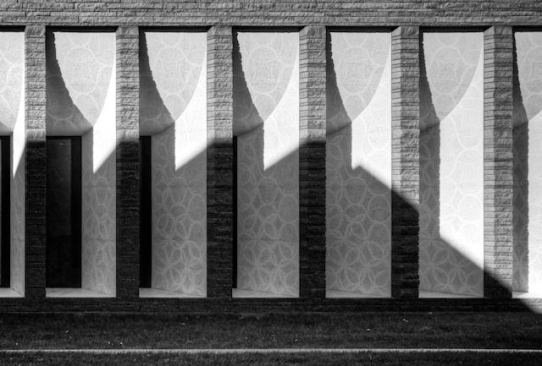
The realized design, which is clad primarily in rough stone and closely connected to the surrounding landscape, does embrace these more substantive qualities. The lower level of the building consists of a thick concrete frame that is tucked into the earth, for example. The split-faced, hand-laid granite that covers the facade exhibits a rough, imperfect quality sought by the architect, and its inherent tactility conveys a powerful sense of touch to visitors.
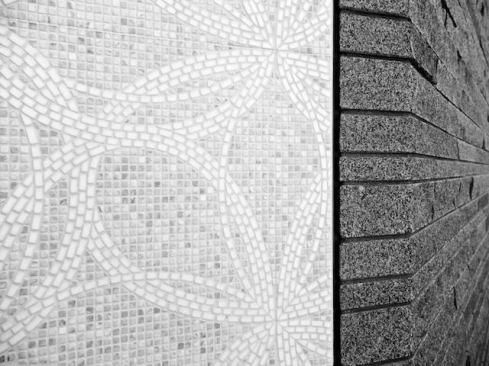
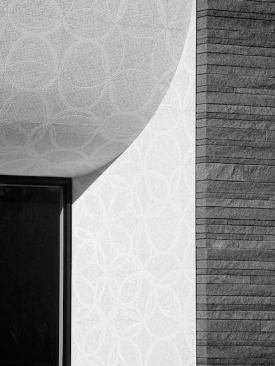
The building is not all about thickness and weight, however. A series of elements keeps the architects’ original desire for lightness and delicacy alive in the project. Sweeping planes clad in white mosaic tiles made of Carrera marble and Mexican glass direct light into the entrance and crypt rooms, for example. Visually frameless skylights appear as abstract white volumes, illuminating lower level spaces with minimal substance.
The result is an architecture that hovers between gravity and lightness, substance and delicacy, earth and sky. As Soranno describes, the design team’s journey was not a linear process. Nor was it a hasty one. The architects may not have been able to imagine their final design at the outset, but their thoughtful and methodical development ensured a successful outcome: an architecture deftly balanced between the material and the ephemeral, poised to endure through the ages.
Blaine Brownell is a regularly featured columnist whose stories appear on this website each week. His views and conclusions are not necessarily those of ARCHITECT magazine nor of the American Institute of Architects.