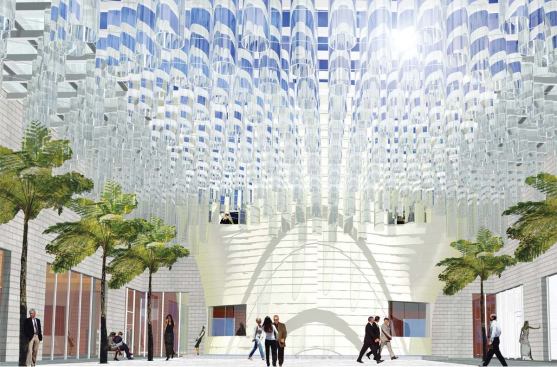
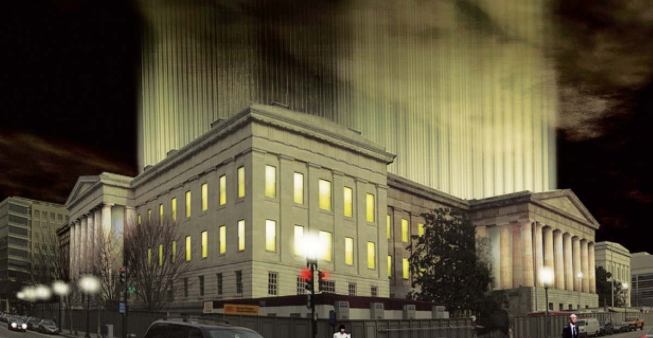
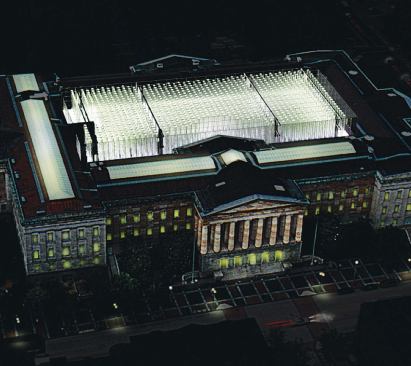

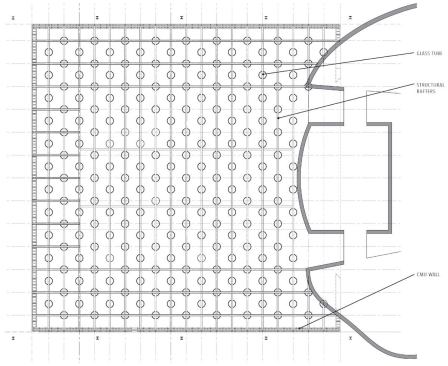
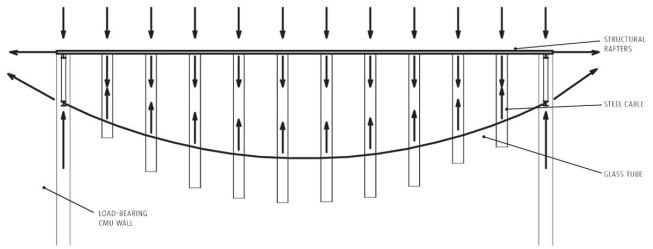
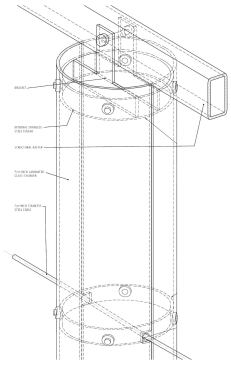
A rendering of the courtyard at Nike's Los Angeles offices demon…
In past projects, Eric Owen Moss has used fields of glass rods emerging from the ground as a means of organizing space and influencing pedestrian movement. These rods, when installed over a skylight, provided visual interest to the ceiling plane of subterranean spaces. Taking the concept a step further, the architect explored using the glass rods not just for their formal properties, but as structural components. The result is A Surface of Points, a system of deep cable trusses that incorporate glass tubes as compression members. The concept was proposed for the Smithsonian Institution Patent Office Building in Washington, D.C., and is appearing in two projects: the Nike Los Angeles offices at 3505 Hayden Avenue and 8511 Warner Drive, also in Los Angeles.
The system involves a base of steel truss frames within a boxlike enclosure. Steel cables are hung between the truss frames, approximating the surface plane of the ceiling. The cylinders, formed from ½-inch-thick laminated glass, are installed and threaded on the cables, forming the compression members of the deep cable trusses.
Depending on whether a skylight or an opaque ceiling is installed above the truss system, natural or artificial light can be constantly refracted through the glass rods. The tubes also have acoustical properties, which can be adapted by varying the length of the tubes in accordance with the natural acoustics of the room. Sound travels and diffuses in the spaces between and within the tubes, or can be reflected by the use of a plug in the bottom of the tube.
“I thought it was really interesting to invert the idea of a truss and make things that are fragile and brittle into things that are load-bearing and spanning,” says Chris Genik. “The notion of a glass truss, in its capacity to be an acoustical environment and a light environment, reaches a higher plane,” he adds. “I think it’s a really extraordinary project and a vision of how to coerce structure into something which is also producing something for the building as a shell, a kind of container.”
PROJECT A Surface of Points
ARCHITECT Eric Owen Moss Architects, Culver City, Calif.—Eric Owen Moss, Dolan Daggett, Eric McNevin, Kyoung Kim, Grit Leipert, Jose Herrasti, Tom Raymont, Scott Nakao, Andrew Wolff, Fausto Nunes, Vanessa Jauregui, Herbert Ng, Ren Huang (project team)
CONSULTANTS Arup-NY—Neil McClelland (Smithsonian); Englekirk Structural Engineers—Bill Wallace (3505 Hayden Avenue Glass Courtyard)