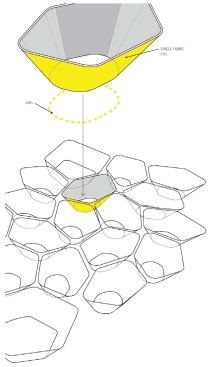


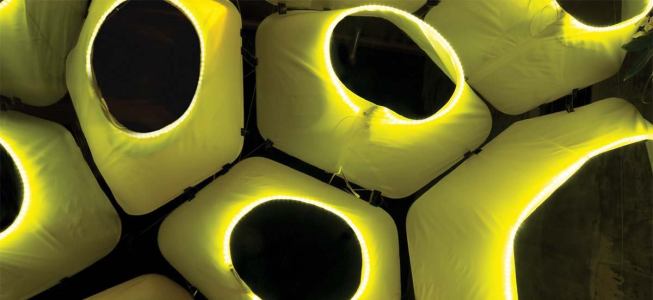
SINGLE CELL UNIT Each cell is formed from coated nylon ripstop …
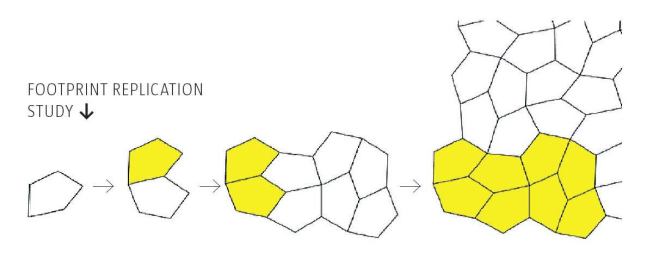
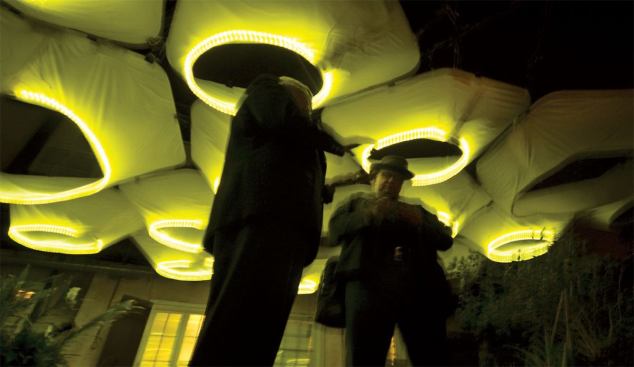
Designed as a temporary canopy for the DesCours festival, an annual weeklong celebration of design sponsored by AIA New Orleans, Hover is a luminous canopy featuring both LEDs and photovoltaic cells that power them. Höweler + Yoon designed Hover—an entirely off-the-grid construction —as a kit of parts that is easily scaled up or down to adapt to a variety of venues and increase the potential for future installations. Coated nylon ripstop fabric is stretched and framed into a form derived from a cell in the human body. Each unit is rimmed at the top with flexible photovoltaic cells that generate enough energy to power a rope of LEDs placed in the fabric around the base. These fabric units were manufactured in several sizes, carefully measured to allow for replicable multicell groupings that can be rotated and fit together to form the layout of the complete installation. The installation reacts directly to the surrounding environment, emitting more light on sunny days and less on cloudy days, a direct effect of the amount of energy absorbed and generated by the PV cells.
The jury remarked on how the project’s formal and technical simplicity stimulates a larger dialogue about temporality and urban space. “It’s something that can be very quickly installed and make a significant sort of presence for itself,” Chris Genik said. “It’s not a very deep project, but it taps into a number of different ideas about temporary places.” Blaine Brownell, while concerned about the integration of the flexible PV cells with the fabric, appreciated the exploration of new material technologies: “I liked the fact that it attempted to be fairly hermetic in terms of supplying the solar cells using the latest technology and flexible films, as well as the lighting of the structure.”
PROJECT Hover, New Orleans
SITE OWNER Mari Kornhauser
CLIENT DesCours, New Orleans
SPONSOR AIA New Orleans—Melissa Urcan (executive director)
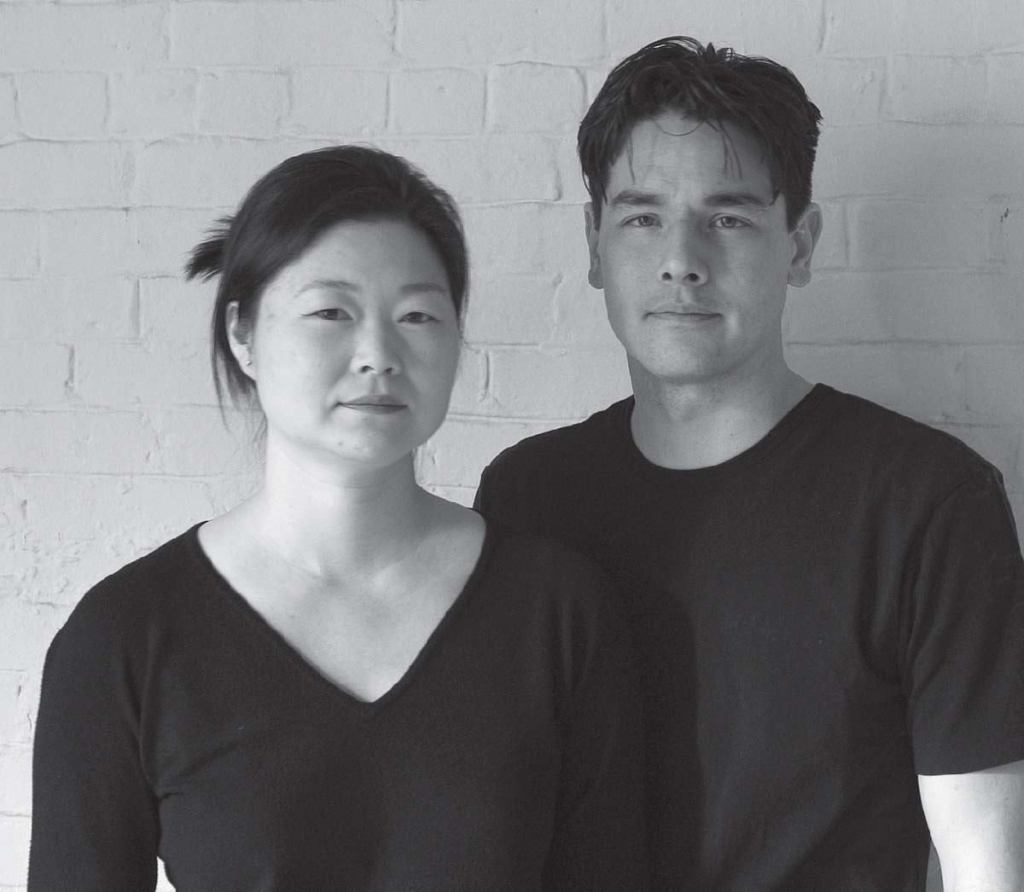
ARCHITECT Höweler + Yoon Architecture, Boston—Eric Höweler, J. Meejin Yoon (principals); Meredith Miller (project architect); Daniel Cho, Lizzie Krasner, Gabe Blue Cira (project team)
ELECTRONICS ENGINEER Parallel Development—Will Pickering
STRUCTURES Paul Kassabian