Launch Slideshow

Prepared for Takeoff

Constructed next to Eero Saarinen's historic TWA terminal, and respectful of it, the new JetBlue Terminal 5 is as operational as it is elegant.

Prepared for Takeoff

Constructed next to Eero Saarinen's historic TWA terminal, and respectful of it, the new JetBlue Terminal 5 is as operational as it is elegant.

  • http://www.architectmagazine.com/Images/tmp3F8C%2Etmp_tcm20-139400.jpg

    600

    Prakash Patel

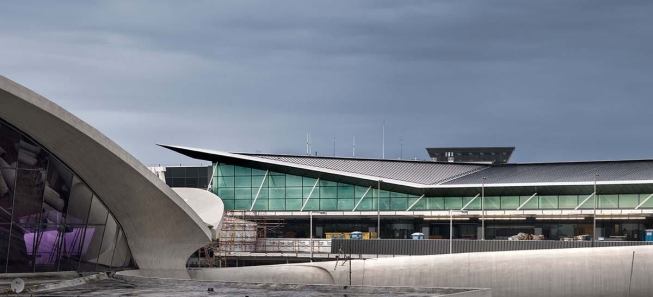
    Gensler’s new JetBlue Terminal 5 at JFK airport sits respectfully behind Eero Saarinen’s 1962 TWA terminal (at left), which was placed on the National Register of Historic Places in 2005.

  • http://www.architectmagazine.com/Images/tmp3F92%2Etmp_tcm20-139442.jpg

    600

    Prakash Patel

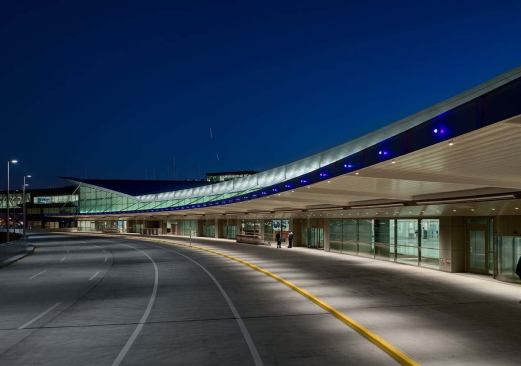
    The departures drop-off roadway (opposite) separates T5 from the TWA terminal.

  • http://www.architectmagazine.com/Images/tmp3F93%2Etmp_tcm20-139449.jpg

    600

    Prakash Patel

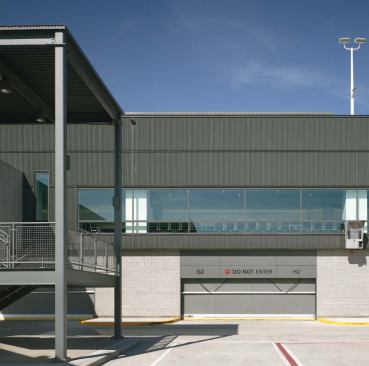
    The exterior of the arrival gates is clad in a system of concealed-fastener corrugated wall panels in a gunmetal color. Access stairs and baggage handling areas offer necessary access for airline employees.

  • http://www.architectmagazine.com/Images/tmp3F94%2Etmp_tcm20-139456.jpg

    600

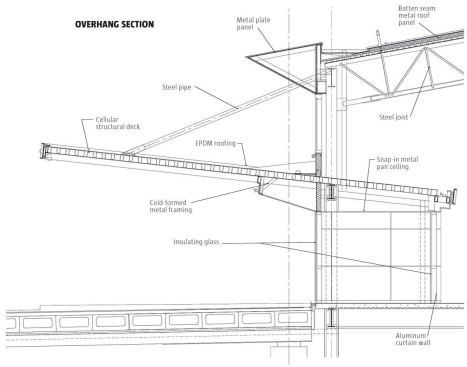
    A large overhang protects travelers from the elements, while clerestories admit light into the interior.

  • http://www.architectmagazine.com/Images/tmp3F95%2Etmp_tcm20-139463.jpg

    600

    Prakash Patel

    The security area is just off the main ticketing hall, allowing for ample space for passengers to line up before going through screening.

  • http://www.architectmagazine.com/Images/tmp3F96%2Etmp_tcm20-139470.jpg

    600

    Prakash Patel

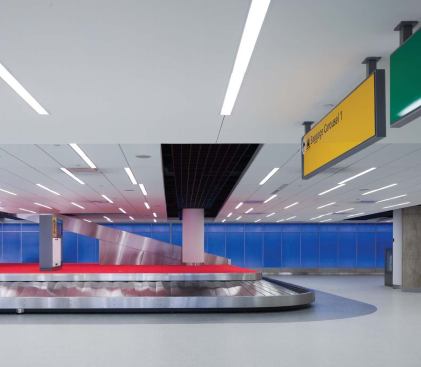
    TRANSLUCENT PANELS Panelite Panelite.us Gensler chose Panelite’s Laminated Series with custom blue facings for 10,000 square feet of backlit walls in the Marketplace and security and baggage-claim areas, reinforcing JetBlue’s brand and creating a novel design feature to designate transitional moments. The panels are ideal for backlit applications due to their translucent facing and self-structural qualities, which reduce the need for significant vertical framing members, allowing for large, lightweight expanses. Panelite’s Insulating Glass Unit with blue ClearShade IGU core was used in the clerestory windows in the ticketing hall. The ClearShade IGU off ers a signifi cantly better solar heat gain coefficient than other typical IGUs due to the integral shading properties of its core.

  • http://www.architectmagazine.com/Images/tmp3F97%2Etmp_tcm20-139477.jpg

    600

    Prakash Patel

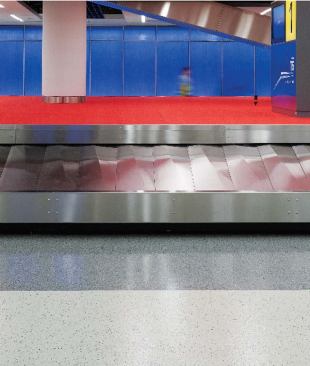
    RUBBER FLOORING Nora Rubber Flooring www.norarubber.com Nora products were used extensivelythroughout the National Aquatics Center at the Beijing Olympics in corridors and high-traffic areas. At JetBlue, the slip-resistant and durable products are in the baggage claim areas.

  • http://www.architectmagazine.com/Images/tmp3F98%2Etmp_tcm20-139484.jpg

    600

    Prakash Patel

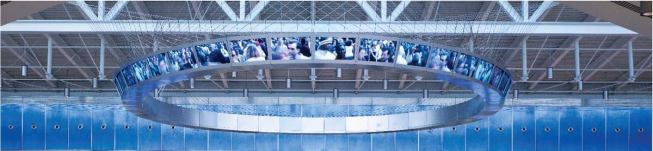
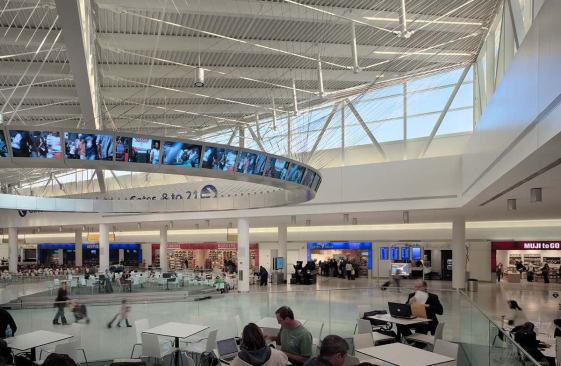
    The Marketplace, located just past the security area, serves as the central concessions area. The three concourses branch off it. Restaurants and stores, a performance venue, and a suspended, egg-shaped “information yoke” dominate the space.

  • http://www.architectmagazine.com/Images/tmp3F99%2Etmp_tcm20-139491.jpg

    600

  • http://www.architectmagazine.com/Images/tmp3F8D%2Etmp_tcm20-139407.jpg

    600

    Prakash Patel

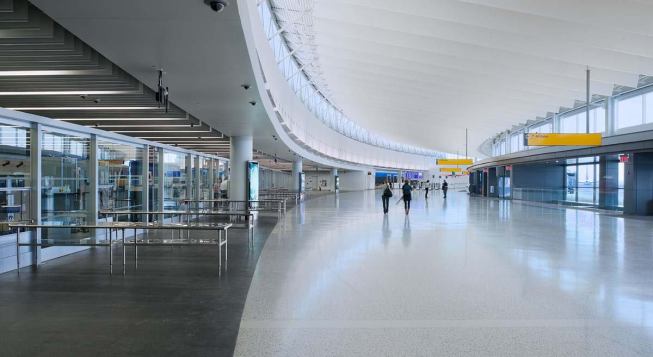
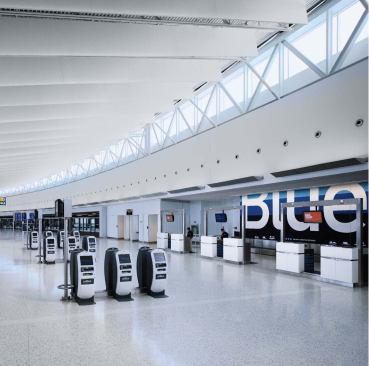
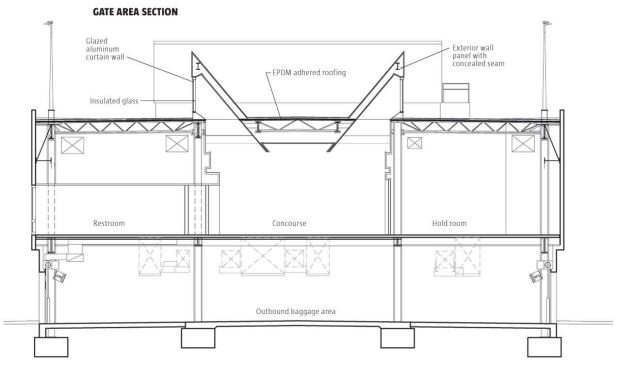
    Upon arriving at the new building, travelers come to the main ticketing hall, an expansive curving space that mimics follows the arc of the roadway outside. Clerestories admit natural light, and a canted ceiling is one of the signature architectural features.

  • http://www.architectmagazine.com/Images/tmp3F8E%2Etmp_tcm20-139414.jpg

    600

    Prakash Patel

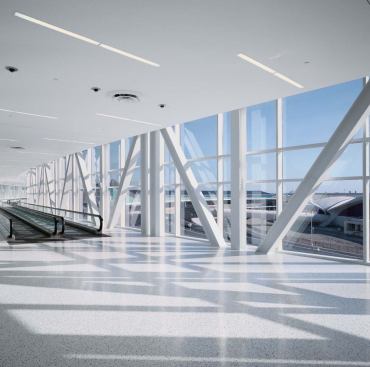
    Passengers arriving at JFK via the city-encouraged AirTrain access the new T5 via a skybridge, which offers views of the Saarinen TWA terminal from moving walkways.

  • http://www.architectmagazine.com/Images/tmp3F8F%2Etmp_tcm20-139421.jpg

    600

    Prakash Patel

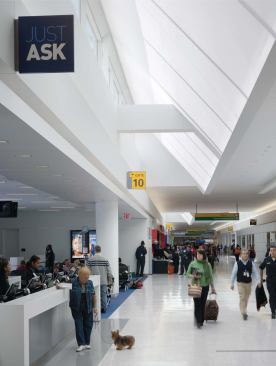
    The concourses are peppered with information stations and concessions. White walls and light-colored flooring allow JetBlue’s signature blue and other accent colors to pop.

  • http://www.architectmagazine.com/Images/tmp3F90%2Etmp_tcm20-139428.jpg

    600

  • http://www.architectmagazine.com/Images/tmp3F91%2Etmp_tcm20-139435.jpg

    600

    Prakash Patel

    Baggage claim areas are on the lower level, directly below the main ticketing hall. These carousels are merely the public face to an extensive baggage handling system that snakes throughout the entire terminal building.

A discussion of urban or architectural context at New York's John F. Kennedy International Airport (JFK) would be short: There is none. JFK, which opened as Idlewild International Airport in 1948, has evolved through terminal and auxiliary expansions and additions into a daunting labyrinth of on- and off-ramps, parking lots, and information overload. The latest addition is the one exception that proves the rule.

The new $550 million facility for New York City–based JetBlue Airways—also known as Terminal 5, or T5—actually has a context of historic significance. T5's site is directly adjacent to the iconic TWA Flight Center, designed by Eero Saarinen, which opened in 1962 and closed in 2001. Due to programmatic complexity, terminals typically are designed from the inside out. In order to secure the site, however, JetBlue had to commit to providing a contextual solution respectful of, if not deferential to, the Saarinen structure, which received historic landmark status from the City of New York in 1994 and was placed on the National Register of Historic Places in 2005.

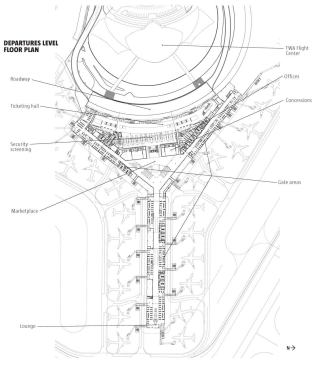
The Washington, D.C., and New York offices of Gensler, the design architect of record, responded with a crescent-shaped structure that slips quietly behind the landmark, separated from it by arrival and departure roadways. Though the TWA terminal will never be an operational component of JetBlue, it will house, when renovations are complete, an e-ticket kiosk for passengers who choose to enter there. Passage to T5 will be provided through Saarinen's original tubular corridors, which have been restored and joined to the new terminal.

Efficiency and Comfort

JetBlue's brand identity stands out for its emphasis on high-value, low-cost service. Gensler translated the airline's brand and business model into a minimalist architectural aesthetic by the smart use of simple materials, including exposed structural steel, corrugated metal, and glass.

The 635,000-square-foot, 16-gate facility will be JFK's busiest, accommodating 20 million passengers a year and 10 flights at each of 26 gates every day. One primary goal is to maintain a 30-minute plane turnaround time, which is 40 percent faster than the industry average. "Optimal operational performance of all functions in the terminal was a priority," explains Gensler principal William Hooper Jr., who led the design team. "The by-product of efficient operations is passenger comfort," he says, "and comfort is a major part of the JetBlue paradigm."

The budget was extremely tight. "Any construction-related cost that might result in an increase in the price of a plane ticket was out of the question," says Hooper. "On the other hand, durability is essential to efficiency. If we could demonstrate that a particular material, though slightly more expensive, would reduce the kind of maintenance and repair that can interfere with operations, the client was amenable."

Security and Transparency

Since 9/11, all U.S. airports have undergone extensive security upgrades and reorganizations, many of which have a stress-inducing, jerry-built feel to them. When building the new terminal, Gensler seized the opportunity to apply lessons learned from the 50 passenger terminals it has completed over the past two decades. The central security area has 20 lanes, each with an X-ray for carry-on baggage and magnetometers for passenger screening, making it the largest single checkpoint in the country. To expedite traffic, there are special lanes for families with small children and strollers, as well as "black diamond" lanes for seasoned travelers, called after the name for expert ski slopes.

"Passengers can clearly see which channel they should take, and there is enough space to allow them to move down the line without overcrowding," says Hooper. "Such transparency speeds movement."

The floors in the screening area feature soft rubber flooring, typically found on playgrounds and in athletic facilities. "We determined that this surface was more comfortable than cold, hard terrazzo for standing without shoes," says Hooper. "We also wanted to reduce the stress of having to hurriedly gather your belongings as they come off the conveyor, so we designed a 225-foot-long bench for 'revesting' before continuing to the gate or marketplace area."

Interior Organization And Circulation

Gensler worked in collaboration with the engineering firm Arup, which, as master planner and design manager, (as well as building services engineer), determined air-side and terminal capacity, operation needs, and public-access requirements. Arup conducted rigorous computer analyses of projected passenger flow through the building, in order to maximize efficiency and reduce passenger stress.

In the end, the design team adopted several creative measures with regard to logistics, recognizing that all systems are interdependent and performance is only as good as the weakest link. First of all, dual taxi lines on the runway allow two planes to arrive and depart simultaneously, thus alleviating backup delays. Since baggage transfer can impact the 30-minute aircraft turnaround, the design team chose an inline baggage handler to speed clearing and delivery to the planes. "The more hand-handling of bags, the slower the process," explains Hooper. "This system allows bags to be X-rayed right on the conveyor belt in an automated mode." Although there are 40 ticket counters, check-in is largely self-service. Sixty-five e-ticket kiosks are evenly distributed on both sides of the ticket hall with the entrance to security located in the center. Because of the generous spacing, congestion is minimized and circulation becomes more intuitive, reducing the need for abundant signage.

After clearing security, passengers are funneled down gradually sloping floors to the Marketplace—a central hub from which three concourses lead to the gate areas. New York–based Rockwell Group developed the concept and design for the 55,000-square-foot Marketplace. The signature architectural move is a 4-foot-tall ziggurat for performances, inspired by the steps of the Metropolitan Museum, the bleachers of Yankee Stadium, and other New York landmarks. When vacant, it serves as an additional seating area. A twisting array of stainless-steel cables, reminiscent of the forms of the TWA terminal, support an "information yoke"—an egg-shaped aluminum structure with 43 40-inch LCD monitors that flash sponsored videos and scenes of New York City. Lighting consultant Fisher Marantz Stone designed a field of suspended downlights, which adds another layer of interest and is visible from all concourses.


Toolbox

Translucent Panels
Panelite
Panelite.us
Gensler chose Panelite's Laminated Series with custom blue facings for 10,000 square feet of backlit walls in the Marketplace and security and baggage-claim areas, reinforcing JetBlue's brand and creating a novel design feature to designate transitional moments. The panels are ideal for backlit applications due to their translucent facing and self-structural qualities, which reduce the need for significant vertical framing members, allowing for large, lightweight expanses. Panelite's Insulating Glass Unit with blue ClearShade IGU core was used in the clerestory windows in the ticketing hall. The ClearShade IGU offers a significantly better solar heat gain coefficient than other typical IGUs due to the integral shading properties of its core.

Rubber Flooring
Nora Rubber Flooring
www.norarubber.com  
Nora products were used extensively throughout the National Aquatics Center at the Beijing Olympics in corridors and high-traffic areas. At JetBlue, the slip-resistant and durable products are in the baggage claim areas.

Wall Coverings
Trespa
trespa.com   
Durability and ease of maintenance was the mantra during materials selection for JetBlue. Since passenger traffic is expected to be among the highest in the country, Gensler picked Trespa Virtuon wall panels that are impervious to moisture, chemicals, disinfectants, impact, and wear. Its sealed surface and pore-free core make it virtually stain-proof and resistant to bacterial growth. Seams and joints are all designed to minimize dirt retention.


Project: JetBlue Terminal 5, New York
Architect and Interior Designer: Gensler, New York and Washington, D.C.—Chris Banks, Sophie Berry, Kashyap Bhimjiani, Cliff Bollmann, Jeffrey Brite, Pati Coleman, Karina Elizalde-Ferrales, David Epstein, Arthur Gensler, Kristian Gregerson, Thomas Gregory, William Hooper Jr., Darris James, Ruth Jansson, Matt Johnson, Kathleen Lepley, Giulio Leucci, Kap Malik, Beth Miller, Francesca Miller, Ty Osbaugh, Beth Ready, Maurice Reid, Joseph Romano, Umang Shah, Stephanie Shapiro, Carolyn Sponza, Tim Taylor, Marion White, Joyce Young (project team)
Associate Designer: Daroff Design Inc.
Associate Architect: Anthony C. Baker, Architects & Planners
Structural Engineer: Ammann & Whitney
Civil Engineer: DMJM Harris
M/E/P, IT, Security, and Telecom Engineer: Arup
Baggage Engineer: BNP Associates Inc.
Lighting Consultant: Fisher Marantz Stone
Concessions Consultant: AirProjects Inc.
Curtain Wall Consultants: Gordon H. Smith Corp.; Gilsanz Murray Steficek, LLP
Cost Estimator: U.S. Cost
Construction Observation: Domus AG
Marketplace Image Consultant: Rockwell Architecture Planning & Design
Size: 635,000 square feet
Cost: $550 million