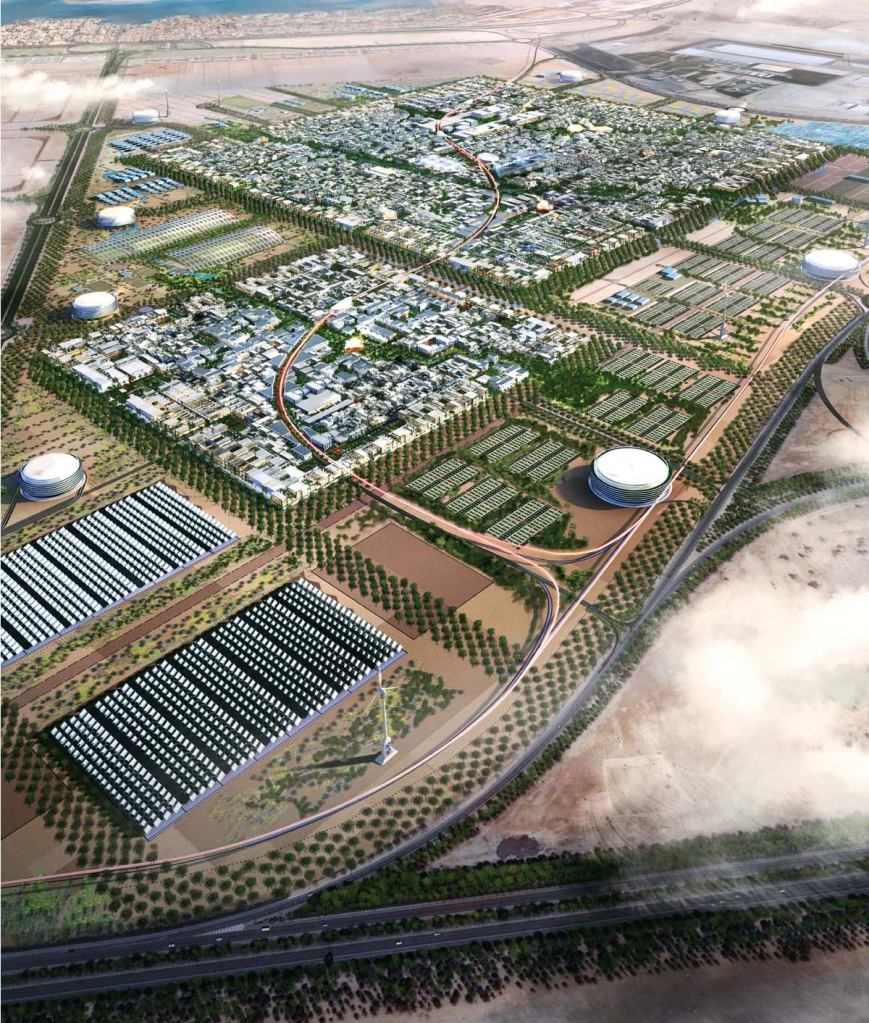
Norman Foster, Masdar City, Abu Dhabi
Ground was broken in early February on what is being touted as the world's first zero-waste, carbon-neutral city, Masdar City in Abu Dhabi, United Arab Emirates. When the city is completed in 2016, at a projected cost of $22 billion, it will reuse all its wastewater and derive 100 percent of its energy from photovoltaics, wind, and other renewable sources. Foster + Partners has master planned the 3.7-mile-square site (rendering opposite), which is expected to grow to 1,500 businesses and 50,000 residents.

Norman Foster, Masdar City, Abu Dhabi Ground was broken in early February on what is being touted as the world's first zero-waste, carbon-neutral city, Masdar City in Abu Dhabi, United Arab Emirates. When the city is completed in 2016, at a projected cost of $22 billion, it will reuse all its wastewater and derive 100 percent of its energy from photovoltaics, wind, and other renewable sources. Foster + Partners has master planned the 3.7-mile-square site (rendering opposite), which is expected to grow to 1,500 businesses and 50,000 residents.

Credit: Foster + Partners

Famous architects are no longer just in the business of designing signature buildings. They are also increasingly functioning as megascale planners, hand in glove with the biggest developers in the world and with local municipalities, usually with both.

Frank Gehry's controversial $4 billion, 22-acre project for Atlantic Yards in Brooklyn, N.Y., for Bruce Ratner of Forest City Ratner Cos. with the Empire State Development Corp., is only the tip of the iceberg. In downtown Los Angeles, Gehry is working on the first phase of a $1.8 billion development plan by the Related Cos. to turn the nine acres around his Walt Disney Concert Hall, which opened in 2003, into an “arts district” including a hotel, residences, retail establishments, restaurants, and public amenities. Another potential Gehry project, for Lehi, Utah, will be located on 85 acres, with housing, hotels, an amphitheater, and a sports arena; the scheme, for the owner of the Utah Flash basketball team, is worth $2 billion and won city council approval last August.

Elsewhere in the world, Daniel Libeskind is at work on a 4.5-million-square-foot, “skyline-creating” waterfront development in Busan, South Korea; a master plan with office towers, condominiums, a hotel, and a cultural institute for a three-mile development corridor south of the historic center of Copenhagen, Denmark; and a huge shopping and entertainment center on the west side of Bern, Switzerland, scheduled for completion this year and boasting a hyperactive menu of amenities such as a theme-park swimming pool, a movieplex, and a senior citizens' residence. In Morocco, Jean Nouvel is projecting a 345-acre low-rise, high-density suburb of Rabat, as well as a new port complex in Tangier.

Norman Foster has been retained as master planner for the historic center of Duisburg, a deindustrialized city in Germany's Ruhr Valley where he previously completed a renewal project for the inner harbor. He is also working on the first of a series of five hill towns for 15,000 residents on the Black Sea in Bulgaria and a car-free, waste-free, carbon-neutral “green utopia” for 50,000 in Abu Dhabi. This last—a collaboration between a government-owned oil company and the World Wildlife Fund (WWF)—is slated to cost $22 billion and be home to “international businesses and top minds in the field of sustainable and alternative energy.”

If some of these matches between private developers and public entities have entailed enormously complex financial and political handshakes, not to mention some strange bedfellows, the luster of big-name architecture is increasingly—and, when coupled with the rhetoric of sustainability, literally—providing a green light. Historically at odds, architecture and urban planning have found a rapprochement today on the terrain of high-profile, large-scale real estate development.


Daniel Libeskind, Haeundae Udong, Busan, South Korea 
With six towers-three residential, one hotel, one office, and one retail-rising up to 72 floors and totaling 4.5 million square feet, Haeundae Udong Hyundai I'Park in the port city of Busan, South Korea, is the biggest project currently on the boards at Studio Daniel Libeskind. Libeskind intends the curvilinear shapes of the towers, which are scheduled to open in 2011, as allusions to flower petals, waves, and the sails of ships. The project by the Hyundai Development Co. will include parks, playgrounds, and other public spaces.

Daniel Libeskind, Haeundae Udong, Busan, South Korea With six towers-three residential, one hotel, one office, and one retail-rising up to 72 floors and totaling 4.5 million square feet, Haeundae Udong Hyundai I'Park in the port city of Busan, South Korea, is the biggest project currently on the boards at Studio Daniel Libeskind. Libeskind intends the curvilinear shapes of the towers, which are scheduled to open in 2011, as allusions to flower petals, waves, and the sails of ships. The project by the Hyundai Development Co. will include parks, playgrounds, and other public spaces.

Credit: STUDIO DANIEL LIBESKIND

BACK IN THE DOLDRUMS of the 1970s and ‘80s, at a dark moment for architectural ambition, Aldo Rossi would write with melancholy in A Scientific Autobiography, “To what, then, could I have aspired in my craft, having seen that the possibility of great things was precluded?” Those were years of postmodernist contextualism, of infill and façade work, and of philosophical questioning of grandiose narratives. Adherents of political correctness strove to take the master out of the master plan and, in the wake of Jane Jacobs' rousing defeat of Robert Moses, to snatch cities back from creative destruction at the hands of would-be megastructurists. That the arrogant Le Corbusier had once, in a megalomaniac gesture, imagined a new Paris for 3 million inhabitants by sweeping away the old one, or that Kenzo Tange, as recently as 1960, had had the chutzpah to propose rolling Tokyo out into its bay to accommodate a population of 10 million, was cause for derision and vilification.

Out of the backlash against modernist overreaching emerged both the new field of urban design, focused on devising models for more flexible, democratic, and process-oriented urbanism, and the “retrotopia” of the New Urbanism, founded on the principles of Camillo Sitte–esque old urbanism and, ironically, more prescriptive than its predecessors when it came to codes and covenants. Meanwhile, a new architectural avant-garde—including those who showed in the “Deconstructivist Architecture” exhibition at the Museum of Modern Art in 1988—remained preoccupied with isolated object-buildings, even as the fragmentation and fluidity of their imagery already gestured, at least metaphorically, to more urban or landscape-oriented spatialities.

The first glimmer of real consciousness among architects concerning the inevitability of a new scale of architectural operations came in the early 1990s, when Rem Koolhaas, caused to rethink his worldview by his commission to design a new city center for Lille, France—an assignment that entailed a massive and apparently traumatic (for him) expansion of his previously modest-sized practice—came to reflect on “the problem of bigness.” Koolhaas shrewdly grasped that the global reorganization, expansion, and consolidation of late 20th century capital implied the emergence of a commensurate form of architecture. He envisaged an architecture of bigness more akin to the complexity and unscriptedness of the city, however, than to Architecture with a capital “A.” Bigness, as Koolhaas theorized in his book S,M,L,XL, required a giving up of “architecture's compulsive need to decide and determine” and a “surrender to technologies; to engineers, contractors, manufacturers; to politics; to others.” However much of a historical symptom, or pragmatic rationalization, this theory was in itself (especially in the case of a personality as controlling as Koolhaas), there is no doubt that it created an irreconcilable contradiction for architects: between design and nondesign; form and formlessness; heroic monumentality and sheer, dumb size.

THE MID-TO LATE ‘90S saw the realization of several colossal redevelopment projects in which superstar architects were called upon to supply window dressing for the transformation of dysfunctional urban districts into tourist and consumer meccas, from Times Square in Manhattan to Potsdam Square in Berlin. But it was the triumphal opening of Gehry's Guggenheim Museum in Bilbao, Spain, in late 1997 that appeared, to architects, nothing short of a miracle. Gehry not only delivered a more optimistic, less intellectualized, and visually ravishing vision of architecture's potential and one, moreover, that innovatively integrated but was not entirely determined by new technologies; against all odds, he showed that it was possible to regenerate an entire city with nothing more nor less than a single, singular building. Koolhaas, it seemed, had underestimated the power of architectural form—or the architectural image—to stir both the local and global imagination.

That the Bilbao effect became a wildly successful urban development strategy for resuscitating declining cities throughout the world, and then a de rigueur formula, is a familiar story, if one that is not completely played out. The “build it and they will come” approach still remains unsubstantiated by the evidence. On a single day last December, The New York Times carried two unrelated articles in different sections of the paper. One reported on the Carnival Center for the Performing Arts in Miami, a sprawling and costly—$461 million—complex by Cesar Pelli that opened in late 2006 to high urban hopes but which is currently struggling to find an audience. (Its propensity to devour the municipal budget has earned it the nickname “Carnivorous Center.”) The other concerned a $66 million zinc, glass, and steel art museum scheduled to open in November in smaller Roanoke, Va., designed by the Los Angeles architect Randall Stout, a Gehry protégé, which is viewed by boosters and detractors alike as one of the biggest gambles in the city's history.

Even on the triumphal museum in Bilbao, now exactly a decade old, the verdict is not yet completely in. Another feature story in the Times, published in the travel section last September, “Bilbao Ten Years Later” acknowledged that despite the fact that the museum continues to draw an impressive 1 million visitors a year, and despite the influx of a trendy art crowd, plentiful tourist services, and ongoing patronage of star architects by the city, Bilbao is still “very much a one-attraction town.” Buildings by Ricardo Legorreta (a hotel), Pelli (a 40-story office tower), Santiago Calatrava (the airport terminal), Philippe Starck (a wine warehouse conversion), Robert A.M. Stern (a shopping mall), and Rafael Moneo (a library), among others, have been completed. Zaha Hadid has designed a 150-acre master plan for the Zorrozaurre peninsula across from the city center that features a warped field of solid blocks striated by corridors of urban fabric and parkland.

Yet many locals have never set foot inside Gehry's museum, the Times writer observed, and “the disconnect between Bilbao the brand and Bilbao the city” remains palpable. Moreover, a surfeit of “icon buildings,” however creative and well-designed, especially in cities that have little else visually to recommend them, runs the risk of engendering architectural cacophony and ennui. In the case of Rotterdam, a Dutch city that has become a veritable architectural theme park with prominent contributions by Foster, Helmut Jahn, Renzo Piano, Wiel Arets, Ben van Berkel, and others, the skyline from certain viewpoints takes on the quality of a surrealist montage. If the icon derives both its logic and its energy from its uniqueness and difference from its surroundings, then its proliferation can only cancel the effect.

In this context, the current trend toward rebranding celebrity architects as planners appears as both an evolution of the Bilbao effect, expanded to a new scale, and also a departure from it. From the developer's point of view, the decision to use “ ‘design architects' instead of ‘developer architects,' “ as Ratner has put it of his decision to engage Gehry for the Brooklyn project, genuinely seems to be motivated to some extent, at least in the most laudable cases, by a desire to overcome past mediocrity. Above all, though, it is a bid for name-brand cachet and market differentiation. (Cachet, of course, does not come cheap. According to Kurt Andersen writing in New York magazine, the difference in cost to the Atlantic Yards project is an extra 15 percent, which comes to about $40,000,000.)

At the same time, the preference on the part of the developer to work with one architect rather than many reflects a wariness about having to deal with too many prima donnas at once or to get mired in the notoriously rancorous and inefficient process of design-by-committee. The cliché image of celebrity architects as creators of buildings that are over budget, hard to maintain, and difficult to adapt to changing needs no doubt also makes for a cautionary relationship. Gehry himself has complained that he tried to convince Ratner to bring in other architects to design parts of the Brooklyn project, but Ratner refused.

For Gehry, this has led to the conundrum of how not to upstage his own buildings. His solution has been to set up a “design hierarchy”—to devise ordinary-looking “background buildings” as counterpoint for his “iconic towers.” His insecurities about the huge scope of the project have also led him to engage a raft of consultants to help him “get it right,” as he puts it. Among them is Peter Arnell of the Arnell Group, a branding specialist who put together the first monograph on Gehry's work back in the 1980s and who, from his website, appears tailor-made to package the Gehry identity: “We help brands capture and realize differentiation by exploiting a unique emotional dimension in a rational world of business.”

AS THIS SUGGESTS, the new type of work obviously poses both substantial opportunities and risks. On the one hand, it allows the famous architect to have an impact beyond the privileged precincts of high culture and to transcend the banality of the conventional development scheme. It offers an exhilarating chance to take charge of a significant chunk of urban realty and to deal with the big picture. Ideally, it enables talented and visionary design practitioners to make a profound mark on the city, affecting it at the level of urban systems rather than just superficial imagery or piecemeal interventions. Avoiding the latter is especially important from the standpoint of sustainability, if a real difference is to be made, given the interrelated and systemic problems such design poses.

On the other hand, to maintain design excellence while producing more than sexy diagrams or formularized gestures, with all the specialized skills, diverse expertise, and local knowledge this implies, is a daunting challenge. Large, bureaucratized firms like Skidmore, Owings & Merrill (SOM), which have historically designed everything from “the master plan to the ashtrays”—as they used to boast—are far better set up to provide full services than the expanded boutique firm orbiting around the reputation of one or two principals. Partnership arrangements between global superstars and large firms or, alternatively, local firms with offices on the ground have, of course, been common practice for years and are often mandated by public and government clients. But such asymmetrical relationships can introduce too many chefs and lead to bruising power struggles, as famously occurred under a harsh public spotlight with the shotgun collaboration between Daniel Libeskind and David Childs of SOM at the World Trade Center site.

They can also produce homogenization. In China, foreign architects doing short-term business in the country are obliged to work with a state architecture institute, no matter their own in-house capacities, and are legally limited to “conceptual design.” The same China Architecture Design & Research Group (CAG)—one of the largest architectural practices in China with more than 4,000 employees, created in 2000 out of a merger between the Architecture Design Institute Ministry of Construction, the China Building Technology Development Center, and other entities—is currently collaborating with Herzog & de Meuron on the Olympic Stadium in Beijing, with Koolhaas' Office for Metropolitan Architecture on the CCTV headquarters in Beijing, with Murphy/Jahn Architects on the 21st Century Tower in Shanghai, and with Kohn Pedersen Fox on the Shanghai World Financial Center.

At the same time, the computer has enabled smaller offices to handle complexities today that a couple of decades ago would have been far beyond their reach. Nimble young firms with a feel for both advanced design and real-world building practice, like SHoP Architects in New York, which completed a two-mile-long esplanade for Manhattan's East River waterfront in 2005 and is now working on a 5-million-square-foot mixed-use complex near New Delhi, are scrambling to find innovative ways to meet all sizes of demand. As principal Gregg Pasquarelli has noted of emerging technologies, the speed at which multiple options can be developed, presented, priced, and analyzed urbanistically and aesthetically has given design firms like his the ability to “outperform” both larger offices and more glamorous names.

Yet perhaps the fundamental question remains what the relationship really is between architecture and urban planning. Are these two disciplines—one traditionally focused on the object and the other on the fabric—part of a continuum, or are they, in fact, opposites? Apart from the different skill sets they require, do they also involve different mindsets? In the last century, most of the acknowledged “masters,” from Le Corbusier, Frank Lloyd Wright, and Ludwig Mies van der Rohe to Oscar Niemeyer, Louis Kahn, and Philip Johnson, aspired to wear both hats, although only in a handful of exceptional cases did these architects succeed in realizing their largest schemes, and then not without contradiction. Gehry's dilemma of foreground versus background buildings is not a new problem for the architect, nor can it be dismissed so easily.

The extrapolation of the logic of the circumscribed object-building to the scale of the city has tended to produce the totalizing effect of the “continuous monument”—Niemeyer in Brasilia—while the absorption of the primarily symbolic and representational building into the larger urban order threatened to dilute its impact. As the critic Alan Colquhoun pointed out apropos of the irreconcilable difference between Le Corbusier's architecture and urbanism of the 1920s, the “Corbusian city seems to lack any strategy by which representational buildings could continue to exist”; the “very qualities of discreteness, difference, and lack of continuity that would make it possible for his buildings to fulfill their larger signifying ambitions” are compromised once they are turned into “a fragment of urban tissue.” Similarly, if Mies' Seagram Building and Gordon Bunshaft's Lever House changed the direction of architecture in the 1950s, they are still best appreciated against the backdrop of the more banal buildings on Park Avenue by the developer firm of Emery Roth, which, as Ada Louise Huxtable once observed, was ultimately responsible for changing the face of Manhattan.

Frank Gehry, Atlantic Yards, Brooklyn, N.Y.
In developer Forest City Ratner's proposal for Prospect Heights in Brooklyn, N.Y., six square blocks would be transformed into a sports arena; office, hotel, and retail space; and 6,400 units of housing-all of it designed by Frank Gehry. The $4 billion development has provoked litigation from community groups upset by its scale and a top-down decision-making process.

Frank Gehry, Atlantic Yards, Brooklyn, N.Y. In developer Forest City Ratner's proposal for Prospect Heights in Brooklyn, N.Y., six square blocks would be transformed into a sports arena; office, hotel, and retail space; and 6,400 units of housing-all of it designed by Frank Gehry. The $4 billion development has provoked litigation from community groups upset by its scale and a top-down decision-making process.

Credit: Atlantic Yards and Forest City Ratner

THE DISCIPLINE OF URBAN DESIGN that emerged in the 1960s was, as already suggested, a reaction to the hubris of modernist master planning, yet the New Urbanism's pedestrian-scaled townscapes punctuated by static civic monuments have hardly been less doctrinaire in their imposition of an overall formal order (notwithstanding the rhetoric of community and pluralism dissembling their basic strategy of standardized diversity). In contrast, the recent urbanism is computer-driven and emphasizes fluid connectivities, organic or self-organizing urban processes, and network thinking. (For a thoughtful overview of the field, see David Grahame Shane's recent book, Recombinant Urbanism: Conceptual Modeling in Architecture, Urban Design, and City Theory.) In the hands—or on the screens—of many of the vanguard designers today, the urban aesthetic tends to be characterized by topologically distorted surfaces, giant landforms inspired by 1960s and ‘70s earth art, the literalization of map vectors, and the like. Yet for all the new formal and technological sophistication, the aphasia between architecture and urbanism remains unresolved. In the case of Peter Eisenman's City of Culture in Santiago de Compostela, Spain, for example, a 173-acre project whose first phase is under construction, it's all or nothing: Rather than the antiformalism of Koolhaas, everything urban has become architecture.

What is clear, however, is that the master plan is very much back today, if in a markedly different ideological setting from its 20th century origins. Koolhaas himself is currently working on various master plans for cities, from England, Belgium, and the Netherlands to Latvia, Singapore, Kuwait, and the United Arab Emirates. Obviously, there are significant cultural and historical differences among places, and “planning” in, say, Europe and the United States still has different implications with respect to the roles of the public and private realms. But in the context of global capitalism, the idea of “large-scale” is increasingly bound up with that of “upscale,” and the use of publicly underwritten gentrification has become the preferred neoliberal strategy for urban renewal.

In the case of idealistic architects who are able to push back against purely economic calculations, this strategy may be one, as its proponents claim, that can lift all boats. In 2007, the National Building Museum recognized Related—which has worked with, besides Gehry, Richard Meier, Starck, Stern, and Arquitectonica— for its “commitment to design excellence, affordable housing, urban revitalization, and innovative mixed-used development.” A more jaundiced view is taken by critics like the Marxist geographer Neil Smith, who has condemned the contemporary nexus of large-scale real estate development, public subsidies, and elite architecture as a “revanchist” conspiracy against the urban poor. The battle will probably play out once again in the near future in Jane Jacobs' own backyard, Pier 40 in the West Village in Manhattan, where Related is proposing to build a $600 million entertainment complex designed by Arquitectonica, Elkus Manfredi Architects, and the Rockwell Group that its opponents in the local community have dubbed “Las Vegas on the Hudson.”

Beyond the economic impact on cities, the new scale of architectural work also has important geopolitical dimensions. Clearly, the current crop of projects reflects a concentration in the hands of the few of not just great wealth but also great power. In places around the world where a royal family or a single political party is in control, it is possible to implement a monolithic vision by bypassing any semblance of democratic decision making. Elsewhere, efforts by developers and urban administrations to impose spatial order upon larger and larger pieces of territory appears a kind of defense mechanism in the face of the global phenomena of rampant urbanization, sprawling megalopolises, and free-flowing boundaries. An event like the 10th Biennale of Architecture in Venice in 2006, titled “Cities, Architecture and Society,” dominated by wall-to-wall statistics and digitally generated urban analyses, was primarily notable for denying any viability to its middle term and largely followed the apocalyptic scenario put forward by Koolhaas in S,M,L,XL and his subsequent Harvard Project on the City. Against this vision, the commissioning of architects today to give aesthetic identity to gated communities, self-contained office parks, and security-conscious culture and entertainment complexes may be understood as a reaction-formation.

If all these issues raise profound questions for both public policy and the culture of architecture, there is, finally, the matter of the desirability of having a single architect put his or her stamp on such a wide swath of our everyday landscape. Roland Barthes wrote of the Eiffel Tower that the only way to get away from its dominating presence in Paris was to be on top of it looking out. If not just the museum and the office tower but also the corner grocery and the street lamp are designed by Frank Gehry or Zaha Hadid, will we become true prisoners of architecture?