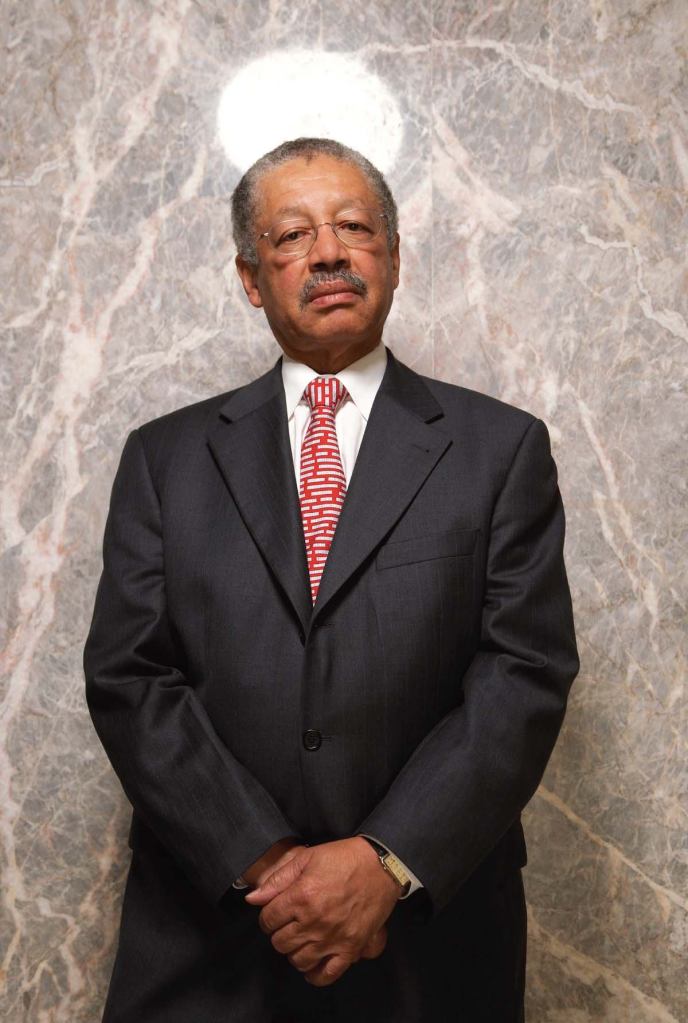
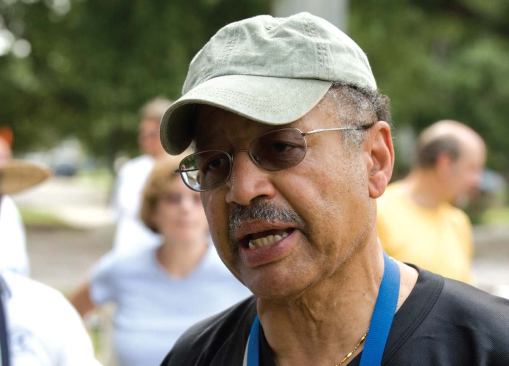
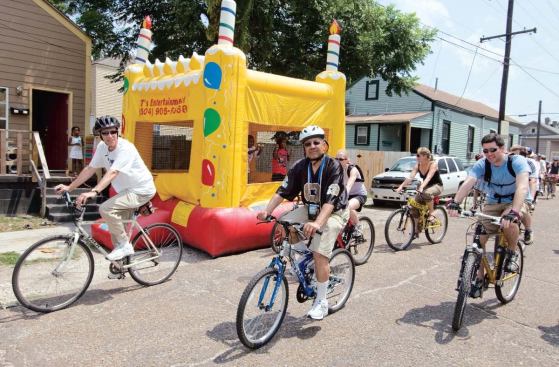
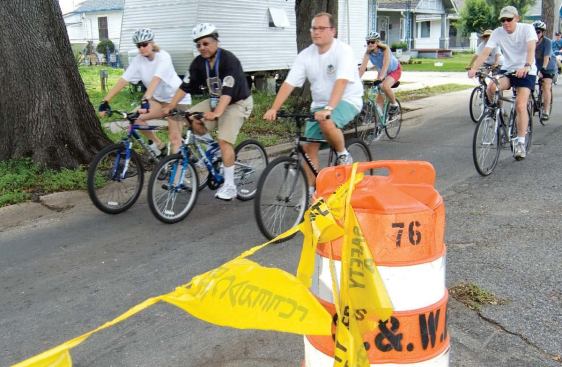
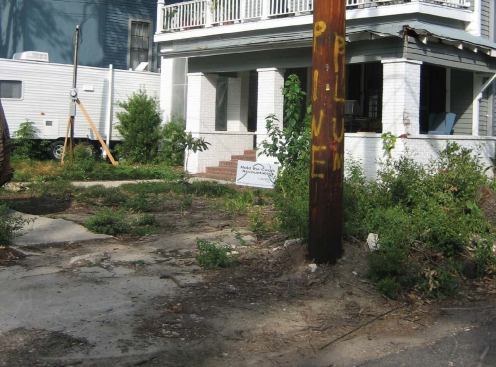
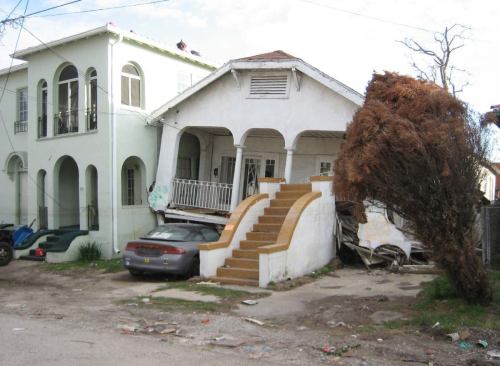
Ed Blakely is multitasking again, scheming and talking as he rides his mountain bike through Broadmoor, one of New Orleans' flood-ravaged neighborhoods. He pedals past a mix of early 20th century residential and commercial buildings, situated where the spokes of streets beginning at the Mississippi River converge in a long-drained cypress swamp. Behind the spry 68-year-old follows a string of about 25 other bikers, mostly local residents who've come out this showery spring morning on one of several bike tours Blakely has led since he reported to work in January as the director of the city's Office of Recovery Management.
He points to a collapsing house as he coasts by. “What we need is sort of a barn-raising—get the whole neighborhood out and rebuild a house, and then get a new neighbor to move in,” he says. “Just one house on a block would help jump-start things.”
The several-mile tour finishes up at the gutted Rosa F. Keller Library, a Mission-style former mansion that today is home mostly to echoes. Inside, Blakely takes note of an antediluvian sign facing an empty reading room: These premises are monitored by surveillance cameras. He puts on a lighthearted scowl. “That's the old New Orleans,” says Blakely, a California native. “Libraries should be welcoming places.”

Credit: Rick Olivier
The group soon drifts back outside, and from the side steps Blakely begins to wax visionary, saying the library will become a seed to regrow the neighborhood, creating a cultural cluster with schools and recreational facilities. The more he talks, the more he likes the idea. He's pointing to structures and conjuring up a new urban core where weedy lots and battered buildings now stand. With his arms waving, he's got the confident bearing of a conductor leading a grand orchestra.
Of course, New Orleans isn't known so much for its orchestras as its raucous brass bands and freewheeling jazz. And this sort of local improvisation has been going on, neighborhood by neighborhood, since the pavement was scarcely dry. Local groups have been scheming, planning, and carrying out their own rebuilding plans in many of the city's dozens of neighborhoods. One wonders: Can Blakely, an academic who arrived from Australia just eight months ago, adapt to the local beat?
If there's a single characteristic Edward J. Blakely has shown since taking over New Orleans' recovery effort, it's been his outspokenness. He got the city's attention early on when he unexpectedly demanded, at a Louisiana Recovery Authority hearing, that all recovery money for the city go through his office. He made some ill-considered remarks in speeches and interviews, referring to locals as “buffoons” and New Orleans as a “third-world country.” A Times-Picayune columnist dubbed him “Dr. Flakey,” and Blakely had the dubious honor of being dressed down for his off-the-cuff comments by Mayor Ray Nagin, whose own lips are often unbuttoned.
But as Blakely himself is quick to note—in his quiet, professorial, and vaguely irritated way—he is exactly the right man for this job. He has authored or co-authored several urban planning texts, is chairman of urban and regional planning at the University of Sydney in Australia, and is the namesake of the Edward J. Blakely Center for Sustainable Suburban Development at the University of California, Riverside. He got his expertise in post-disaster planning in his home state of California (he grew up in San Bernardino), where he was involved in rebuilding after the 1989 San Francisco earthquake and the 1991 Oakland fires. He also happened to be teaching at the New School University in Manhattan in the fall of 2001 and assisted with neighborhood planning after the World Trade Center attacks.
In speeches after he started work, Blakely put forth some big-ticket ways in which New Orleans could reinvent itself and rise above selling trinkets to tourists. (“We have an economy entirely made up of T-shirts,” he said in a speech last spring.) New Orleans should strive to once again become a trade and travel gateway to Latin America, he said. He hoped that well-orchestrated investments could build the city into a major bioscience research center. He'd like to see tax credits help revive the grand old theaters of Canal Street and create a “Broadway South,” just as tax credits have made Louisiana into Hollywood South. (It's third, after California and New York, in attracting moviemaking expenditures.)
And he believes the underused Mississippi riverfront, which contains some of the highest ground in the city, could become a centerpiece of development for the new New Orleans. After attracting entries from teams that included Zaha Hadid, Frank Gehry, and Daniel Libeskind, the New Orleans Building Corp.'s “Reinventing the Crescent” competition was won last December by the team led by architects Enrique Norten and Allen Eskew, landscape architect George Hargreaves, and urban planner Alex Krieger, who together will craft a plan to bring parkland and other public uses to a six-mile stretch of wharves.
But these ambitions are tempered by doubts that grand plans can ever take root in the culturally and politically fragmented Big Easy. (The New Orleans 1984 World's Fair is chiefly remembered for being the first to declare bankruptcy while under way.) “The last person who had a big idea was Huey Long,” Blakely says, mentioning the revered and reviled former governor of the late 1920s. “Big ideas are hard to swallow here.” A much-ballyhooed new jazz district, for instance, announced in 2006 by Nagin and corporate partners, has virtually disappeared; downsized plans now call for just a revamping of the Hyatt Hotel (Thom Mayne is the architect) with an accompanying small jazz museum.

When the floodwaters of Hurricane Katrina were finally pumped out of New Orleans in the fall of 2005, something unexpected emerged from the sludge and blistering sun: a massive, bowl-shaped petri dish in which a culture of local urban planning has grown and, by some measures, flourished.
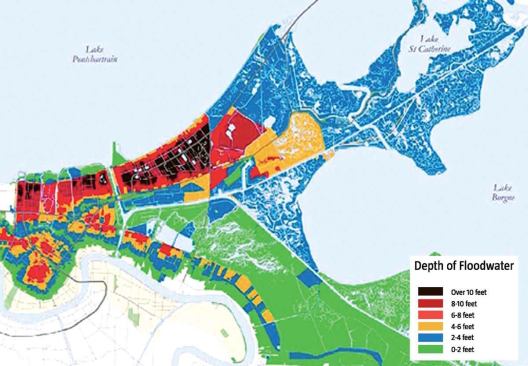
Professional planners, sympathetic nonprofits, neighborhood groups, and citizen committees—sometimes working together but often not—have come up with dozens of ideas for reviving New Orleans. And ideas were needed: The flood inundated 80 percent of the city; fully half of its structures, totaling more than 100,000, took on at least 4 feet of water.
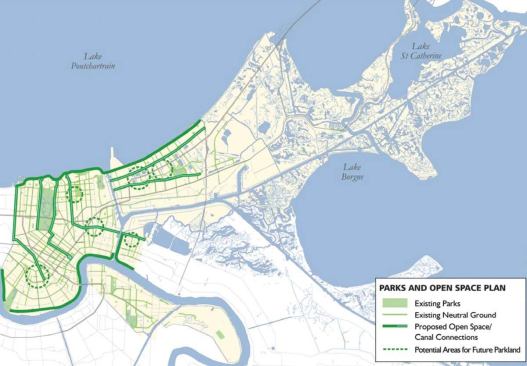
The first high-profile citywide planning prescription, released just a few months after Katrina, was from the Urban Land Institute, prepared at the request of the city's Bring New Orleans Back (BNOB) Commission. The plan, which was painted in broad, bold strokes, was a warning against random redevelopment. Among the ideas: Let many of the lower-lying neighborhoods revert to green space, and move those residents to higher ground.
It did not go over well.
“Folks were like, ‘No way!'” says LaToya Cantrell, president of the Broadmoor Improvement Association. “It's safe to say the report sent shockwaves through the community.” (The center of the Broadmoor neighborhood appeared on the planning map as “proposed park.”) Accusations flew that the BNOB plan was part of an underhanded effort to make New Orleans whiter and wealthier by eliminating poor and largely African-American neighborhoods. Political support for the plan evaporated. Nagin disavowed it and announced that, henceforth, all neighborhoods would be open for resettlement.
The city council soon after went into action, mandating a series of community-based neighborhood plans. This planning effort was overseen by Lambert Advisory, a Miami-based real estate and housing consulting firm. Forty-nine of the city's 73 officially recognized neighborhoods completed “Lambert plans” in a matter of months. (Neighborhoods that lacked an organization or a critical mass of returning residents had more urgent priorities.)
These neighborhood plans, in turn, were distilled into 13 district plans, which later served as the foundation for the Unified New Orleans Plan (UNOP), created by a public-private partnership (which included the city leadership) to set priorities for $14 billion in capital investments. The unified plan was refined in large part through three high-tech “community congresses,” in which thousands of New Orleanians (those already home and those in several cities with large evacuee populations) participated in daylong events to voice their opinions.
The planning process was reasonably smooth, given the scale of the rebuilding. But a long 16 months after the flood, residents were eager to put away the PowerPoint and pick up the power tools. So Nagin finally established the Office of Recovery Management and appointed Blakely its director. New Orleanians were hungry for someone who could lead a citywide exodus out of the thicket of planning and into actual construction. And with Ed Blakely, they thought they could hear the sound of hammers.
The role of the office of Recovery Management is, in large part, to set priorities in the rebuilding, to coordinate with various groups working on the recovery, and to hunt down the funding to pay for it.
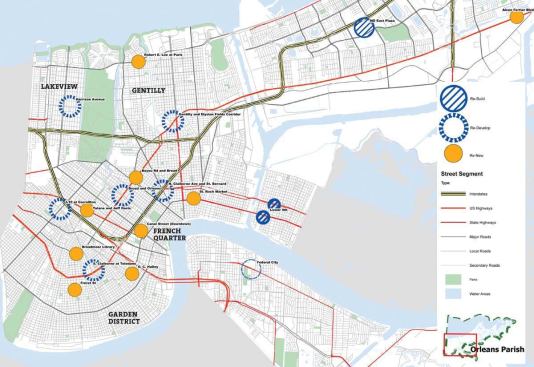
On the first task, Blakely moved swiftly. After less than three months in office, he issued a plan to redevelop 17 key neighborhoods, which would receive about 40 percent of the $1.1 billion that Blakely projected was essential for the first phase of recovery. The pedestrian-oriented neighborhoods were selected based on the criteria crafted in the UNOP proposal, with the target zones falling into three categories: rebuild, redevelop, and renew.
The majority—nine neighborhoods—fall in the renew category, neighborhoods already close to being viable. “These areas are doing fine and were doing fine before,” Blakely says. “With just a little bit of touch-up, paint-up, and spruce-up, they'll do very well.” Only two neighborhoods are rebuilds, requiring major reconstruction: a portion of the devastated Lower Ninth Ward and a shopping district in New Orleans East.
The ultimate goal? Attracting private investment to higher, safer neighborhoods. “We're trying to cluster people around our civic assets,” says Blakely. “This is all carrot,” he claims, without any stick. Anyone can rebuild anywhere they want, but better city services will be concentrated on higher ground, serving as a lure. According to Blakely, early analysis shows that it's more economical to move people into elevated neighborhoods than to elevate houses on stilts, as some homeowners are choosing to do.
Some bloggers and other critics have faulted the plan as too timid, focusing on neighborhoods that are basically fine and overlooking the hundreds of acres of wholesale devastation. But others defend Blakely. The redevelop and renew zones “represent low-hanging fruit,” agrees Cantrell, but she says there's a good reason for starting with healthier neighborhoods. “People are tired of planning. We're planned out. We need action.”
For his part, Blakely offers a blunt diagnosis of what has ailed the recovery.
“The federal government has been the biggest disappointment,” he says, adding that it has actually hurt things rather than helped them. “I've worked with FEMA before, and I think FEMA officials, for whatever reason, have been told that they should do everything they can to interfere. In my previous experience, they were told to do everything they could to get it done quickly, smoothly, and efficiently.” Blakely shakes his head over the money spent keeping Katrina evacuees in hotels for months. “Everybody could be living in a brand new, 1,500-square-foot house just for the hotel bills alone,” he says. “There's some insanity and lack of logic here I can't follow.”
Blakely bemoans the “total incompetence” of the state government. “In most states, the state government is a step up from the local government. But in this state, it's a step down,” he says. “Government here is almost deliberately poor and starved, so you don't have very good people. If you pay peanuts, you get monkeys.”
At the local level, the city's racial politics have proven more cutthroat than he anticipated. “The black-and-white issues go beyond black and white. They get into almost like the Sunnis and the Shiites—one would rather see the other one dead than successful.” Also discouraging to him is that many local businesses “have grown pretty lazy,” he says. “They're neighborhood-serving or tourist-serving, and so [they feel they] don't need to be involved civically.”
Blakely's biggest challenge to date has been coming up with the $1.1 billion he says he needs to carry out his plan. Blakely envisioned five funding streams, but none has been without problems. They include a bond issue backed by blighted properties, which spawned legal complications; a $260 million bond issue passed in 2004, which must legally be spent on projects previously attached to that bond; and funding recently allocated by the U.S. Congress, which may get diverted to the state-run Road Home program that's now at least $4 billion in the red.
Given these shortfalls, Blakely has revised his earlier aggressive timetable. In June, he canceled a meeting with interested developers, noting that it was premature to discuss detailed rebuilding plans until funding was in hand. The promises made last winter of cranes “on the skyline in September” have become cranes “pretty soon.”
But some encouraging news has surfaced: Also in June, the Louisiana Recovery Authority accepted the city's recovery plan, opening the door for the city to receive $117 million in federal block grants. It's only about 10 percent of the money Blakely needs, but it's the first promise of serious cash.
And he's still building local support. On another Blakely bike tour through the Riverbend and Carrollton neighborhoods early this summer, about a hundred bikers showed up to ride along. Blakely was wired for sound by two camera crews, radio reporters held out mics, and riders jockeyed for position to tell him about improvements on their streets. People working on their houses stopped and stared; a few hooted and clapped as Blakely pedaled by, according him the status of a minor rock star. Despite the “Dr. Flakey” moniker, he appears to maintain significant reserves of goodwill.
Nathan Shroyer, executive director of the Neighborhoods Partnership Network, a collective of 60 local groups formed after Katrina, says his members generally favor Blakely's take-charge attitude. Based on what he's learned from leaders in other disaster areas, Shroyer says, the two-year anniversary is when a recovery often breaks either positive or negative. “My own sense is the tipping point will go positive,” he says.
A couple of weeks later, the Broadmoor Improvement Association announces it's lined up its own grant of $2.5 million to fix up the Rosa F. Keller Library. This is the good news from New Orleans, says Blakely: “[The] biggest bright point is the people themselves,” he says. “The people have cleaned up the parks, they've cleaned up the city, they cleaned out houses. It hasn't been the government that's done any of that.”
Wayne Curtis is a freelance journalist based in New Orleans.
AN ED BLAKELY TIMELINE- 1938
Born in San Bernardino, Calif. - 1960
B.A., History/Political Science & Economics, University of California, Riverside - 1964
M.A., History and Development Studies, University of California, Berkeley - 1967
Master of Management, Pasadena Nazarene College - 1970
Ph.D., Management and Education, University of California, Los Angeles - 1972-83
Helps develop rural community and health policies in West Africa - 1977-94
Holds various positions at the University of California, Berkeley, including chair of the Department of City and Regional Planning - 1988
Leads response to earthquake in Oakland, Calif. - 1991
Leads response to Oakland firestorm, which destroyed nearly 3,000 homes - 1994-98
Dean of the School of Urban Planning and Development, University of Southern California, Los Angeles - 1998
Runs for mayor of Oakland against ex-California Gov. Jerry Brown, finishing second - 1998-2003
Helps develop regional economic policies in China - 1999-2004
Dean of the Robert J. Milano Graduate School of Management and Urban Policy, New School University, New York - 2004-07
Chair of Urban and Regional Planning, University of Sydney, Australia - 2007 present
Executive Director for Recovery Management, City of New Orleans