Day after day, in a locked and sealed room on the third floor of the National Building Museum in Washington, D.C., two volunteers in white cotton gloves are quietly and methodically dissecting the question of how we play with form. They’re examining building toys—more than 2,000 of them spanning a century from the 1860s to the 1970s. Wooden blocks, Lincoln Logs, Tinkertoys, Erector sets, LEGOs, and many one-hit wonders, all holding the same promise that curator Chrysanthe Broikos neatly sums up: “You can create a whole other world.”
One man, George Wetzel, collected these toys in his attic in Peotone, Ill., for the last 25 years. In 2006, the Building Museum acquired Wetzel’s collection—thought to be the largest of its kind in public trust—and the museum is cataloging the toys now. It’s a process that is slow and precise, painstakingly so given the high fun quotient of the material at hand.
You’ll have to wait, kids. Since it takes an average of four hours to catalog each toy, look for the first exhibits of this collection around 2013. In the meantime, here’s a peek at what the Building Museum has in store.
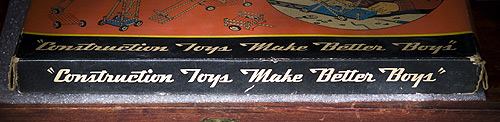
TOY: The Constructioneer Metal Building Set No. 4
YEAR: 1947
MANUFACTURER: The Urbana Manufacturing Co., Urbana, Ohio
MATERIAL: Metal
INFO: Bearing the motto “Construction Toys Make
Better Boys,” this building set is made of heavy-gauge steel with
nickel-plate finish and includes rubber wheels. An electric motor could
be purchased separately.
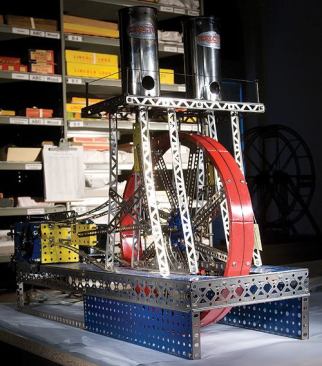
TOY: Erector Set No. 10 ½
YEAR: Circa 1951
MATERIAL: Metal
INFO: The “Giant Power Plant Model” incorporates an
electric engine and features a steam cylinder “with valve action,”
according to the toy’s manual; a tower platform with boilers that
“represent compressors in the original Corliss engine,” the steam engine
that powered the 1876 Centennial Exposition in Philadelphia; and a
flywheel built from eight wheel segments.
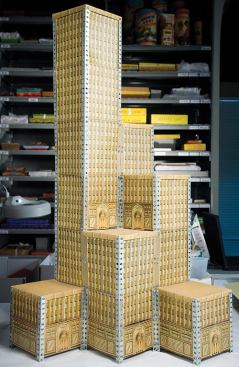
TOY: Gilbert Skyscraper Erector Set
YEAR: Circa 1935
MATERIAL: Cardboard with metal girders
INFO: A Gilbert Skyscraper Erector Set included up
to seven different types of cardboard panels with names such as “Main
Entrance,” “Garage Entrance,” “Office Entrance,” and “Upper Story.” Each
panel is color-lithographed on both faces, offering a choice of two
façades: concrete (shown here) or brick. Cardboard panels are fastened
to metal girders with either machine screws or snap rivets.
PROCESS
UNTIL MORE FUNDING COMES IN, cataloging is done by two specially trained volunteers rather than salaried staff. The work requires patience, attention to detail, and the ability to work for long periods in isolation. All handling of the toys is done with white cotton gloves. “You have to be a little OCD,” says museum senior registrar Dana Twersky.
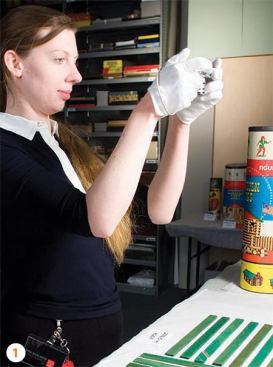
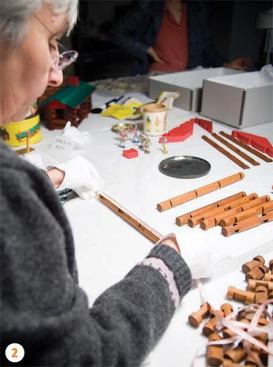
Pictured here are volunteers Mary Purcell (1) and Joyce Arsnow (2). Purcell, who studied industrial design at RISD, was introduced to the collection when she helped to unpack it. Arsnow is new to the project; a retired preschool teacher, she sees her work cataloging the toys as the “last hurrah” of her teaching career. “This will be used to develop children’s minds, and I don’t have to deal with potty training,” she says.
Toys are catalogued one at a time in the order they’re shelved in the museum’s archives, which is based on the organizing system George Wetzel developed in his attic. Next up is object number 2006.5.140, a set of Lincoln Logs in an 18-inch-high cardboard tube. Lincoln Logs were patented in 1920 by Frank Lloyd Wright’s son John Lloyd Wright. Guessing from “Daniel, Christmas 1955,” the handwritten inscription on the side of the container, this set probably dates to the mid-1950s.
1. Photograph
The first step: documenting the toy in the condition it was received from the collector. Using no flash, Purcell photographs the closed container first, then the open container with its contents displayed around it. The object number is clearly displayed on a label.
2. Measure
With a cloth tape, Arsnow measures the height, width, and depth of all the toy’s parts. It can be a tedious process, but “it’s worth it to do it the right way up front,” says Twersky. The information will help in planning future exhibits.

3. Clean
Arsnow uses a natural-bristle brush, which has the handle’s edges taped off to prevent scratching, to gently remove dust, grease, insect casings, or other dirt that might degrade the toy. A small portable vacuum, typically used for cleaning toner dust from electronics, removes 0.3 micron–sized dust. Catalogers only clean preventively now; later, conservators will spend hours cleaning toys that are chosen for display.

4. Label
Each toy is assigned an object ID number in sequence after “2006.5,” which indicates that the item is from the fifth collection the museum acquired in the year 2006. The number is recorded on worksheets and on the toy itself, using a 6B pencil (on a scale up to 9B, it’s close to the softest pencil made). If the toy is metal or plastic, volunteers paint the number on it with acrylic paint.

5. Catalog
Purcell enters a report on object number 2006.5.140, the “Daniel, Christmas 1955” set of Lincoln Logs, in a database using PastPerfect software. Eventually, researchers worldwide will be able to access images and information about the toys from the database.
MEET THE COLLECTOR
Why did you decide to part with the collection?It was just sitting on shelves gathering dust. I was so frustrated seeing it myself and not being able to share it with the world.
What can people learn from the toys?These things are so realistic and authentic, I feel like I’ve got a little piece of history in my hand. You learn cultural history and social history. And you see all the trends and the developments in architecture from one decade to the next. I feel like an archaeologist.
Why did you start collecting?When my kids were young, I thought, “Boy, they don’t make toys the way they did when I was a kid.” There was nothing that would challenge your imagination or stimulate any creativity. … [My sons] liked slot cars and Transformers. So somehow this became my hobby. Why am I drawn to these things? It’s actually kind of a physical thing. Building with them, working with them … it gets in your blood.
How did you acquire these, pre-internet?It meant a lot of chasing around, going to antique shows and antique shops around the country. I would write letters. I would make a point to go visit people and see their collections firsthand. When you pick [the toys] up in your hand and you touch them, it changes your focus.
For 25 years you collected these toys. What are you doing with your time now?I’ve decided I’m going to do it again. I’m focusing on the Chicago toys—Lincoln Logs, Tinkertoys, American Bricks (an early competitor of LEGO), Bilt-E-Z. … Many of the best, most popular toys were made right here in Chicago.

NAME George Wetzel
LOCATION Peotone, Ill.
AGE 60
JOB Middle school English teacher, retired
HOBBIES Collecting construction toys and toy trains; playing ragtime piano; driving vintage Cadillacs.
TIMELINESeptember 2005 Retired schoolteacher George Wetzel calls the National Building Museum in Washington, D.C., to inquire about donating his collection of vintage building toys. He estimates his collection, amassed over 25 years and stored in his attic, to number around 1,400. Chase Rynd, the museum’s executive director, agrees to visit Wetzel’s home in Peotone, Ill. Rynd has been faced with the challenge of collecting for a museum whose core subject—buildings—is essentially uncollectible. Arriving in Peotone, Rynd is astonished to see the size and scope of the toy collection. As a bonus, he recalls, “I got to play with them.”
July 10, 2006 Four staff people from the Building Museum arrive in Peotone and begin to empty the Wetzel attic, inventorying, tagging, and packing the collection in the family’s living room. Each night, art transporters pick up the bins filled that day, usually three to five boxes weighing 200 to 300 pounds each.
July 31, 2006 With the inventory complete, the Building Museum can attach a dollar figure to the toys as objects (over $500,000) but not to Wetzel’s time and knowledge in building the collection (priceless). The museum buys the bulk of the collection for an undisclosed sum, and Wetzel agrees to donate the rest.
August 9, 2006 Two air-ride, climate-controlled tractor trailers deliver the collection to the National Building Museum in Washington, D.C. Fifty-five bins of toys are unloaded in the museum’s Great Hall.
November 2006 An empty gallery space on the third floor of the museum is transformed into a permanent storage and cataloging space for the toy collection, which on closer inspection seems to number closer to 2,000 than Wetzel’s original estimate of 1,400. Baked-enamel steel shelving provides 1,053 linear feet of open-view storage, which not only helps catalogers see what they’re doing but also helps the museum’s fundraising by bringing visitors behind the scenes to see the work in progress. To protect the toys, a hydrothermograph regulates the climate at 50 percent relative humidity and 70 degrees Fahrenheit. UV sleeves cover the overhead fluorescent lights.
May 22, 2007 Cataloging begins with object 2006.5.001, alphabet blocks, manufacturer unknown. Wooden ABC blocks are among the earliest forms of building toys—both in terms of history and the way children learn to play. Pictured here, object 2006.5.37, Big Letter ABC Blocks, copyright 1889 by McLoughlin Bros., New York. The hand-stitched repair along the sides of the box make this one of registrar Dana Twersky’s favorite items in the collection.
August 7, 2007 Item 2006.5.97, architectural wooden blocks from The Embossing Co. There is no date on the toy, but the box top shows two people in Victorian style clothing, suggesting that the toy is from the late 1800s.
February 14, 2008 One of many sets of Lincoln Logs, object number 2006.5.140, circa 1955.
Forecast: October 2009 With a full-timer on staff, catalogers could reach the shelves of Froebels wooden blocks next fall. Frank Lloyd Wright had a set as a child and would later recall, “The smooth shapely maple blocks with which to build, the sense of which never afterwards leaves the fingers: so form became feeling.”
Forecast: December 2009 Heavy in their wooden boxes are “stone” block sets, such as the Richter’s Anchor Blocks shown here. The German stacking blocks feel like real stone but are made from compressed and dyed sand, chalk, and linseed-oil varnish. The popular early 20th century toys came with guides illustrating possible designs. Richter blocks fall into the category collectors call “Sunday toys”—treasured items children played with once a week.
Forecast: July 2010 The collection includes 531 metal toys, of which 108 are Erector sets. Knockoffs include the Ezy-Bilt, an Australian toy that claims to be “Creative Constructive Instructive Absorbing 1001 Toys from One.”
Forecast: September 2011 LEGOs aren’t the only plastic building toys. Predating LEGOs is the Tri-State Brick Town, advertised as “Professional! Instructional! Authentic!”
Forecast: April 2012 Ninety cardboard toys make up a small section of the collection. Mostly produced during the Depression and World War II, cardboard toys haven’t survived the test of time as well as other materials.
Forecast: July 2012 Dominoes, puzzles, and assorted parts are grouped under the miscellaneous category, which the museum plans to catalog last.