

Launch Slideshow

Stretching the Pour

Architects Stephen Kanner and Joe Addo are entering the building products industry with a concrete additive designed to help the people of Ghana.

Stretching the Pour

Architects Stephen Kanner and Joe Addo are entering the building products industry with a concrete additive designed to help the people of Ghana.

  • http://www.architectmagazine.com/Images/tmpCB34%2Etmp_tcm20-172736.jpg

    600

    Bags of Pozzoghana-a local variety of pozzolana ash, a concrete additive-are now in production in a small factory in Ghana. The additive can stretch a bag of portland cement (a necessary ingredient in concrete) up to 30 percent, making the ubiquitous building product more affordable to the local market.

  • http://www.architectmagazine.com/Images/tmpCB37%2Etmp_tcm20-172743.jpg

    600

    Kanner Architects

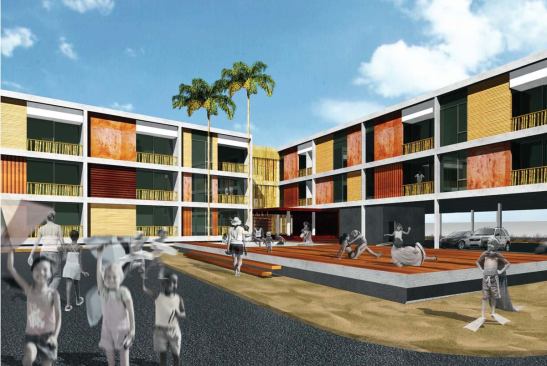
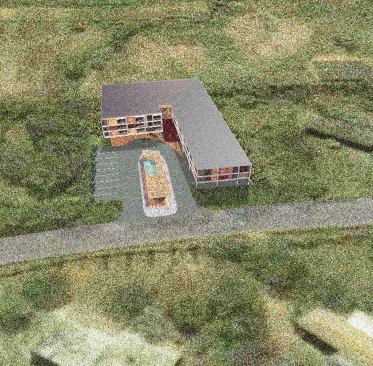
    The first project to use the Pozzoghana additive will be the Independence Avenue condominiums in the Ghanaian capital of Accra.

  • http://www.architectmagazine.com/Images/tmpCB48%2Etmp_tcm20-172729.jpg

    600

    Kanner Architects

    Located on a street lined with embassies and near the main airport, the upscale complex will be a good testing ground for use of Pozzoghana on a commercial scale. Permits are in place; the project should break ground in the coming months.

  • http://www.architectmagazine.com/Images/tmpCB39%2Etmp_tcm20-172750.jpg

    600

    Kanner Architects

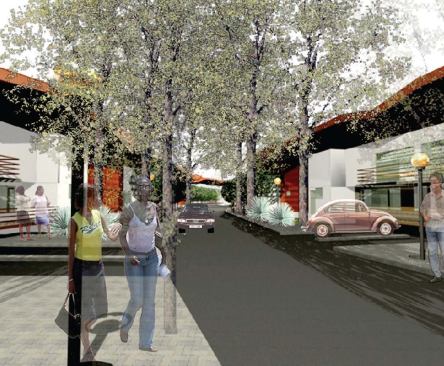
    The second project to use the additive will be the Agostine Neto mixed-use project in Accra. Kanner and Addo won a design competition organized by a local developer, and the project should break ground next year.

  • http://www.architectmagazine.com/Images/tmpCB3A%2Etmp_tcm20-172757.jpg

    600

    Kanner Architects

    The second project to use the additive will be the Agostine Neto mixed-use project in Accra. Kanner and Addo won a design competition organized by a local developer, and the project should break ground next year.

  • http://www.architectmagazine.com/Images/tmpCB3B%2Etmp_tcm20-172764.jpg

    600

    Kanner Architects

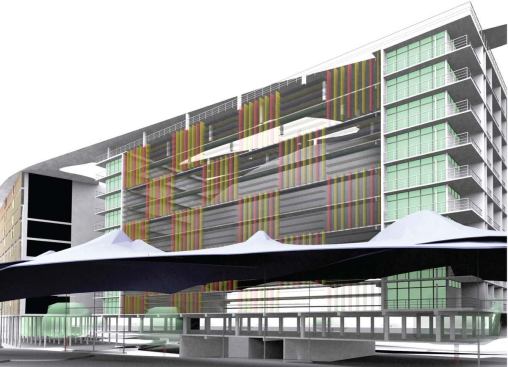
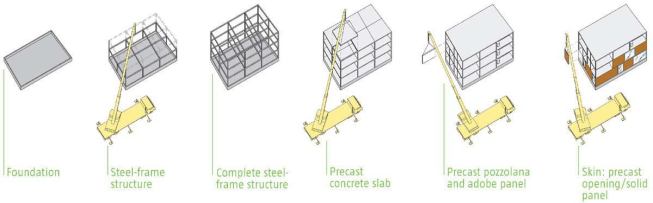
    Spintex Road development: prefab cladding system using Pozzoghana

Concrete is one of the most consumed substances in the world, second only to water. In the West African country of Ghana, it is used to build seemingly every part of every kind of structure, from foundations and walls in single-family homes to patient rooms in hospitals, and it is the center of a cottage industry of concrete block makers, layers, and artisans. But because of the rising costs of importing portland cement (which is a primary ingredient of standard concrete), an economic crisis is brewing in Ghana, where some people now can't afford to build even the most modest of homes.

Enter longtime friends and architects Stephen Kanner of Los Angeles–based Kanner Architects and Joe Addo of Constructs in the Ghanaian cities of Accra and Tamale. Addo, after nearly 20 years in the United States, recently moved back to his home country of Ghana. On one of Kanner's visits (he is the godfather of Addo's child), the two men spoke with a friend of Addo's who was working with the Ghanaian government to analyze a variety of state-run projects.

One of the projects was a 20-year-old effort to test a concrete additive, a variation on traditional pozzolana ash, that stretches the use of a bag of portland cement by up to 30 percent. To test the durability of the pozzolana formula, the Ghanaian government built roads and structures using the material and simply waited to make sure they would remain structurally stable.

The buildings are still standing and still strong. Now the government was looking for someone to take over the manufacturing and marketing of the pozzolana product. Kanner and Addo jumped at the chance. “In a country like Ghana, things just take a long time,” says Kanner. “That's the way it is. I was lucky to be there at the right time.” Addo and Kanner bought the rights to manufacture with a third partner, PMC Global. “I am a shareholder, but most importantly, a Ghanaian advocate,” says Addo. With a five-year noncompete agreement from the government in place, the three-person joint venture has embarked on the process of making this additive commercially available under the name Pozzoghana.

Stephen Kanner
Kanner Architects

Stephen Kanner Kanner Architects

Joe Addo
Constructs

Joe Addo Constructs

Pozzolana is an additive that has been used as far back as ancient Rome, taking a claylike soil and burning it with a local firing agent in order to form a cementitious powder. Much like water added to soup, pozzolana will stretch the amount of concrete that can be mixed from a single bag of portland cement, without drastically modifying drying time, texture, or overall appearance.

The Pozzoghana formula makes use of local resources: the clay soil of the region to start, with the addition of palm kernel caps as the flammable substance. The soil that is used in Pozzoghana is only topsoil; collecting it does not require any strip mining, and it is very quickly regenerated. Palm oil is one of Ghana's biggest exports, and the nuts that provide the oil are structured like acorns, with a small cap that connects the kernel to the tree. The caps have simply been discarded for centuries, but they have chemical properties that interact with the clay of the soil to make pozzolana stable. Kanner describes the use of the palm kernel caps as “using something that is just sitting in piles by the side of the road,” and the Pozzoghana process in general as “very gentle, environmentally.” The clay and kernels are burned together in a kiln, using a series of careful heating and mixing techniques, and the end result is Pozzoghana.

By adding Pozzoghana to portland cement before mixing the concrete used to make block and most structures, the average price of each bag of cement drops from $6 to $4, leaving the craftsmen more money for their families and making home construction more affordable. “The vision and mission of Pozzoghana Ltd. is simple: to create a complementary product to portland cement, to promote indigenous materials and know-how, and to prove that we need to look within and not without,” says Addo.

The production of Pozzoghana is undeniably a business venture for Addo and Kanner, but the partners also hope the product will have a humanitarian use. They are in talks with the Ghanaian government to use the additive to build subsidized, low-income housing in rural areas, and, Kanner reports, “They are very supportive of the product for that kind of use.”

In the meantime, Kanner and Addo are already at work on three projects using the additive to showcase its versatility. One project is about to break ground: a 25-unit condominium project on Independence Avenue in the capital city of Accra, located near the airport and on a street with embassies. “The product can be used for market-rate condos as well as low-income housing,” says Kanner, “and this is just a way to have it actually in a built project, which is very exciting.” One mixed-use project using Pozzoghana has just won a competition run by a local housing developer and will break ground in the next few months, and another is on the boards. All three projects were designed in Kanner's Los Angeles office, with Addo serving as a project architect locally. For these projects, Pozzoghana is being added to portland cement in varying ratios depending on the object; more additive can be used in decorative details than in structural slabs and columns.

Production is stepping up as well. The joint venture bought the government's test plant, and it is now making commercial product. “If all market indicators are positive, a large-scale plant should be up in a year or so,” says Addo. More plants are in the works, with a long-term vision including many small facilities across West Africa, so that each can serve a local clientele and employ local workers. Sustainability is a major concern for the partnership. By using a renewable material and a waste product and cutting down on importing and long-distance shipping, the project can save fuel and maintain a relatively small environmental footprint.

The partners also have faith in the initiative's financial sustainability. “Knowing Ghanaians and knowing how money is not that plentiful, I suspect that if there is a $6 bag and a $4 bag and one of them is effectively homegrown, I suspect [they] would buy the $4 bag,” says Kanner. “And I expect it will be successful because it helps their economy, it hires their people, it uses their natural resources. There are many good reasons to do this rather than import material that they have to pay more for.”

Addo feels similarly. “My interest in this project is to create a whole new industry for Ghanaians, with a product developed by us to meet our growing demand for ‘the building blocks' for the new Ghana,” he says. “As an architect/entrepreneur, I believe that as Africans we need to control the supply chain, and I see no contradiction in my social agenda and my capitalistic endeavors—one informs and benefits the other. It's a win-win.”