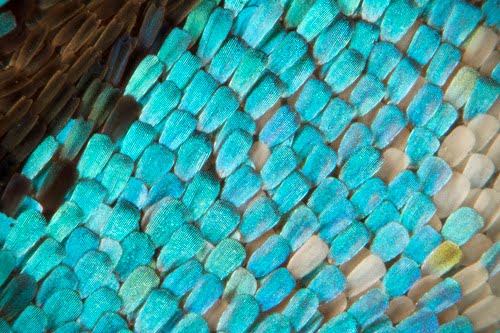
The complex optical effects created by iridescent natural materials such as butterfly wings have long intrigued scientists, yet knowledge of how light behaves within these materials has not been well understood until now. Recently, scientists have been able to map light behavior in so-called photonic crystal substances, thanks to a new microscopic technology that boasts a resolution 10 times smaller than light’s diffraction limit.
“We were thrilled in the lab to observe the finer details of the photonic crystals that were simply inaccessible before,” said Riccardo Sapienza from King’s College London, one of the universities participating in the study. “This is very important as it allows scientists to test optical theories to a new level of accuracy, fully characterise new optical materials and test new optical devices.”
After studying the light maps they recorded, Sapienza and his colleagues fabricated a synthetic photonic crystal out of a thin layer of silicon nitride. They etched the membrane with a hexagonal array of holes, strategically eliminating certain holes to create what are called “crystal defect cavities”—hot spots that reflect light and create the iridescent sheen so familiar in butterfly wings.
Future applications include improved biosensor and graphic-display technologies. “Our research provides a fundamental insight into light at the nanoscale and, in particular, helps in understanding how light and matter interact,” said Sapienza. “This is the key to advance nanophotonic science and it can be useful to design novel optical devices like enhanced bio-sensors for healthcare, more efficient solar cells and displays, or novel quantum optics and information technologies.”