
Project Description
This project was a finalist in the Chicago Architecture Biennial Lakefront Kiosk Competition.
FROM THE ARCHITECTS:
Project Abstract
In terms of function, the existing
kiosks efficiently meet the needs of the various vendors that supply goods and
services to the millions of visitors to Chicago’s lakefront each year. All
summer long these modest huts are alive with energy, but for nine months of the
year these once-active spaces are shuttered to form a ghost town—a constant
reminder that the magic that is summer in Chicago is long gone. This proposal
for a new lakefront kiosk doesn’t seek to reinvent the wheel in terms of
supplying the millions of visitors to Chicago’s lakefront with goods and
services. It functions as easily and as efficiently as do the existing kiosks. The
difference lies in its reinvention of the way the public interacts with it, and
the way it remains an active element along the lakefront year-round.
Written Description
On
Intention, or the Occult Monument
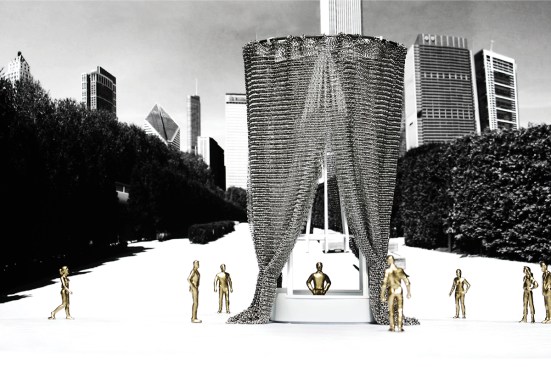
Like a small child’s not-so-inconspicuous
hiding spot, this project is intent on concealing itself poorly. This is not to
say that the project aims to present itself poorly; rather, it aims to present
itself in a manner that tries to conceal or mute, as opposed to embellish, its
inherent qualities of monumentality, iconicity, and symbolism. To begin: look
closely and you will see that our disguise is fairly superficial (i.e., skin-deep).
A thinly meshed veil conceals, but also attracts, an attenuated figure held
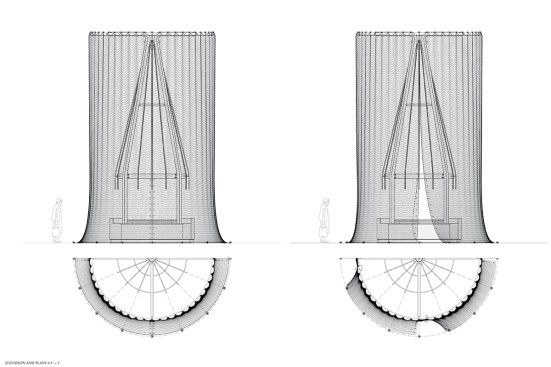
within its loose-fitting cylindrical body. Only after peeling back this veil,
now a curtain, does the project reveal its function. Alas, it is simply a
kiosk. Nothing more, nothing less. It is still grand, however. Pull up a seat
and transact your business.
On
History, or the Economy of Spectacle
The Exposition Universelle of 1889
unveiled the Eiffel Tower, a glorified entrance arch. The World’s Columbian
Exposition of 1893 was saved from bankruptcy by George Ferris’ Wheel,
essentially a vertical carousel. In 1939, the New York World’s Fair hoisted its
visitors to a height of 250 feet to simulate the effects of falling with a
parachute. It goes without saying that grandiosity and spectacle are often the
main attractions of a public event. Fast-forward to 2015, the year of the first
Chicago Architecture Biennial. Is spectacle still a desirable pursuit? Perhaps
a more economical position is more favorable for the times we currently
inhabit. That a kiosk speak as spectacle is a potentially futile request to
make of such a modest architectural type. That said, given Chicago’s climate,
the charge of spectacle lends itself to life-span. If you look closely at
function, the existing kiosks efficiently meet the needs of the various vendors
that supply goods and services to the millions of visitors to Chicago’s
lakefront each year. All summer long these modest huts are alive with energy,
but for nine months of the year these once-active spaces are shuttered to form
a ghost town—a constant reminder that the magic of summer in Chicago has
disappeared. This proposal for a new kiosk does not seek to reinvent the type. In
fact, it functions as easily and efficiently as do the existing kiosks, but it
does so while providing alternative readings of what constitutes a spectacular
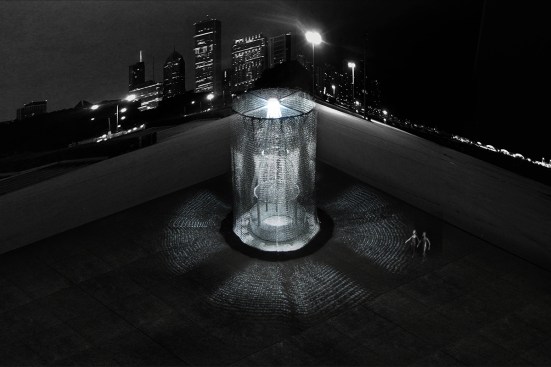
yearlong interaction. A veil dangles, casting its shadows on any ground it
occupies. The kiosk invites the casual passersby to join in its dance. Overall,
the structure is more than just a place of commerce; it is a shy icon that
tempts its audience to stare into and beyond.
On
Features, or an Act in Three Parts
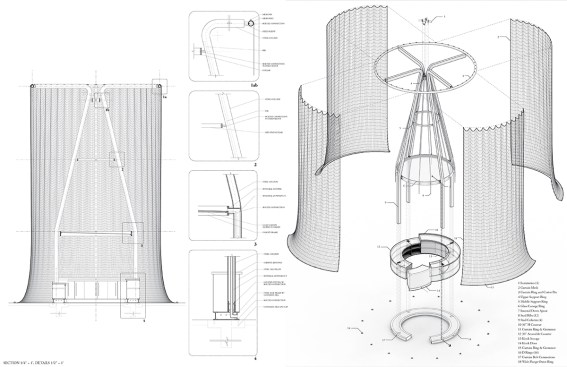
The kiosk assembly system is
intentionally simple. The features are organized into three parts: (a) base,
(b) frame, and (c) veil. All parts are mechanically fastened to one another on
site so the kiosk can be assembled and disassembled multiple times for easy
transportation or storage.
a. Base
The base is made of two component parts:
base structure, and cabinetry. The structure of the base is a 12-foot diameter
steel ring made of bent 8-foot C-channel with four column anchors attached to
it. Diamond plate is welded to the steel frame as a finished surface. The cabinetry
is a simple assembly of a formed steel wall attached to the outer diameter of
the base. The formed steel walls will have grommets located within each reveal,
to allow for flexibility in attaching banners and signage of various sizes to
it. A steel counter is attached to the wall, making a space for storage carts. When
sited in a sandy location, the base can be stabilized using sand augers.
b. Frame
The frame structure is made of three
components: the primary, secondary, and Vail structures. The primary structure
is made of four (4-foot by 6-foot by 35-foot) steel tubes bent into the same
profile. The four tubes are set into the four column anchors of the base. The
secondary structure is made of two collar rings that lock the four columns
together and stabilize the structure. The two collar rings are located at the
midpoint and top of the structure. In addition to stabilizing the structure,
these two collar rings act as anchor points for the (2-foot by 2-foot) bent
steel tube that forms the conical silhouette of the structure. A light is
attached to the upper collar ring, and the lower collar ring provides anchor
points for a glass canopy for shade and cover. The Vail structure is an 18-foot-diameter
steel ring made from bent (3-foot by 6-foot) steel tube anchored to the ends of
the four steel columns.
c. Veil
Stainless steel coil mesh is attached to an equally spaced set of
grommets that securely attaches the steel mesh to the structure and produces
the pleated-curtain quality of the kiosk. While having a visual delicacy, the
steel mesh of the veil will have a rigidity that will allow the curtain to
serve as a means to secure the kiosk in off hours and the off-season.