
Project Description
This project was a finalist in the Chicago Architecture Biennial Lakefront Kiosk Competition.
FROM THE ARCHITECTS:
Project Abstract
The form of this building is an attempt
to express Chicago’s unlikeliness: that chutzpah, the strange emergence of
something intricate and sophisticated in a hostile environment. It is a gradual
transformation from a blank (vaguely block-like) mass into something more
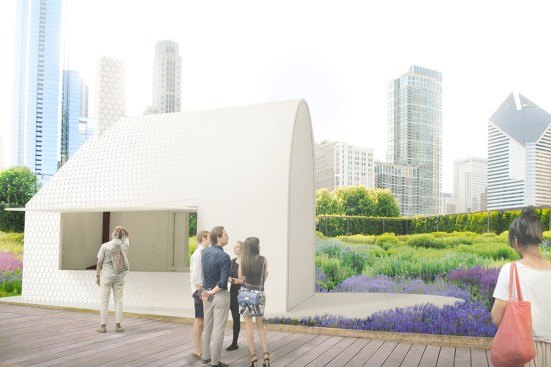
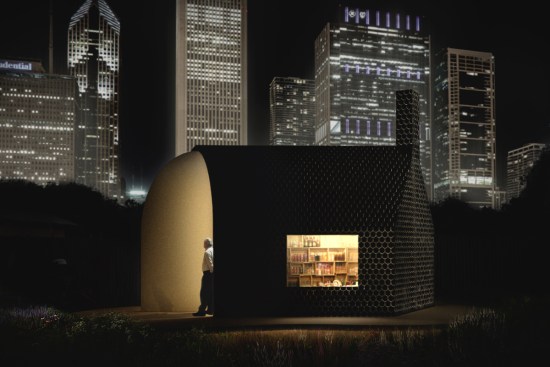
architectural, more refined, more domestic. On its surface, a pattern of
shingles “fades” in, routed from plywood panels to increasing depth. For the
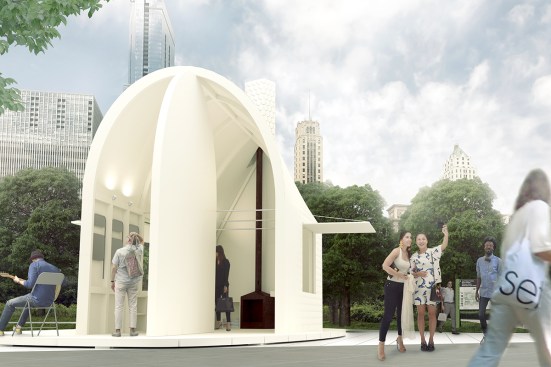
Biennial, we had imagined it as a kind of micro-venue for local music and
drinks, spilling out like many of the famous jazz and blues venues of the South
Side. At other warm times, it might serve as an information booth or a food stand.
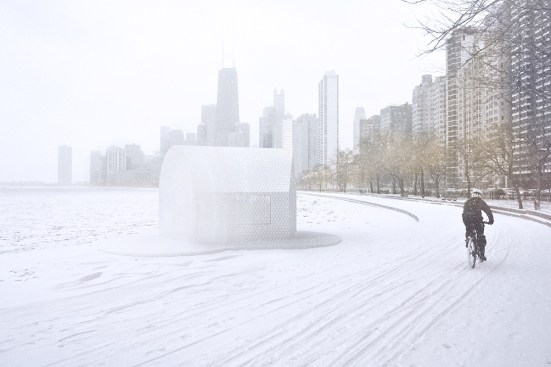
In the winter, it is abandoned and takes on a strange form of solidity—a frozen
mass, or solid object, that appears to be only half architectural and beyond
the range of human inhabitation.
Written Description
Comaroff: This is a Chicago proposal,
born in Singapore in a fever of nostalgia. The leader of this particular team,
I grew up in Hyde Park and in Old Town. As a high school intern, dangerously in
love with buildings, I got shouted at daily by Helmut Jahn. Stanley Tigerman
told me that I should never, ever be an architect.
For many, Chicago will always be
something of a magical place. A large part of this appeal may be its sheer
unlikeliness, an impossible elegance in the teeth of impossible climate and
geography. Despite the delicacy and sophistication of its buildings, one gets
the sense that it probably should not be there at all. And with this, there is
a genuine, local form of madness: a habit of getting revenge by making only the
hugest, unlikeliest plans.
The form of this building is an attempt
to express this unlikeliness: that Chicagoan chutzpah, the strange emergence of
something intricate and sophisticated in a hostile environment. It is a gradual
transformation from a blank (vaguely block-like) mass into something more
architectural, more refined, more domestic. For the Biennial, we had imagined
it as a kind of micro-venue for local music and drinks, spilling out like many
of the famous jazz and blues venues of the South Side. At other warm times, it
might serve as an information booth or a food stand. In the winter, it is
abandoned and takes on a strange form of solidity—a frozen mass, or solid
object, that appears to be only half architectural and beyond the range of
human inhabitation.
Most obviously, perhaps, the form of
this kiosk invokes a kind of persistent Chicago image: the “rude” Prairie
house. Not the stylized version of Wright—which we are not skillful enough to
take on—but the simpler, earlier version that suggests an origin of Chicago
architecture. The gabled form that appears to emerge, pushing out of the
stereotomic block, is something like a little shack that finds itself planted
in Millennium Park (and later, somewhere else). It is made of wood, and appears
at first to be shingled, suggesting a kind of building that would have stood
prior to the great fire in neighborhoods such as the Southwest Side. As an
icon, the image also recalls some of our favorite Chicago postmodern moments,
such as Tigerman’s Black Barn, which we love unapologetically. More directly,
it echoes those tough, lonely kiosks that stand along the lake, regardless of
the season.
The surface of our kiosk is a sham; a
shameless sham. It is also a reference to one of our favorite Chicago
traditions: that architecture which finds a playful expression in “bad” or “wrong”
materials. We are thinking, here, of our most loved local fantasy: the White
City of the Columbian Exposition. We love that “staff” (basically plaster and
burlap) applied to scenographic skeletons made for an amazing, utopian
proposition about the American city. Even better that it was bullshit, and that
architects such as Richard Morris Hunt seemed to enjoy working a material that was
so dishonest, making buildings that gave a splendid material language to stuff
that was considered too poor to engage.
In our proposition, the pattern of the shingle becomes a kind of skin or
scaling. It is a purely nontraditional treatment. The shingles fade in and out,
in the manner of a drawing or a cute Photoshop technique. It appears to
solidify and articulate the building, but is not “fake”; it never pretends to
substitute for the “real” thing. We play the same trick as Henry Ives Cobb with
his quasi-tectonic ornament, trying out a language for a cheap materiality:
plywood and paint. The shingle itself is meant to recall the extravagant roofs
of an elegant Chicago, such as the Gold Coast manor of William Borden (another
of Hunt’s works).