Deep in the woods with views of the Catskill Mountains in the distance, architect Marica McKeel’s house in New York’s Hudson Valley needed—without question—a seamless connection between inside and out. But McKeel wanted to push that boundary a step further.
“It’s not necessarily a blurred boundary line, but a continuous space between indoors and outdoors,” she says. “You’re never really turning a corner and seeing a wall; you just see continuous space to the outdoors.”

VIA43, McKeel’s home and studio in Olivebridge, N.Y., by Studio MM Architect.
McKeel, founder and principal of Studio MM Architect, designed the house both as a residence for herself and her husband and as a studio for her team. That dual purpose is expressed in a pair of two-story volumes—one for the couple’s private spaces and the other for the firm’s studio—connected by a glassed-in hallway. About 50 steps away, a bunkhouse perched like a treehouse on a steep rocky bluff, where it seemingly floats above the land, accommodates overnight stays for McKeel’s colleagues and visiting family and friends.
At every turn, transparent thresholds with slim window and door profiles were pivotal to her design.
Building Continuity
An aerial view of McKeel’s house looks as if the tree canopy grew up around it. With nearly half of its walls made of large expanses of windows and glass doors, the house emerges from the landscape, positioned horizontally along the site.

VIA43, McKeel’s home and studio in Olivebridge, N.Y., by Studio MM Architect.
Guests are welcomed at the entry through a sleek glass Marvin Modern Swinging Door with views of the mountain range. That view pulls visitors into the 8-foot-wide glass corridor that doubles as an art gallery overlooking a central courtyard where the couple often entertain up to 16 people around an outdoor dining table. “At night, that gallery just glows inside,” McKeel says.
The home’s gathering spaces project into the landscape with communal areas that spill out to decks and courtyards. Floor-to-ceiling windows—some operable, others fixed—and sliding doors from the Marvin Modern collection wrap the main living areas in panoramic views.
“The collection gave us a lot of flexibility with how we designed because you can have really big panes of glass in any size, which allowed us to work with the visual rhythm of the home,” McKeel says. “The glazing really allows you to be all over that space, and the spaces remain connected.”
Views for All Seasons
Upstate New York’s distinct seasonal shifts, from winter’s snow-feathered evergreens and fall’s kaleidoscope of colors to the fresh spring scents of the pear and peach trees that border the kitchen courtyard, provide endless inspiration.
“Every single season, there is something new,” McKeel says. “We have a wonderfully clear view in the winter, and in the summer, we have the shade, so it’s the best of both worlds.”
Generous overhangs allow windows and doors to be free of coverings, while hidden screens turn the spaces into comfortable outdoor rooms that catch the cross breeze, rustling leaves, and bird songs.
“We didn’t want a screened porch because we’d rather be outside,” McKeel says. “I can open all the doors on the opposite sides of the kitchen, and basically I’m in a screened porch—the screens drop down when we need them. It really allowed us to open up the house.”

VIA43, McKeel’s home and studio in Olivebridge, N.Y., by Studio MM Architect.
An outdoor grill area just steps from the kitchen is connected with a Marvin Multi-Slide Door. “It’s very much an expansion of the kitchen,” McKeel says. “You open those doors and you’re really in both places, which is great because my husband loves to grill but I’m always in the kitchen.”
Separate Yet Together
At the edge of the mountaintop clearing, McKeel designed the bunkhouse for overnight guests, including teammates who commute from New York City.
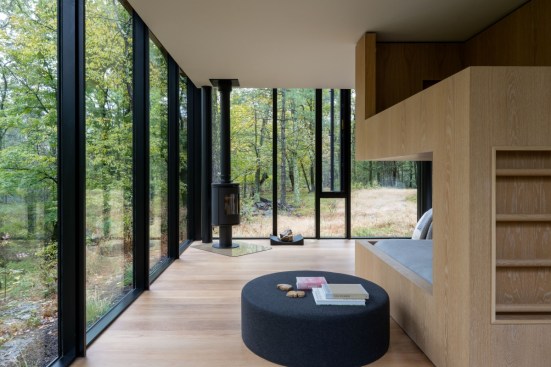
VIA43, McKeel’s home and studio in Olivebridge, N.Y., by Studio MM Architect.
The glass walls extend past the ceiling plane to a thin roof that looks as if it floats above the windows, accentuating its jewel box effect.
Although the 20-by-24-foot bunkhouse is compact, “it feels large and more expansive because the windows extend and you feel that continuity of space,” McKeel says. “You take in more of the sky when you’re standing there.”
At its center, four cozy bunks—each equipped with lights, outlets, and cubbies—is a single sculptural piece formed with white oak. The twin-sized bunks are oriented to different views, offering privacy from one another.
“It’s a different feeling in here versus our main house,” McKeel says. “Here, you’re in the treetops at the edge of a cliff. You can look below and see the treetops.”
Whether looking out from the guesthouse, the main house, courtyards, or the rooftop deck above the studio, each orientation has a distinctive view, with a sense of togetherness threaded through glazing. “You can be on a deck talking to someone on another deck,” McKeel says. “If you look at it on paper, there are all these different places. But it’s really just one big space—and everybody is connected.”