
Project Description
This project was a finalist in the Chicago Architecture Biennial Lakefront Kiosk Competition.
FROM THE ARCHITECTS:
Project Abstract
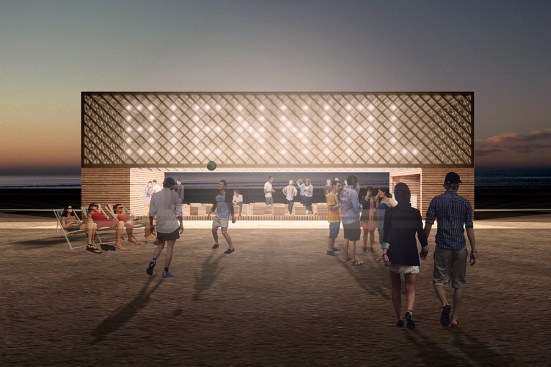
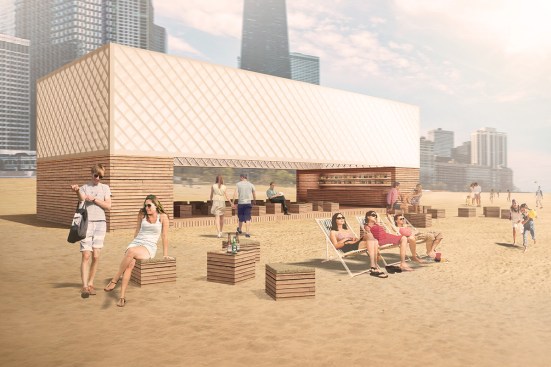
The Lakefront Kiosk is a unique
architecture made of simple structural elements. A translucent free-span roof
rests on two structures, which house the kiosk and a storage space. The entire
construction is built of ordinary squared timber battens, which are recycled
through the process of building.
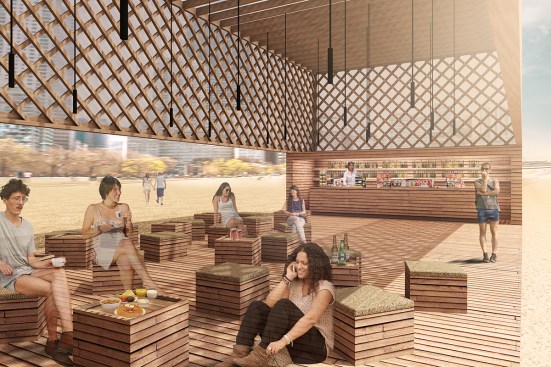
The main space of the kiosk is the
roofed terrace, which allows for various types of use. The kiosk can transform
into a bar, a cinema, or a space for lectures and discussions. When the kiosk
is closed, the terrace provides a sheltered space open to the public.
The Lakefront Kiosk is a low-cost
building that shows the constructive potential and the beauty of timber
constructions. Beyond that, it is an example of material-saving and
ecologically worthwhile building methods.
Written Description
The Lakefront Kiosk is a unique
architecture made of the most simple structural elements. A translucent free-span
roof rests on two massive structures, which house the kiosk and a storage
space. The entire construction is built of ordinary squared timber battens,
with offcuts being recycled in the building process.
a. Terrace
The main space of the kiosk is the
roofed terrace, which allows for various types of use. The kiosk can transform
into a bar, a cinema, or a space for lectures and discussions. When the kiosk
is closed, the terrace provides a sheltered space open to the public.
b. Roof
The cubic roof is constructed of wood
lattice trusses spanned by rafters beneath. The roof is covered with a truck
tarpaulin, made of translucent fabric-reinforced PVC (1.7 pounds/square meter) that
is tied to the trusses.
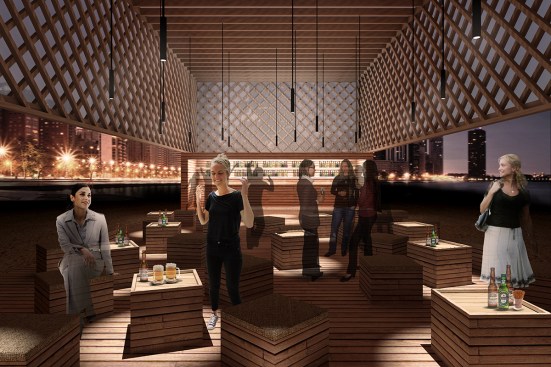
The roof gives various opportunities for
lighting. Illuminated with spotlights from the inside, the roof appears as a
big color-changing light cube. Pendant lights give the opportunity to create
intimate atmospheres on the inside. The truss grid and membrane can also be
used for illumination by placing small spotlights in the inner truss fields and
operating them as a low-resolution display for announcements toward the city in
5-bit by 3-bit type.
c. Kiosk and Storage Room
The walls of the kiosk and storage room
are constructed of timber battens of various lengths, which are nailed up to a
wall. Offcuts of the lattice truss production as well as any recycled timber of
similar dimensions are used to build the walls. The wall surfaces are rough and
of changing wood tones. The terrace cladding and all furniture are built in an analogous
manner. Wooden sliding panels close the kiosk counter when not in use.
Synthetic curtains can enclose the terrace along the lattice trusses for
weather protection. When not used, the curtains are kept in the storage room.
Stackable seats and tables are also stored in the storage room when not used on
the terrace.
d. Sustainability
The Lakefront Kiosk is a low-cost
building that shows the constructive potential and the beauty of timber
constructions. Beyond that, the kiosk is an example of material-saving and
ecologically worthwhile building methods. The Lakefront Kiosk stores at least
70,000 pounds of carbon dioxide. All construction parts can be recycled
residue-free.
e. Build-Up
The build-up of the Lakefront Kiosk is
done in a single day. All construction elements (lattice trusses, kiosk box,
storage box, terrace elements) are prefabricated and delivered to the site on
two low-loading trucks. Assembly is completed with the support of a mobile
crane.
f. Donation
Because it showcases the capability of
timber constructions, the design of the Lakefront Kiosk should compel the wood
industry to support the project by donating materials.