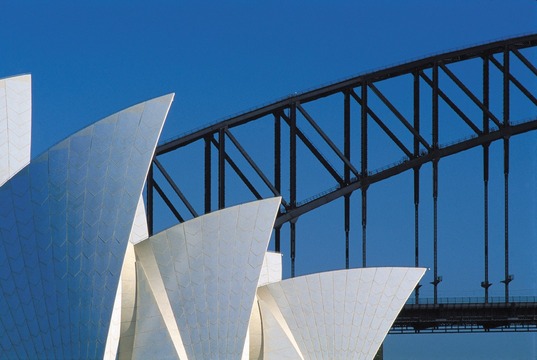
The sculptural roof of the Sydney Opera House, a UNESCO World Heritage site since 2007, requires a tap-test inspection every five years to make sure the glazed ceramic tiles cladding the precast concrete structure retain their durability. Because the test is both tedious and dangerous, researchers at the University of Sydney and global engineering and design group Arup have been looking into alternative methodssolutions for conducting this inspection, such as deploying the use of robotic technology. With the help of the Getty Foundation’s Keeping it Modern initiative—which awards grants to help preserve Modern architecture projects worldwide—the research team has recently been able to attach sensors and a microphone to the hammers used to tap the tiles so that more in-depth information can be gathered about the state of the roof more effectively. [The Art Newspaper]
ICYMI: Colder winters and 3D manufacturing technology could mean a new market for ice architecture. [ARCHITECT]
Wattway, a solar-powered road, was installed on 0.6 miles of a road in a Normandy village, in France. The resin-covered panels can withstand high traffic and are being tested to see whether they can produce energy to supply the 3,400 residents of Tourouvre-au-Perche. [The Guardian]
The cellular respiration from bacteria powers these bio-batteries on a slim sheet of paper. [Tech Crunch]
As our climate continues to change, we must consider how this will geographically alter the entire world. This Popular Science infographic shows readers where it will be safe to settle down in 2100 A.D. (Hint: Head north). [Popular Science]
Fast Company staff writer Jared Newman discusses the ways in which smart home technology will—and won’t—evolve in 2017. [Fast Company]
Stanford University collaborated with the U.S. Department of Energy’s SLAC National Accelerator Laboratory in order to create electrical wires three-atoms-thick out of diamonds. The thin wires could potentially be used in a wide range of applications “including fabrics that generate electricity, optoelectronic devices that employ both electricity and light, and superconducting materials that conduct electricity without any loss,” according to the journal Nature Materials. [Phys.org]
A polymer found in plant cell walls called xylan could be the key to creating glue for tall timber buildings. [Global Construction Review]