
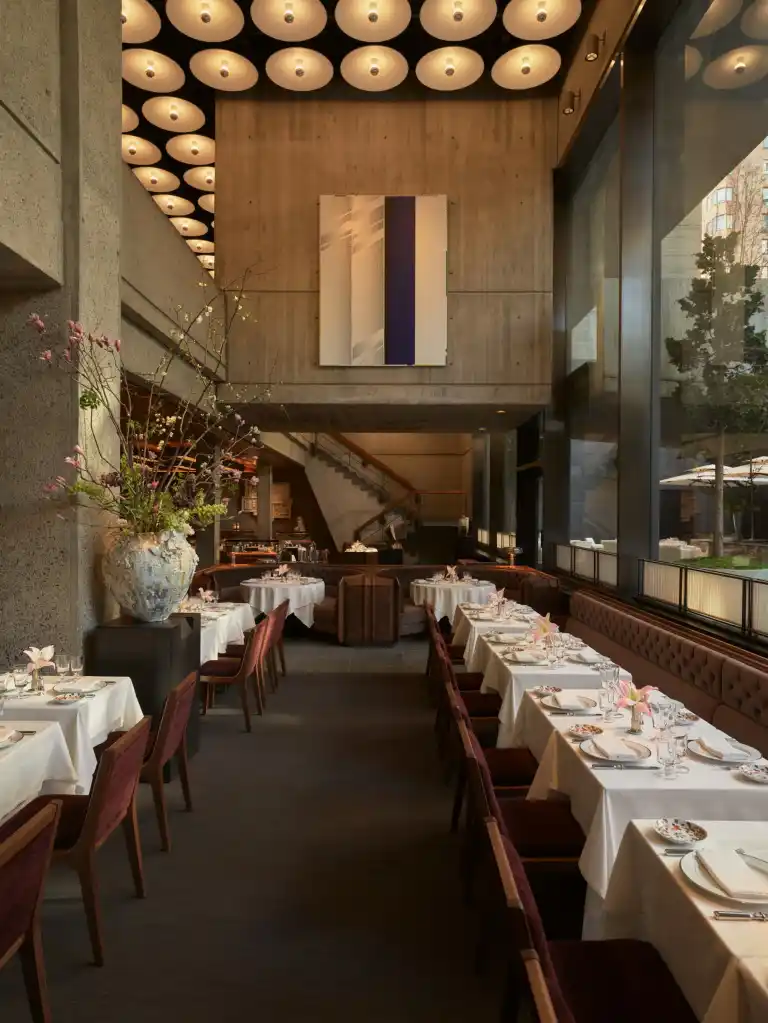
At Breuer Building, architecture has always been about control—of light, of movement, of attention. Designed in 1966 by Marcel Breuer as the home of the Whitney Museum in New York City, the building is a study in restraint. It is a fortress of granite and concrete that turns inward. It asks visitors to look carefully, deliberately, and above all, seriously.
Now, it serves dinner.
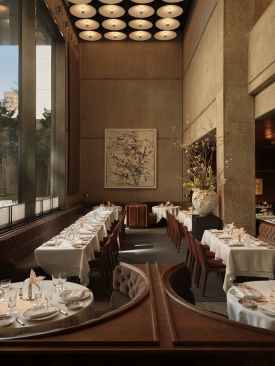
The opening of Marcel introduces a new restaurant by Sotheby’s in collaboration with Roman and Williams.
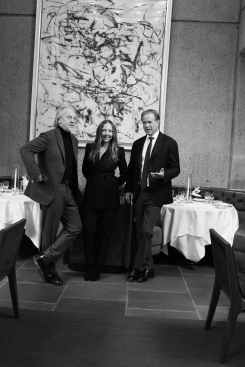
Stephen and Robin Alesch of Roman and Willams, and Charles F Stewart, CEO of Sotheby's. Photo by Sean THomas.
The Breuer enters a new phase. This phase reflects not just a change in program. It signifies a deeper shift in how architecture, culture, and commerce intersect.
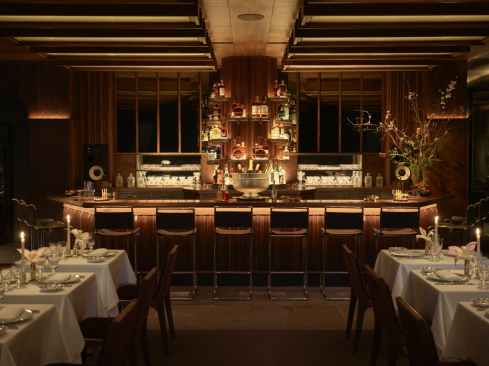
The premise is straightforward, if slightly disorienting. Diners descend into the lower level of the building, where walnut-paneled walls, mohair banquettes, and low, amber light create a world that feels deliberately removed from the austerity above. Around them, a rotating selection of works by artists such as Andy Warhol, Joan Mitchell, and Alexander Calder hangs within reach—part exhibition, part atmosphere, part inventory.
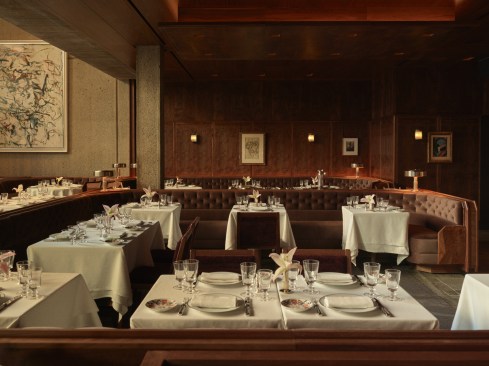
In vitrines, jewelry by houses like Boucheron and David Webb glints alongside natural curiosities—a Tyrannosaurus rex tooth, fragments of meteorite—objects that blur the line between artifact and commodity.
The message is subtle but unmistakable: this is not simply a restaurant inside a cultural institution. It is a restaurant inside a marketplace.
Architecture as Atmosphere
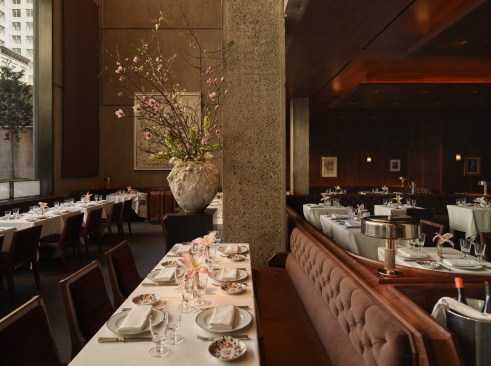
Roman and Williams approach the project as an exercise in what they describe as “choreographed tension”—a phrase that captures both the ambition and the challenge of inserting a lush, materially saturated interior into one of New York’s most disciplined buildings.
Their response is not to soften Breuer’s architecture, but to work against it. Where the original building is heavy, the restaurant glows. Where it is austere, Marcel is tactile—bronze and glass lighting, mirrored surfaces, deep upholstery, and an almost cinematic layering of textures.
The descent into the space is key. It creates a threshold—a transition from the controlled neutrality of the galleries to something more immersive, more sensory, and more ambiguous. The dining room opens gradually, revealing a view onto the sculpture garden, now reimagined as an outdoor extension of the restaurant, where trees, tables, and an outdoor bar animate what was once a more contemplative space.
This is architecture as staging: a sequence designed not just to house activity, but to frame it.
The End of the Museum Restaurant
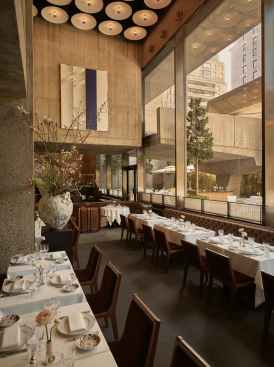
Marcel arrives at a moment when the role of the museum restaurant is quietly changing. Traditionally, such spaces have been ancillary—places to pause between exhibitions, to extend the visit without altering its terms.
Here, the terms are different.
By embedding the restaurant within Sotheby’s operational ecosystem, Marcel collapses the distance between viewing and buying. The art on the walls is not just curated; it is circulating. The objects in vitrines are not simply displayed; they are part of an active market.
Even the wine program, developed in partnership with Sotheby’s Wine, reinforces this logic—offering access to rare vintages that mirror the exclusivity of the objects on view.
The result is a space where cultural experience and commercial transaction are no longer clearly separated. They coexist, seamlessly.
Craft, Consumption, and Control
If this sounds like a critique, it is also an acknowledgment of reality. Sotheby’s is not a museum; it is a marketplace. What Marcel does is make that condition spatially explicit.
At the same time, the project leans heavily on craft to mediate that tension. Custom lighting from Roman and Williams Guild, handcrafted Japanese glassware, and meticulously detailed interiors signal a commitment to material quality that aligns with the values of both high-end dining and collectible design.
In the kitchen, chef Marie-Aude Rose reinforces this sensibility with a menu that draws on French culinary traditions while adapting them to a New York context—classic forms, subtly reinterpreted.

Photo by Suzanne Saroff.
Even the adjacent bakery, La Mercerie Patisserie, extends the narrative. Its viennoiserie and pastry offerings, packaged in carefully designed boxes, echo the language of luxury goods—portable, desirable, and unmistakably branded.
Everything here is considered. Everything is framed.
A New Type of Cultural Space
Marcel is not the first restaurant to occupy a landmark building, nor the first to pair art with dining. What makes it notable is how fully it integrates these elements into a single system.
This is not about adding a restaurant to a cultural institution. It is about rethinking the institution itself—as a place where exhibition, hospitality, and commerce are intertwined.
For architects and designers, the implications are significant. The project challenges long-standing assumptions about the separation of program, the neutrality of exhibition space, and the role of architecture as a mediator between culture and market.
At the Breuer, those boundaries are no longer stable.
The building remains what it has always been: a powerful piece of architecture, resistant to easy interpretation. But within it, Marcel introduces a new layer—one that reflects a broader shift in the cultural landscape, where the distinctions between looking, buying, and experiencing are increasingly blurred.
In that sense, the restaurant is less an addition than a signal.
A sign that architecture is no longer just the frame for culture.
It is part of the transaction.


