
Project Description
Text by Deane Madsen
The Len Lye Centre, which opened in July in New Plymouth, is New Zealand’s first museum dedicated to the work of a single artist. Len Lye, who was born in Christchurch, New Zealand, in 1901 as Leonard Charles Huia Lye, was perhaps best known for kinetic artworks rendered in stainless steel, which Lye referred to as “tangible motion sculptures,” in part to differentiate them from the “mobiles” of his contemporary, Alexander Calder.
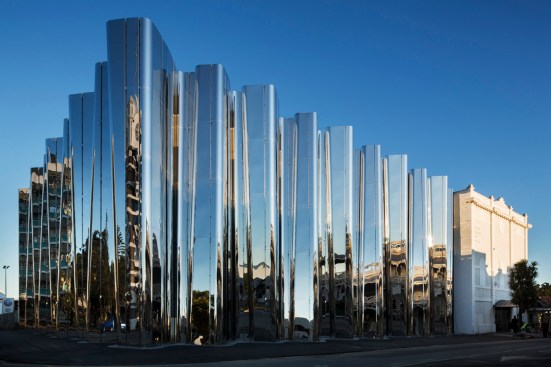
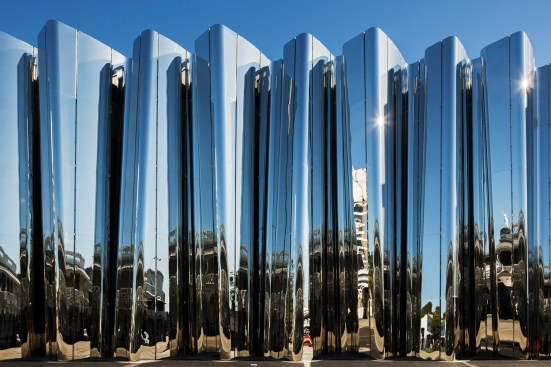
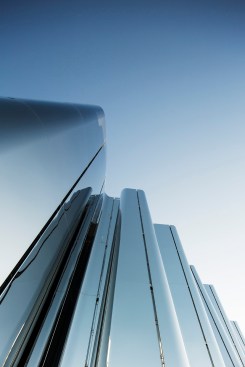
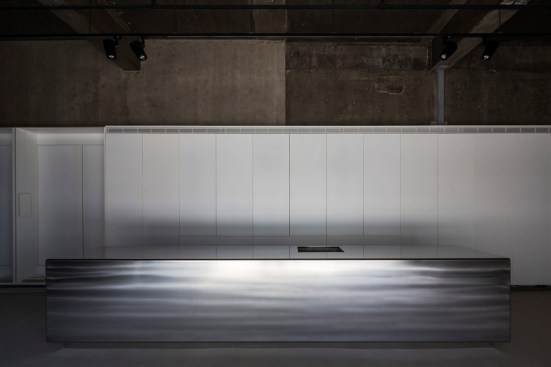
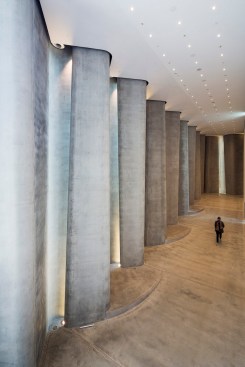
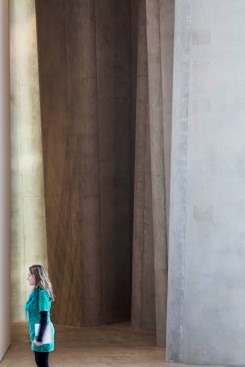
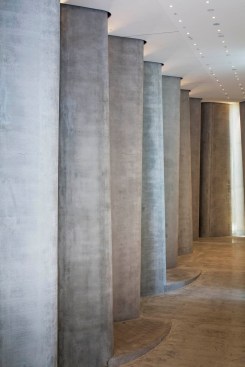
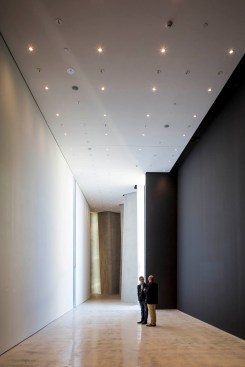
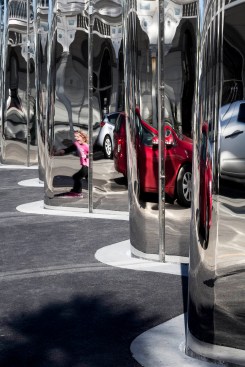
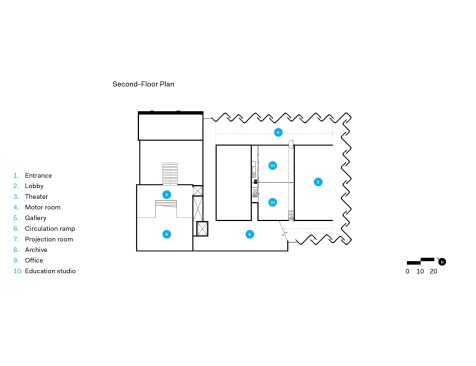
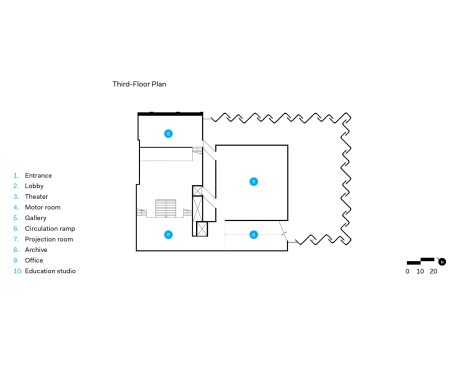
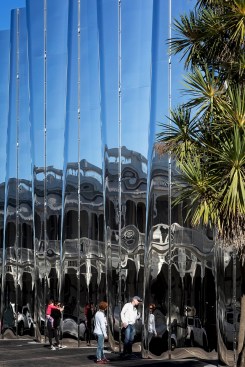
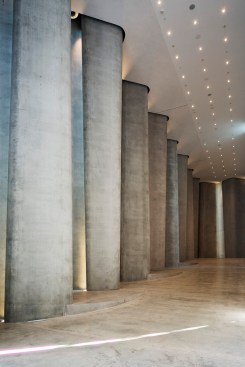
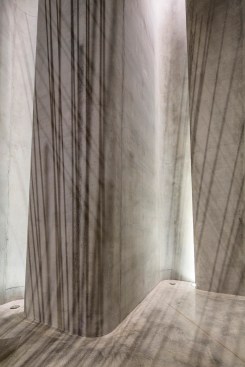
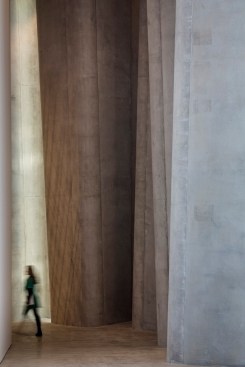
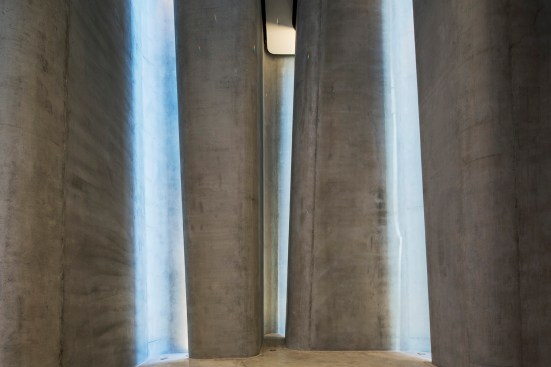
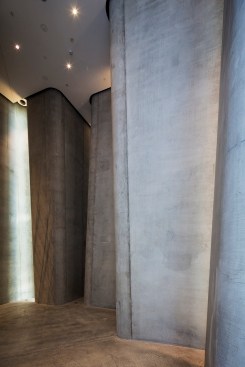
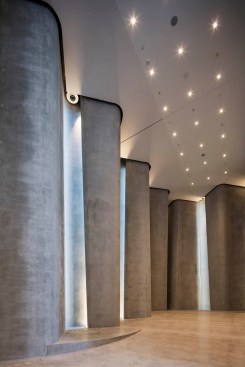
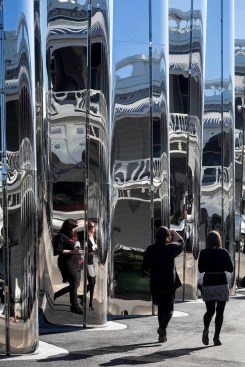
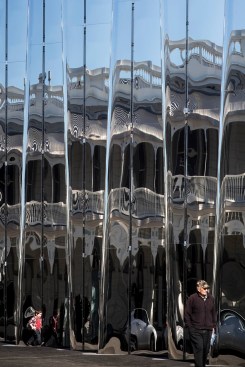
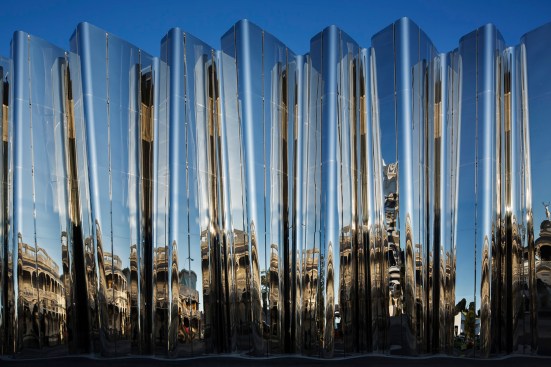
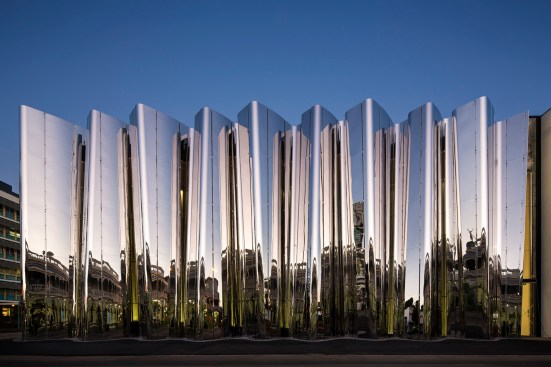
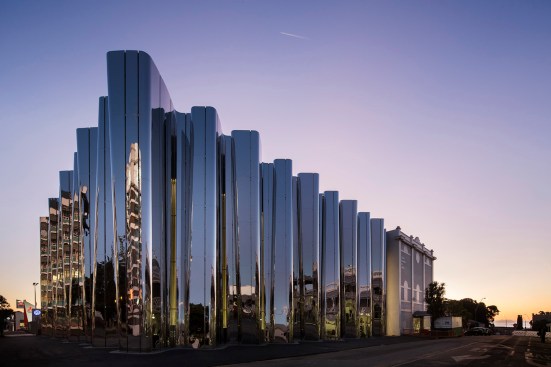
Parnell, New Zealand–based Patterson Associates designed the museum. The rippling stainless steel panels on the 14-meter-tall (46-foot-tall) exterior—540 panels in all—riff on Lye’s work by reflecting the lights and movement of the surrounding city. Prior to Lye’s death in 1980, he bequeathed his estate to the Len Lye Foundation, which he established to share his work with the people of New Zealand. The architects envisioned the museum as a hybrid of classical temple and Māori wharenui, or meeting house, with a gently ascending ramp serving as pronaos to its inner sanctum galleries. The structural concrete perimeter can be seen as either a dense colonnade or a frequently interrupted wall; shuttered glazing in the gaps lets in sunlight and emits electric light at night. Nine-meter (29½-foot) ceilings in the main gallery allow ample room for Lye’s large-scale Fountain series, and the wavy, precast concrete structure comes alive with overhead light bouncing off the works held within.
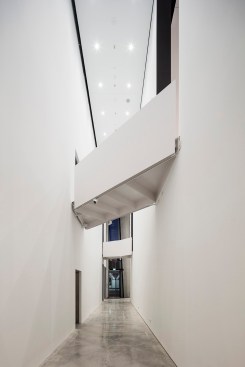
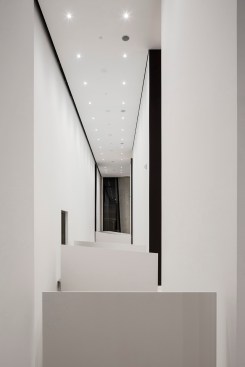
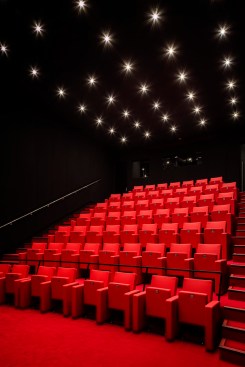
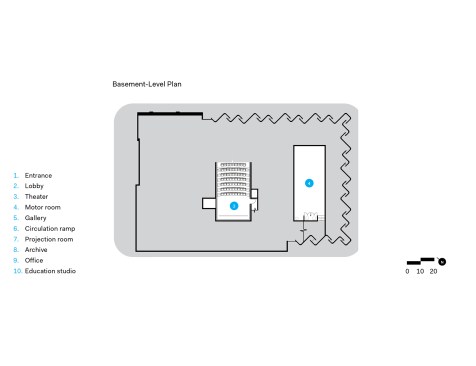
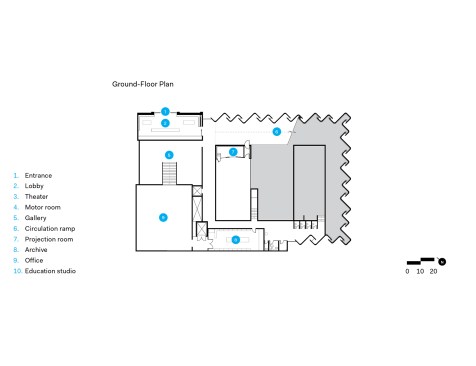
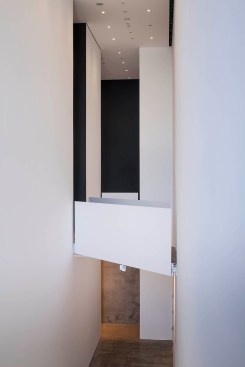
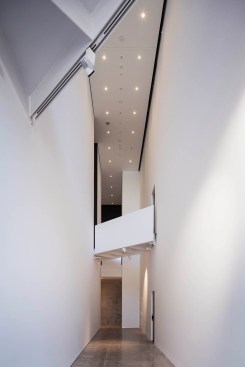
The Len Lye Centre adjoins at its northern edge the Govett-Brewster Art Gallery, itself a former theater renovated in the 1970s and converted into a contemporary museum for Pacific Rim artists. Lye exhibited his kinetic sculptures at the Govett-Brewster in 1977, making the center’s connection to the gallery more than just physical. A hallway just inside the lobby links the renovated Govett-Brewster building, which will continue to exhibit local artworks, with the new addition, and air bridges connect upper-level galleries while providing seismic separation. Patterson Associates was also responsible for bringing the Govett-Brewster up to current standards, which involved consulting with artist Billy Apple, who installed the handrails and staircases in 1979.
Visitors enter the Len Lye Center through the shared lobby, and the intertwined spaces and programming throughout the conjoined facilities reflect cooperation between the gallery and the Len Lye Foundation, which will be jointly administrated but independently curated.
Cost: NZD 11.5 million ($7.5 million)
FROM THE ARCHITECTS:
The Len Lye Centre is New Zealand’s only single artist museum and its design is deeply influenced by the life,
ideas, writings and work of Len Lye (5 July, 1901 – 15 May, 1980).
It was Lye himself who said in 1964 that “great architecture goes fifty-fifty with great art,” a maxim that has
informed the approach and form of the Patterson Associates-designed Antipodean Temple that houses his
work.
Lye was fascinated with temples and in conceiving the overall design it seemed aesthetically and historically
appropriate to draw inspiration from the “megarons,” or great halls, of the classical world, as well as
Polynesian forms and ideas. These also influenced Lye and he is, after all, the client.
To do this in a new way, we developed our thinking in a holistic or adaptive way, using what we call “systems
methodology.” This means that rather than using proportion or aesthetics, we use patterns in the ecology of
the project’s environments to drive the design elements.
For example, the shimmering, iridescent colonnade façade, manufactured locally using stainless steel –
Taranaki’s ‘local stone’ – links both Lye’s innovations in kinetics and light as well as the region’s industrial
innovation. By doing this we celebrate the fortunate gift of his works to Taranaki.
The colonnade creates a theatre curtain, but with three asymmetric ramped sides, leading to a type of
vestibule, known as “pronaos” in Ancient Greece. This is formed by the gallery holding the large Lye works.
Viewed from above, the colonnade’s top edges create a koru form, displaying the Museum’s Polynesian
influences as the meeting house, or wharenui, for Len Lye.
The procession of the colonnade morphs into a portico, announcing the main gallery as a type of megaron but
also functioning as a wharenui; the deities and ancestors referenced and represented by Lye’s inspirational
work.
Traditionally, the most sacred and private part of a temple, the “adyton,” is located at the point furthest from
the entrance. Here is housed the Len Lye archive, while the ‘treasury,’ known as the “opisthodomos,” looks
back to the people entering below.
The project respectfully links into the smaller existing Govett Brewster Art Gallery, which itself has been
retrofitted from the city’s decommissioned heritage cinema. The combined facility is undivided, with a circular
loop allowing visitors to appreciate the changing museum and gallery displays within one flexible and shared
structure.
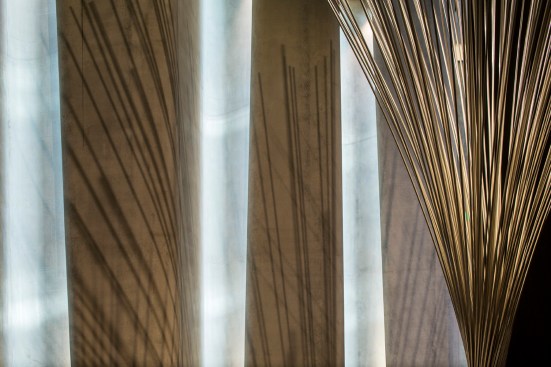
On the circular loop, light is drawn inside through the apertures in the colonnade, and these create moving
light patterns on the walkway, perhaps a form of passive kinetic architecture.
We hope the design challenges the dominance of pure modernism in contemporary thought. Classicism has
been unfashionable for many decades and the Len Lye Museum seeks to extend modernist language with
meaning. Creating space that is more lucid, triumphant and celebratory than Bauhaus traditions, but also more
cogent and flowing than axis-generated architecture.