For more than a century, Los Angeles has been defined by a simple urban equation: mobility equals automobiles. The city expanded outward rather than upward, its neighborhoods connected by freeways, boulevards, and an infrastructure built around private vehicles. Few major American cities have been shaped more profoundly by the car.
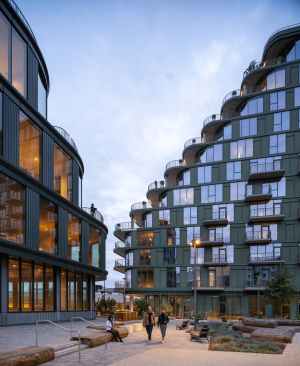
Now, a new mixed-use development in Culver City is attempting to challenge that legacy.
Called Habitat Culver City, the newly unveiled project by SHoP Architects, developed by Lendlease with Steinberg Hart serving as executive architect and RELM as landscape architect, proposes an alternative vision of urban life in Los Angeles—one organized around landscape, transit, public space, and walkability rather than parking and traffic.
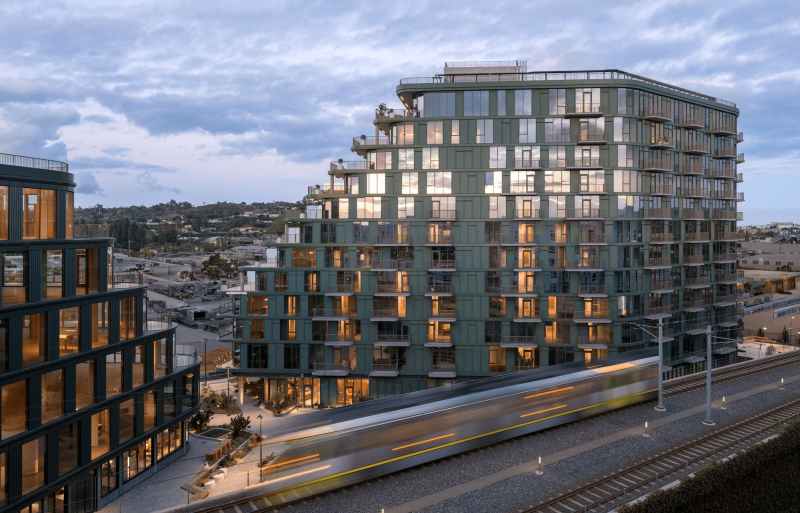
Located at a strategic intersection where the Expo Line Bikeway, Ballona Creek, and the elevated La Cienega/Jefferson light rail station converge, Habitat occupies a site that sits at the center of some of Southern California’s most significant investments in alternative mobility. Rather than treating these conditions as constraints, the design turns them into its defining architectural and urban framework.
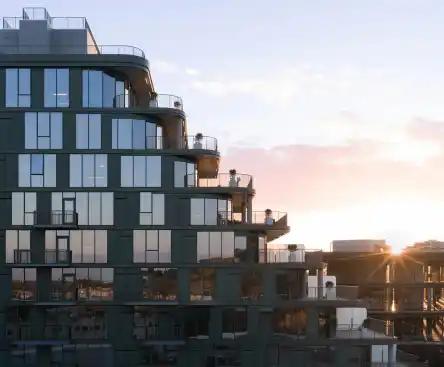
The 455,000-square-foot development consists of a 12-story residential tower containing 260 apartments and a six-story office building encompassing approximately 260,000 square feet of creative workspace. Together, the two buildings frame views toward the Hollywood Hills to the north and Baldwin Hills to the south.
But the project’s most distinctive feature may be what lies between them.
Designing Around Movement, Not Streets
Instead of following the rigid street grid that characterizes much of Los Angeles, SHoP organized the project around a series of informal pedestrian pathways—so-called “desire paths”—that cut diagonally across the site and connect directly to surrounding transit and bicycle infrastructure.
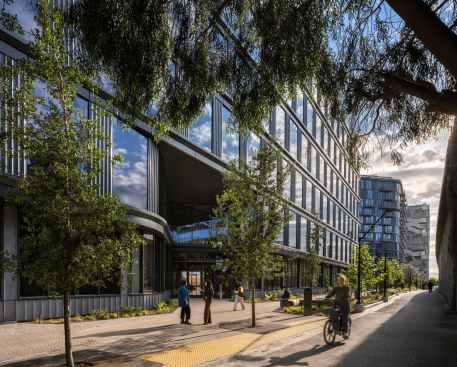
These pathways generate a network of plazas, landscaped corridors, and pocket parks that weave through the development, transforming what could have been a conventional mixed-use project into something closer to an urban campus.
At its center sits Cienega Square, a large public open space that serves as the project’s social and environmental heart. Here, the architecture intentionally steps down, creating what the design team describes as a valley-like landscape framed by two architectural hills.
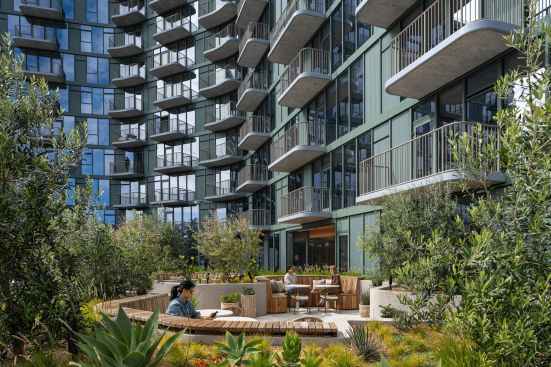
The gesture reflects a broader ambition: to create a place that feels less like an isolated development and more like an extension of Culver City’s public realm.
“The design of Habitat prioritizes what makes Los Angeles distinct: the landscape, the connection to nature, and the way life spills outdoors year-round. Rather than organizing the site around vehicles, we conceived an inviting campus that activates an entire city block—with Cienega Square at the heart of the project: a lush, landscaped area for community and connection.
The buildings respond directly to the light, climate, and views of their surroundings, with sloping forms that frame vistas north to the Hollywood Hills and south to the Baldwin Hills,” says Dana Getman, Principal at SHoP. “Habitat is a uniquely Los Angeles project, shaped by the history, culture, and character of the city we love, yet a design that is entirely its own.”
A Transit-Oriented Vision for Los Angeles
The timing is significant.
Los Angeles is undergoing one of the most ambitious transit expansions in North America. Billions of dollars have been invested in rail lines, bicycle infrastructure, and pedestrian improvements as the region prepares for both the 2028 Olympic Games and a future increasingly shaped by climate concerns and shifting transportation habits.
Habitat appears designed for this transition.
Ground-floor retail activates the development’s edges and creates a continuous flow of activity between the transit station, bikeway, and surrounding neighborhood. Rather than functioning as a self-contained enclave, the project seeks to absorb and amplify existing pedestrian movement.
For Steinberg Hart, the project represents a larger cultural shift occurring throughout the city.
“Life in Los Angeles has always been intrinsically tied to the car,” says Asheshh Saheba, Managing Partner at Steinberg Hart. “With Habitat, we wanted to turn this idea on its head and instead create a space where architecture can create new opportunities for connection and help develop a sense of community in a time of increasing isolation. Architecture doesn’t exist in a vacuum, and this project helps usher Los Angeles into a multi-faceted, more integrated future.”
Workspaces Designed for a New Urban Lifestyle
That ambition is reflected in the office building itself.
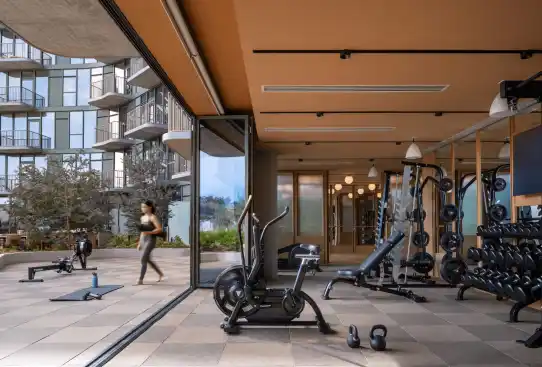
Large floorplates provide flexibility for contemporary workplaces, while outdoor terraces on every level give occupants direct access to fresh air and landscaped environments. The building also includes wellness-oriented amenities ranging from secure bicycle facilities and fitness spaces to hospitality-focused end-of-trip accommodations aimed at encouraging alternative commuting methods.
Drawing Inspiration From a Lost Landscape
Although the project embraces contemporary urbanism, its design is deeply rooted in local geography.
The development takes its name and material inspiration from the site’s historic identity as a ciénega, a wetland ecosystem once common throughout the Los Angeles basin before widespread urbanization transformed the landscape.
This ecological history informed both the architecture and the landscape design.
Muted gray-green tones reference native vegetation such as sage and pine. Horizontal forms, integrated planting systems, and extensive outdoor terraces work together to blur the distinction between building and landscape. Floor-to-ceiling glazing maximizes natural light while reinforcing visual connections between interior and exterior spaces.
The result is a development that seeks to feel less imposed upon the site than organically connected to it.
“Our hope was to create a found experience—something that feels both unexpected and entirely inevitable at the same time,” says David Christensen, Principal at RELM. “Habitat aims to cultivate that feeling through materiality and sequencing; choosing to not feel new or imposed, but like it had existed there all along.”
Sustainability as Urban Infrastructure
Environmental performance also plays a central role in the project’s ambitions.
Habitat is targeting LEED Gold certification for its residential component and LEED Platinum certification for its office building. The development incorporates low-carbon concrete, a fully electric building strategy, climate-resilient planting, and on-site stormwater treatment systems designed to reduce runoff and environmental impact.
Transportation infrastructure reinforces these sustainability goals. The project includes 66 electric vehicle charging spaces and 222 secured bicycle parking spaces, reflecting a deliberate effort to reduce reliance on conventional automobile use.
While sustainability has become standard language for most new developments, Habitat attempts to integrate environmental performance into a broader urban vision—one that links ecological responsibility with public space, mobility, and social connection.
Reimagining the Future of Los Angeles
For decades, architects have imagined alternative futures for Los Angeles. Many have proposed denser neighborhoods, expanded transit networks, and public spaces capable of counterbalancing the city’s automotive culture.
Few projects, however, have had the opportunity to test those ideas at such a strategically important location.
As transit-oriented development becomes increasingly central to Southern California’s growth strategy, Habitat offers a glimpse of what the next generation of Los Angeles projects might look like: less focused on cars, more focused on people; less isolated, more connected; and more willing to treat landscape not as decoration, but as infrastructure.
If Los Angeles was once defined by the freeway, Habitat suggests that its future may be shaped by something else entirely—the public realm.
Project Specs
- Name: Habitat
- Location: Los Angeles, California
- Size: 455,000 total rentable square footage
- 260,000 square feet of creative office space
- 2,900 square feet of retail space
- 198,000-square-foot multifamily building
- Residential Units: 260
- Office Square Footage: 253,000 SF
- Developer: Lendlease
- Completion Date: May 2026
Design Teams & Roles
- Design Architect: SHoP Architects
- Executive Architect: Steinberg Hart
- Landscape Architect: RELM
- Interior Design:
- Residential Interiors: Conceptualized by Kelly Wearstler and brought into being by Jules Wilson Design Studio
- Office Interiors: A + I
Continue the conversation at Elevate this December in Miami.
Join the industry’s top architects, developers, and brokers exploring what’s next in high-rise living at ARCHITECT’s Elevate Conference.