Entering 2008, nonresidential construction was among the bright spots in the U.S. economy. While consumers were fighting their way out of a mound of debt and coping with falling home prices in many markets, businesses were taking advantage of favorable financing costs, a healthy stock market, and emerging international opportunities, particularly given a favorably priced dollar. These conditions resulted in the need for additional nonresidential facilities.

What a difference a year makes. While a devastated housing market remains one of the few constants, we're entering 2009 trying to cope with an international credit market meltdown, a national economy that appears to be well into a recession, and a nonresidential construction market that has suddenly reversed direction.

In this environment, it's no surprise that architects are concerned about their future. According to ARCHITECT's 2008 Confidence Survey, 94 percent of respondents are worried about how the economic downturn will affect their firm. At most architecture firms, commercial projects (offices, retail, and hotels) began to soften earlier this year. Recently, we've seen signs that even the usually vigorous healthcare and education markets will not be spared from this downturn.

As this issue goes to press, the national unemployment rate has reached a 16-year high, and architects are not being spared. Sixty-five percent of respondents know of architects who have been laid off during this downturn. And while two-thirds feel reasonably certain that their job is secure, a quarter are nervous about their prospects, and 8 percent feel that their position is almost certain to be eliminated.

This pessimism springs from client actions in the face of a weaker economy. Almost half of respondents report that one or more projects at their firm have been canceled in recent months, while almost eight in 10 report at least one project put on hold. Of those projects that are continuing, budget cutbacks are common.

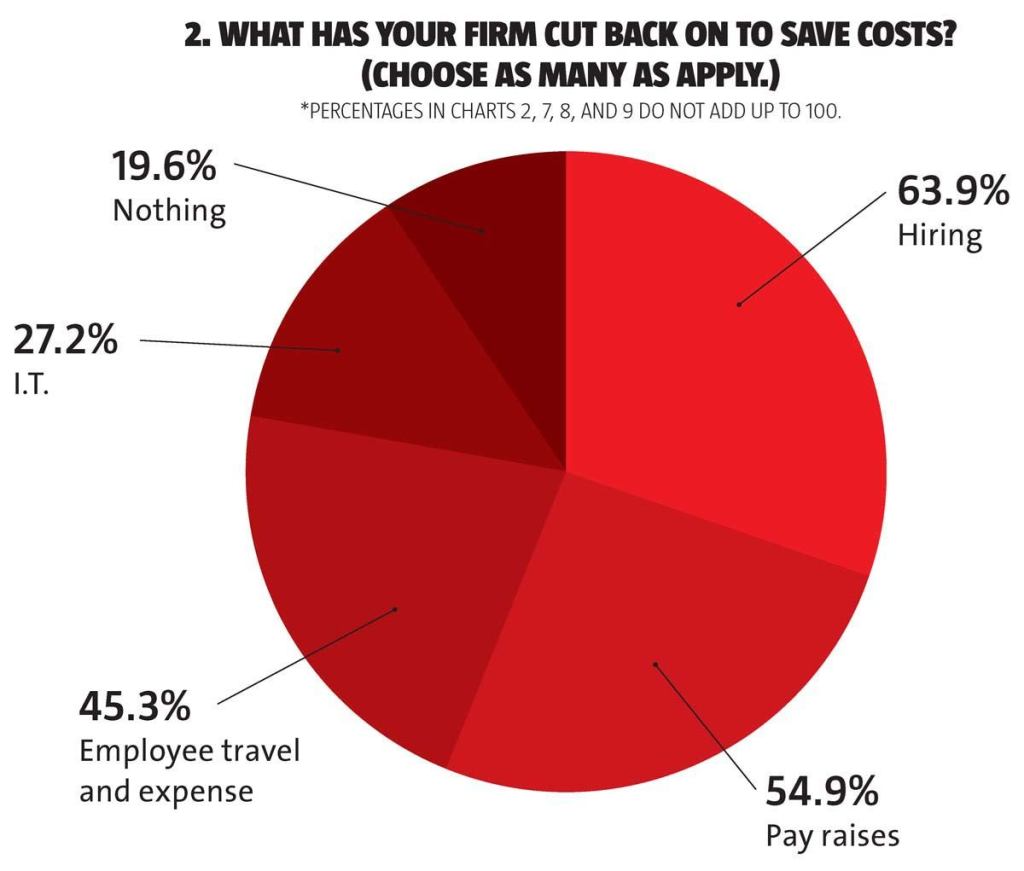
With increasingly frequent cutbacks by clients, architects report that their firms are also implementing cost-cutting measures. Almost two-thirds of respondents report hiring cutbacks at their firm, over half are seeing more modest staff pay increases, and others report restrictions in expenses like I.T. investments and travel.

Business cycles are unpredictable, but many respondents are preparing themselves for the worst. Just over 60 percent feel that we'll see better conditions sometime in 2010, while 30 percent feel that the economic and construction downturn will remain through 2011 or 2012. The remainder are bracing themselves for a downturn that will extend beyond 2012.

Kermit Baker is chief economist of the AIA and a senior research fellow at Harvard University's Joint Center for Housing Studies.

We Hear You: It's Rough Out There

Over three weeks in late October and early November, ARCHITECT administered a 12-question reader survey on economic confidence, administered via SurveyMonkey, a web survey tool, and announced in ARCHITECT's weekly e-newsletter. The total number of responses was 788, though not all respondents answered every question—some questions were skipped by a handful, others by dozens of respondents. (What gives? Aren't architects known for their attention to detail?)

The charts below show how you responded, while the captions offer our own, inexpert analysis of those results. There are a few reassuring surprises: A full 35 percent of you, for instance, reported that no one you know in the industry has been laid off in the past nine months. Then again, that was before the Architecture Billings Index dropped to an all-time low in late November. However bad you were feeling when you took the survey, the symptoms can't have improved much since. –Amanda Kolson Hurley

Anxiety: 94 percent of survey-takers say they're worried about the economy.
Cost-cutting: Not surprisingly, the firms where you work are cutting back on hiring, raises, and T&Es. However, close to 20 percent of you (the "fancy fifth," perhaps) report no belt-tightening at all. Among the 27 percent of firms that are trimming I.T. investment, some must face the vexing question of how to save money while also staying up to date with BIM and other emerging technologies.

2. Cost-cutting: Not surprisingly, the firms where you work are cutting back on hiring, raises, and T&Es. However, close to 20 percent of you (the “fancy fifth,” perhaps) report no belt tightening at all. Among the 27 percent of firms that are trimming I.T. investment, some must face the vexing question of how to save money while also staying up to date with BIM and other emerging technologies.

2. Cost-cutting: Not surprisingly, the firms where you work are cutting back on hiring, raises, and T&Es. However, close to 20 percent of you (the “fancy fifth,” perhaps) report no belt tightening at all. Among the 27 percent of firms that are trimming I.T. investment, some must face the vexing question of how to save money while also staying up to date with BIM and other emerging technologies.


Layoffs: Most of you know at least one architect who's been laid off recently. Given the waves of layoffs that took place nationwide in November, though, there are bound to be even more of you now.

3. Layoff s: Most of you know at least one architect who’s been laid off recently. Given the waves of layoff s that took place nationwide in November, though, there are bound to be even more of you now.

3. Layoff s: Most of you know at least one architect who’s been laid off recently. Given the waves of layoff s that took place nationwide in November, though, there are bound to be even more of you now.


Job security: Although most of you are worried about your jobs, only a shade over 8 percent report sharp anxiety. Again, the recent rounds of layoffs may have increased that percentage.

4. Job security: Although most of you are worried about your jobs, only a shade over 8 percent report sharp anxiety. Again, the recent rounds of layoff s may have increased that percentage.

4. Job security: Although most of you are worried about your jobs, only a shade over 8 percent report sharp anxiety. Again, the recent rounds of layoff s may have increased that percentage.


Backlogs: Only 10.6 percent of you say your firm has a backlog of work that will last a year or longer.

5. Backlogs: Only 10.6 percent of you say your fi rm has a backlog of work that will last a year or longer.

5. Backlogs: Only 10.6 percent of you say your fi rm has a backlog of work that will last a year or longer.


Business strategy: Firms' strategic responses appear to be evenly divided among sitting tight, reining in, and branching out.

6. Business strategy: Firms’ strategic responses appear to be evenly divided among sitting tight, reining in, and branching out.

6. Business strategy: Firms’ strategic responses appear to be evenly divided among sitting tight, reining in, and branching out.


Client behavior: An over-whelming 79 percent of your clients have put a project on hold due to financial jitters. The silver lining? Other clients, 41 percent of you report, are staying the course.

7. Client behavior: An overwhelming 79 percent of your clients have put a project on hold due to fi nancial jitters. The silver lining? Other clients, 41 percent of you report, are staying the course.

7. Client behavior: An overwhelming 79 percent of your clients have put a project on hold due to fi nancial jitters. The silver lining? Other clients, 41 percent of you report, are staying the course.


Strong sectors: It's kind of a no-brainer, but healthcare, education, and government work is seen as a safe harbor. "International" was reported as a strong category; will it still be in 2009?

8. Strong sectors: It’s kind of a no-brainer, but healthcare, education, and government work is seen as a safe harbor. “International” was reported as a strong category; will it still be in 2009?

8. Strong sectors: It’s kind of a no-brainer, but healthcare, education, and government work is seen as a safe harbor. “International” was reported as a strong category; will it still be in 2009?


Weak sectors: Predictably, residential, retail, and office are perceived as weak spots.

9. Weak sectors: Predictably, residential, retail, and office are perceived as weak spots.

9. Weak sectors: Predictably, residential, retail, and office are perceived as weak spots.


Length of downturn: At the time of the survey, just shy of 9 percent of you saw this crisis as on par with the Great Depression. That number may have now risen, along with the jobless rate.

10. Length of downturn: At the time of the survey, just shy of 9 percent of you saw this crisis as on par with the Great Depression. That number may have now risen, along with the jobless rate.

10. Length of downturn: At the time of the survey, just shy of 9 percent of you saw this crisis as on par with the Great Depression. That number may have now risen, along with the jobless rate.


Age: Most survey-takers were over 40, and half were over 50, so it's probably not a stretch to conclude that many are firm leaders with inside knowledge of firm strategy and finances.

11. Age: Most survey-takers were over 40, and half were over 50, so it’s probably not a stretch to conclude that many are firm leaders with inside knowledge of fi rm strategy and finances.

11. Age: Most survey-takers were over 40, and half were over 50, so it’s probably not a stretch to conclude that many are firm leaders with inside knowledge of fi rm strategy and finances.


Firm size: Smaller firms predominate. Are they feeling the heat more than larger firms, or are they nimbler, and therefore better able to adapt to the turbulent economy?

12. Firm size: Smaller firms predominate. Are they feeling the heat more than larger firms, or are they nimbler, and therefore better able to adapt to the turbulent economy?

12. Firm size: Smaller firms predominate. Are they feeling the heat more than larger firms, or are they nimbler, and therefore better able to adapt to the turbulent economy?