Launch Slideshow

The Next Starbucks

As the global coffee chain mulls big changes, five teams of architects present their ideas for a 21st century "third place."

The Next Starbucks

As the global coffee chain mulls big changes, five teams of architects present their ideas for a 21st century "third place."

  • http://www.architectmagazine.com/Images/tmp4400%2Etmp_tcm20-141010.jpg

    600

    designLAB Boston Sam Batchelor, Emily Greene, Bob Miklos, Scott Slarsky, Ben Youtz

  • http://www.architectmagazine.com/Images/tmp4405%2Etmp_tcm20-141045.jpg

    600

    AUTObucks

  • http://www.architectmagazine.com/Images/tmp4406%2Etmp_tcm20-141052.jpg

    600

    BARbucks

  • http://www.architectmagazine.com/Images/tmp4407%2Etmp_tcm20-141059.jpg

    600

    Pentagram Architects New York James Biber, Michael Zweck-Bronner, Dan Maxfield, James Bowman, Suzanne Holt

  • http://www.architectmagazine.com/Images/tmp4408%2Etmp_tcm20-141066.jpg

    600

    Pentagram Architects New York James Biber, Michael Zweck-Bronner, Dan Maxfield, James Bowman, Suzanne Holt

  • http://www.architectmagazine.com/Images/tmp4409%2Etmp_tcm20-141073.jpg

    600

    William E. Massie/Cranbrook Academy of Art • Bloomfield Hills, Mich. • William E. Massie, Scott Abukoff, Lawrence Ha

  • http://www.architectmagazine.com/Images/tmp440A%2Etmp_tcm20-141080.jpg

    600

    William E. Massie/Cranbrook Academy of Art • Bloomfield Hills, Mich. • William E. Massie, Scott Abukoff, Lawrence Ha

  • http://www.architectmagazine.com/Images/tmp440B%2Etmp_tcm20-141087.jpg

    600

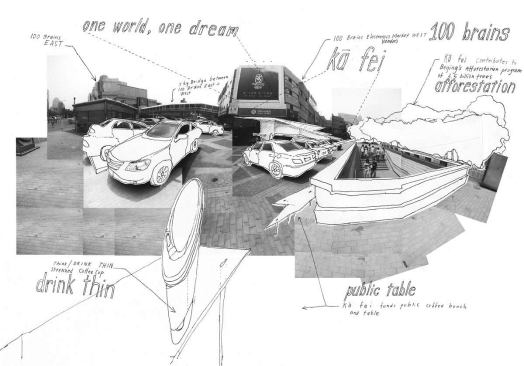
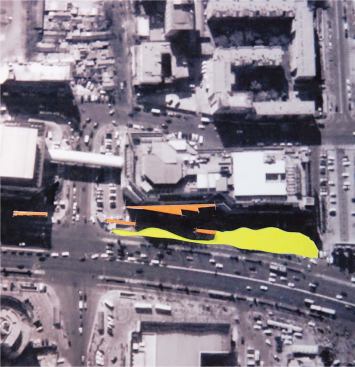
    Studio Works Los Angeles & Beijing Robert Mangurian, Mary-Ann Ray Site: Beijing's Bai Nao Hui ("100 Brains") computer market

  • http://www.architectmagazine.com/Images/tmp440C%2Etmp_tcm20-141094.jpg

    600

  • http://www.architectmagazine.com/Images/tmp4401%2Etmp_tcm20-141017.jpg

    600

  • http://www.architectmagazine.com/Images/tmp4402%2Etmp_tcm20-141024.jpg

    600

  • http://www.architectmagazine.com/Images/tmp4403%2Etmp_tcm20-141031.jpg

    600

    STUDIOS architecture New York Greg Keffer, Angela Vizcarra

  • http://www.architectmagazine.com/Images/tmp4404%2Etmp_tcm20-141038.jpg

    600

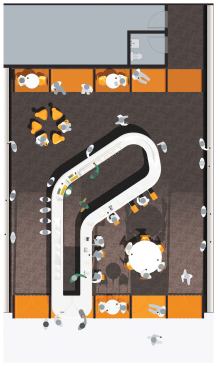
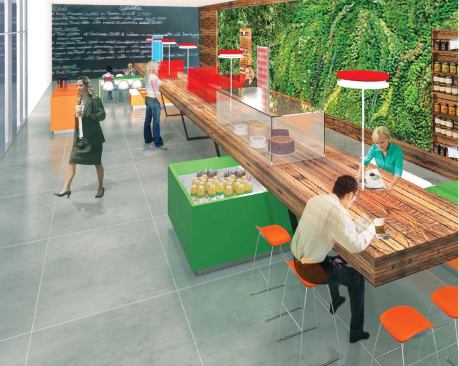
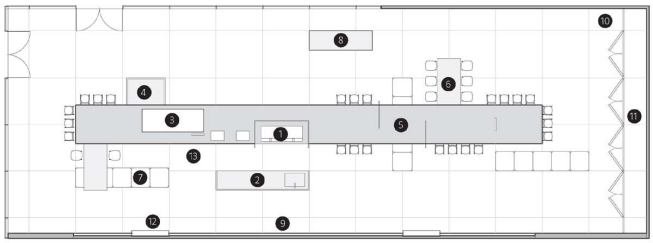
    Floor Plan 1. Barista 2. Back work counter 3. Pastry/food case 4. Drinks cooler 5. Common table 6. Side table 7. Bench 8. Coffee prep area 9. Vegetated wall 10. Community chalkboard 11. Storage 12. Retail display 13. Digital menu board

After two decades of breakneck growth, the world's largest coffee shop, Starbucks, stumbled in 2007. Company shares fell by 42 percent, and Howard Schultz, the former CEO, lamented that Starbucks had overextended itself and the stores “no longer have the soul of the past.”

With Schultz now back at the helm, Starbucks is rethinking its entire strategy. One proposed change among many: a new design for its 15,000 stores, set to roll out in 2009.

We asked five teams of architects from around the country to share their visions of the 21st century coffee shop. Starbucks has in-house designers, of course, but faced with a task of this magnitude, who wouldn't want some extra help?

COFFEE DUALITY: ART VS. FUEL

designLAB - Boston - Sam Batchelor, Emily Greene, Bob Miklos, Scott Slarsky, Ben Youtz

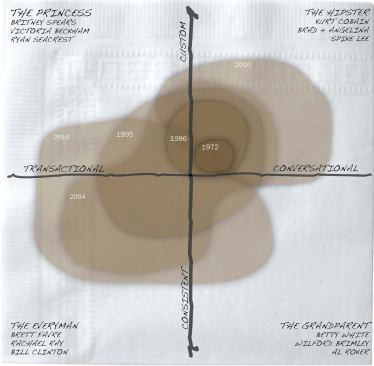
Statement: The space of the American café emerges from the horizonless recesses of the Woolworth lunch counter, where gallons of pale brown water were slung from bulbous Pyrex urns into the proverbial “bottomless cup o' joe.” Not until the mid-1970s did the American notion of coffee begin to condense around the space of the European café—that place of communal politesse so far removed from the lunch counter. At the lunch counter, we face the wall in single file, removed from social discourse and absorbed in solitary self-reflection. In the café, we find ourselves at the table, in the round, immersed in the well-oiled social discourse that caffeine fosters.

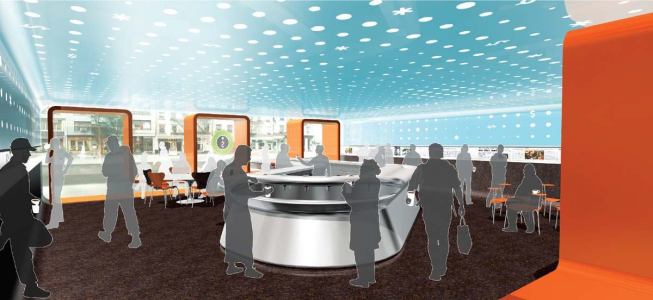
Today's American coffeehouse chain finds itself stretched (see napkin timeline, above) as it tries to act as both counter and café. DesignLAB's exploration seeks to exploit this distinction by creating complementary brands and associated store models offering two distinct kinds of urban space.

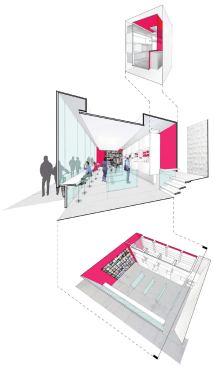
BARbucks is a place for connoisseurship, conversation, and community. Expert baristas are performance artists and stand eye to eye with customers across a clear, uncluttered bar surface. There is no queue, ordering is catch-as-catch-can, and the majority of the beverages are consumed on premises.

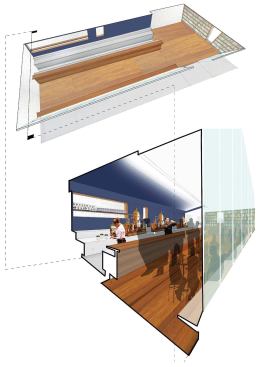
AUTObucks is about efficiency, quality, and consistency. High-speed baristas, called “slingers,” stand in brew-station modules with everything they need at arm's reach and are elevated to be able to survey the bustling place with ease. Customers come in, pick a brew station, line up, input their order, and pay at a digital terminal. By the time they reach the front of the line, their orders are ready to go.

BARbucks and AUTObucks represent a dialogue about the duality of coffee: BARbucks speaks to the old-world notion of coffee as art, while AUTObucks speaks to the new-world notion of coffee as fuel.

THE RETAIL ELVIS, REBORN

Pentagram Architects - New York - James Biber, Michael Zweck-Bronner, Dan Maxfield, James Bowman, Suzanne Holt

Statement: Starbucks is the Elvis of coffee: a remarkable original with a dedicated following, eventually bloated by success and sycophancy. Starbucks will have to evolve to remain the leader, and changing the “physical plant” should be a priority.

Our new chain has a new name: *$. *$ is based on differing paces and differing social relationships to the product and the place. *$ creates two sets of gradated experiences: fast to slow, social to private. It welcomes those of us who want our fix immediately and to go, as well as those of us who want to savor the coffee and sit for a bit (or all day) to write the great American novel—or just do a bit of e-mailing.

The fake-casual current stores are a homey (or homely) attempt to induce chattiness and engender a homemade, local feel. The new stores are quite the opposite: simple, fast, efficient, universal. No more cups and mugs for sale, no more music CDs (which should be a separate business), no more coffee machines and bagged beans, no more decorative bric-a-brac. Just coffee, food, service, newspapers, and the aroma of coffee.

PUSH-AND-PULL BAR

William E. Massie/Cranbrook Academy of Art - Bloomfield Hills, Mich. - William E. Massie, Scott Abukoff, Lawrence Ha

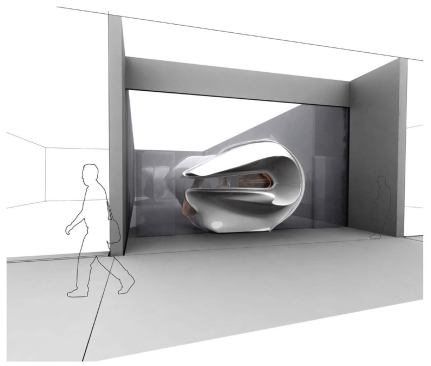
Statement: The program considers a typical strip-mall, infill site. The reimaging of the corporate café chain envisions an automated, barista bar–centered retail space. An enclosed bar expedites beverages and condiments between exterior and interior service windows, filtering the “to-go” crowd from the “lounge” crowd. Customers are directed around the barista bar in a fluid process while minimizing congestion.

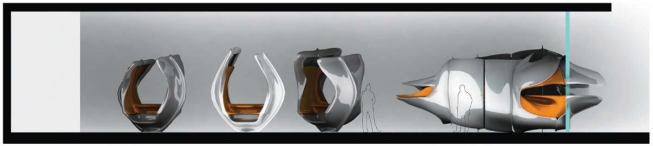
Push and pull: The strip-mall condition offers an opportunity to reconsider street café culture. The bar punctures the exterior glass curtain wall, revealing a street-accessible service window and diverting traffic into the retail space. The sidewalk is pulled in to create a courtyard café and lounge area. The lounge houses a cluster of autonomous seating units, providing an added level of privacy and intimacy.

This proposal responds to a service culture of product refinement, automation, and delivery as a dialogue with emerging technologies and trends.

Studio Works - Los Angeles & Beijing - Robert Mangurian, Mary-Ann Ray

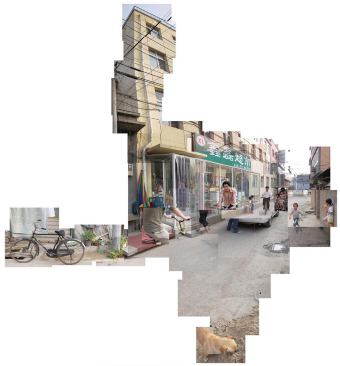
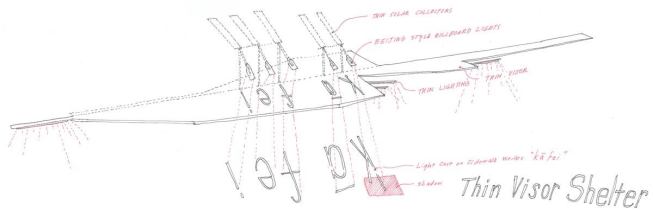
Statement: What if we take the membrane that defines both the building object and the dominant surfaces of the city and sneak into it the place for coffee? Thus, this wall/elevation will expand slightly and thicken into the space of the building and perhaps into the space of the sidewalk. In this way, the coffee “bar” will allow an easy on-the-way stop to acquire the necessary caffeine fix. But perhaps more importantly, by occupying the space between, a minor breakthrough might occur between the rigid separation between OUT and IN.

Drink/Think THIN will take the space of the typical coffee establishment and stretch it THIN. Where possible, the coffee bar itself will be a surface touching the sidewalk space and will move along with the flow of the sidewalk. The ordering can be stretched out along the longer bar, and waiting will occur in the space of the public sidewalk (extended in). Often it will be necessary to carve some space into the building wall to allow for jostling––really an extension of the space of the sidewalk. How Drink/Think THIN negotiates the back counter with the coffee machines, etc., will depend on how open the building is to this intrusion. Ideally, being in THIN space will be a new sensation of being both OUT and IN. Being both in the CITY and in the BUILDING—somehow merging public space and private space.

Drink/Think THIN proposes the THIN counter, containing all the goodies associated with the coffee fix and closing the gap between the patron and the purveyor, perhaps with the inclusion of the chatter of the street. The THIN counter is seen as a bent glass wall, and sometimes this will be cleverly seamless with the building wall.

The back wall, with the now-ubiquitous espresso machines, will be straightforward and perhaps conceptually a kind of bump within the inside of the building: the floor bent up, over, and down again. Ideally, the back wall will be a glass wall, possibly with lengths of mirror, so those in need of caffeine can primp and preen, or people-watch behind them, while waiting. The mirror will also thicken the perceived space, akin to making low-fat milk taste like half-and-half.

Drink/Think THIN will then take on the issue of shelter by developing a THIN visor extending the full length of the coffee bar and out over the sidewalk.

THE MODULAR COMMUNITY KITCHEN

STUDIOS architecture - New York - Greg Keffer, Angela Vizcarra

Statement: People by nature are social creatures. However, in the age of MySpace, Facebook, and other social networks, face-to-face human interaction is sometimes secondary in our daily lives. As national coffee chains struggle with brand identity and rethink their retail experience and environments, a simple cup of coffee could be an opportunity for people to connect in real time with neighbors and colleagues—to redefine community or possibly return to the social networks that were once found in America's coffee shops.

The workplace has been a major focus of STUDIOS' work over the last 25 years. Recent projects for both IAC and Bloomberg were experiments in engaging individuals who work together and yet may rarely associate with each other. Creating moments for unexpected interaction allows ideas to be shared and bonds to be created.

Merging the concept of the flexible, shared workspace with that of communal dining creates a new “third place,” a community kitchen. Anchored by a 60-foot-long wooden harvest table, a kit of parts serving different functions can be freely arranged wherever the user sees fit. The configuration of the pieces as well as the length of the table can be customized, depending on the conditions of the store. Diverse spaces are created along the table's length; some are highly interactive while others, such as the side tables, provide more privacy.

This versatile modular system can also adapt to special functions that may happen inside the store. Its components easily detach and roll around in order to accommodate poetry readings or other large gatherings.