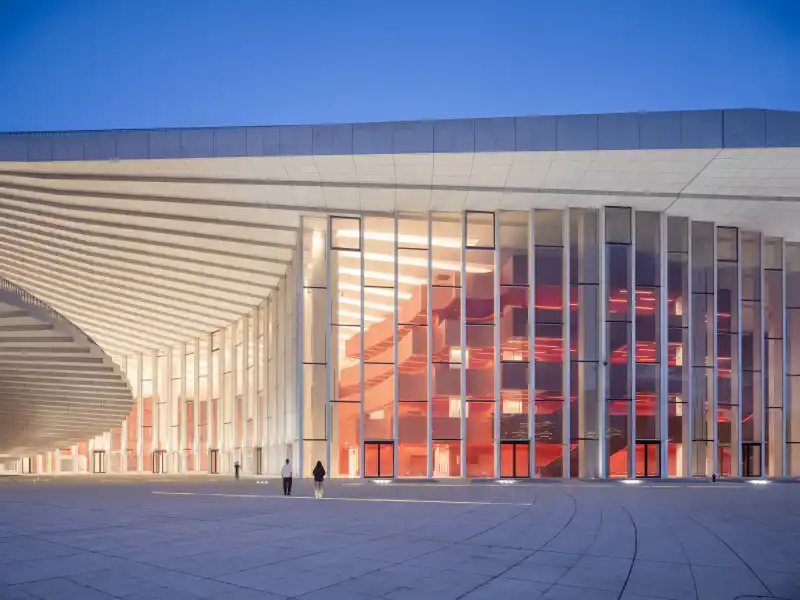
When cities compete for global influence, they often build museums, concert halls, and opera houses. But increasingly, the success of those institutions depends less on what happens inside their auditoriums than on how effectively they become part of everyday urban life.
That challenge lies at the heart of the Shanghai Grand Opera House, the long-awaited cultural centerpiece rising along the Huangpu River in Shanghai’s emerging Houtan district. Designed by Snøhetta in collaboration with the East China Architectural Design & Research Institute (ECADI), Theatre Projects, and Nagata Acoustics, the project is approaching completion after a decade of design and construction and is expected to open during the second half of 2026.
For Shanghai—a city that has spent the past three decades transforming itself into one of the world’s foremost financial and technological capitals—the opera house represents another step in an equally ambitious cultural agenda. Identified within China’s 13th Five-Year Plan as a major initiative to strengthen Shanghai’s international cultural influence, the building seeks to position the city alongside global cultural capitals whose identities are inseparable from landmark performance venues.
Yet Snøhetta’s ambitions extend beyond creating another iconic silhouette for the skyline. Instead, the firm is attempting to solve one of contemporary architecture’s most pressing questions: how can a monumental cultural institution remain genuinely public?
An Opera House That Never Closes
Rather than treating the building as a formal object isolated from its surroundings, the architects conceived the project as an extension of the city itself.
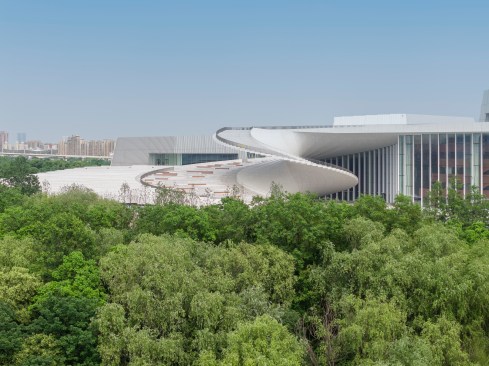
Photo courtesy STUDIO FANG.
The defining architectural gesture is a sweeping helical roof whose geometry recalls the unfolding movement of a traditional Chinese fan. More than an expressive form, the roof becomes inhabitable infrastructure—a spiraling public promenade connecting the ground to an elevated viewing platform overlooking both Shanghai and the Huangpu River.
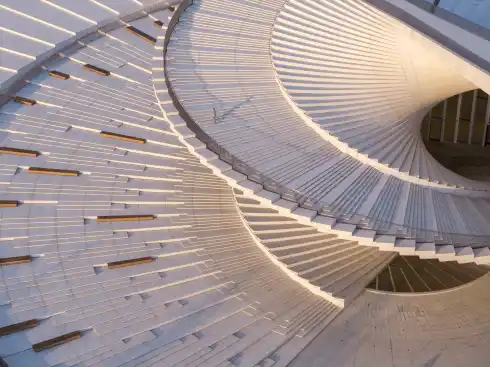
Photo courtesy Tian Fangfang.
Unlike conventional opera houses, whose roofs remain inaccessible, the Shanghai Grand Opera House invites visitors to climb onto the building itself.
The roof functions simultaneously as plaza, park, observation deck, event space, and civic gathering place. It is designed to remain open throughout the year, allowing residents and visitors to experience the building regardless of whether they purchase a ticket.
This idea of public accessibility shapes the project from the outset.
Located within Shanghai’s ecological Houtan neighborhood—an area planned around low-carbon development and generous public landscapes—the opera house occupies a prominent riverside site where radial park systems converge around the building. Those landscape geometries reinforce the architecture itself, creating uninterrupted visual connections between the city, the riverfront, and the opera house.
Rather than serving as an isolated monument, the building becomes one destination within a larger civic landscape.
Designing Opera for a Broader Audience
Opera houses have historically struggled with questions of accessibility—not simply physical access, but cultural relevance.
Many of the world’s great opera buildings continue to project exclusivity through monumental staircases, ceremonial entrances, and programming that appeals primarily to established audiences.
The Shanghai Grand Opera House deliberately challenges that model.
Beyond staging traditional Chinese opera and classical productions, the venue has been designed to accommodate experimental performances, contemporary works, concerts, educational programming, exhibitions, film screenings, and public events intended to attract younger visitors.
The building effectively operates as an all-day cultural campus.
Restaurants, galleries, museums, educational facilities, libraries, exhibition spaces, and small cinemas extend activity well beyond evening performances, encouraging visitors to use the complex as part of daily urban life.
That strategy reflects a broader shift occurring within performing arts architecture worldwide, where cultural institutions increasingly function as mixed-use civic destinations rather than single-purpose venues.
Three Theaters, Three Experiences
The performance spaces themselves reinforce that flexibility.
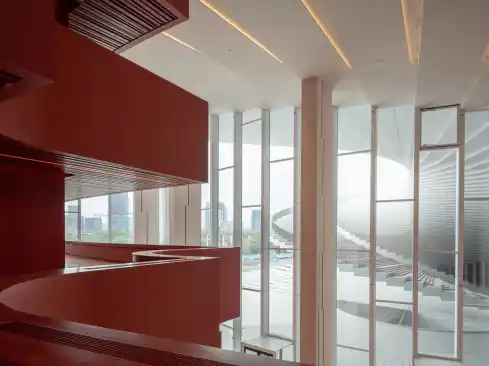
Photo courtesy Tian Fangfang.
At the center of the complex sits a 2,000-seat main auditorium, designed for grand opera productions and major performances. Developed with acoustical consultant Nagata Acoustics, the hall incorporates advanced stage technologies alongside finely tuned acoustic engineering intended to support large-scale orchestral performances.
Complementing the main hall is a 1,200-seat secondary theater, offering a more intimate environment for smaller productions and visiting companies.
Perhaps most significant is the building’s 1,000-seat flexible theater, where seating arrangements and stage configurations can be reconfigured to accommodate experimental productions, multidisciplinary performances, and emerging artistic formats.
Rather than simply expanding capacity, the three venues acknowledge that contemporary audiences consume culture differently than previous generations.
Programming flexibility has become as important as architectural permanence.
Movement Becomes Architecture
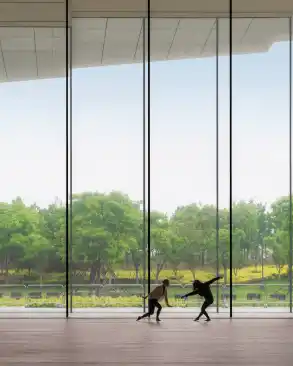
Photo courtesy StudioSZ | Justin Szeremeta.
Throughout the project, movement functions as the organizing principle.
The unfolding fan that shapes the roof also informs circulation inside the building.
Curving galleries, sweeping staircases, flowing lobby spaces, and the organization of the auditoriums all echo the same spiraling geometry established by the exterior form.
Even the opera house’s visual identity continues that language, with its logo abstracting the radial geometry into an instantly recognizable graphic emblem.
The architecture avoids rigid axial symmetry in favor of continuous motion, creating an experience that emphasizes procession rather than arrival.
Visitors never simply enter the building; they move through a carefully choreographed sequence of spaces that gradually reveal the city beyond.
Material Warmth Behind a White Exterior
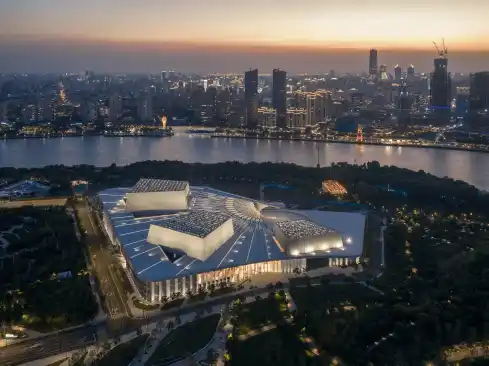
Photo courtesy Tian Fangfang.
While the exterior presents a luminous white form against Shanghai’s skyline, the interiors pursue a markedly warmer atmosphere.
Soft silk-inspired finishes line portions of the public spaces, while extensive oak flooring and wood paneling establish both visual warmth and critical acoustic performance.
Inside the principal auditorium, the wood transitions into rich dark-red tones that evoke the traditional colors associated with many historic theaters while improving sound quality through carefully calibrated surfaces.
Natural light also becomes an active architectural material.
Large expanses of glass introduce daylight deep into public circulation areas, allowing visitors to experience changing weather, shifting seasons, and views across the city even before performances begin.
After sunset, the building undergoes another transformation.
Lighting embedded within the stage towers causes them to glow like oversized lanterns, illuminating both the roofscape and Shanghai’s expanding skyline.
Building on a Global Legacy
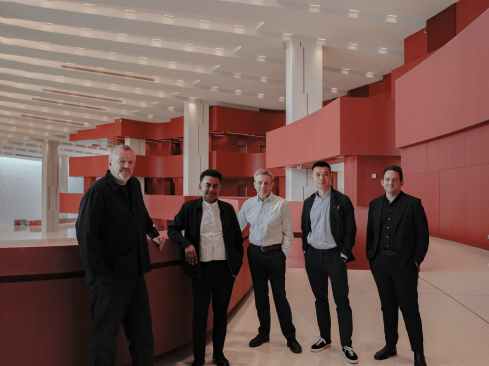
Photo courtesy Honne Dang.
The Shanghai Grand Opera House represents the latest chapter in Snøhetta’s long engagement with performing arts architecture.
Over the past two decades, the practice has designed a series of influential cultural projects, including the Norwegian National Opera and Ballet in Oslo, the Busan Opera House in South Korea, the Isabel Bader Centre for the Performing Arts in Canada, and the ongoing renovation of Théâtre Nanterre-Amandiers outside Paris.
Those projects share a consistent philosophy: dissolving the traditional boundaries separating civic space from cultural institutions.
Instead of monumental objects admired from a distance, Snøhetta has repeatedly sought to create buildings that encourage public occupation regardless of whether visitors attend performances.
As Snøhetta Founder Kjetil Trædal Thorsen explains:
“The Shanghai Grand Opera House is a natural progression of our previous work with designing performing arts centers. It is a culmination of the competence and insight gained through projects such as the Norwegian National Opera and Ballet, the Busan Opera House in South Korea, the Isabel Bader Centre for the Performing Arts in Canada, and the Théâtre Nanterre-Amandiers renovation in Paris. The Shanghai Grand Opera House is a product of our contextual understanding and values, designed to promote public ownership of the building for the people of Shanghai and beyond.”
The statement underscores a recurring theme within Snøhetta’s work: architecture succeeds not simply through formal invention, but through encouraging civic participation.
Architecture as Public Infrastructure
The Shanghai Grand Opera House arrives during a period when many cities are reconsidering the role of expensive cultural landmarks.
As construction costs continue to rise and governments face increasing pressure to justify public investment, iconic buildings are increasingly expected to serve multiple civic functions beyond their original program.
Shanghai’s new opera house appears calibrated for that reality.
Rather than becoming active only during evening performances, the building has been designed as a continuously accessible piece of urban infrastructure—a place where residents can meet, exercise, learn, dine, attend performances, or simply enjoy views of the river.
Its success may ultimately depend less on ticket sales than on whether Shanghai embraces it as part of everyday life.
If that happens, the building could represent a significant evolution in the architecture of cultural institutions—one where the opera house no longer stands apart from the city, but becomes one of its most active public spaces.
As the project prepares to open later this year, it suggests that the future of landmark architecture may not lie in creating ever more spectacular icons, but in designing civic buildings generous enough to belong to everyone. T