The new Geffen Wing of the Los Angeles County Museum of Art (LACMA) is not an oil slick evoking the ooze bubbling up next door from the La Brea Tar Pits, as some people have claimed. Nor is it an homage to the swoop of Southern California’s freeway intersections. It most definitely not a piece of land art, as one critic has gotten its Director to say.
It is a collection of Tik Tok Houses nested into a McMansion. In wandering around this cave I somehow kept thinking of the ruin Ye left behind when he tried to renovate the Tadao Ando-designed beach house in Malibu.
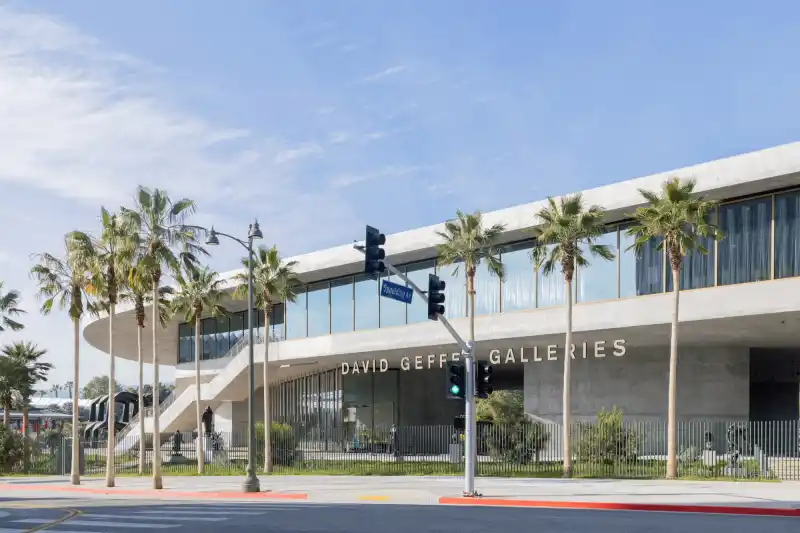
Let me explain. This humongous blob of a building looks even bigger than its 350,000 square feet because it floats like a ponderous cloud over the flatlands of Los Angeles, looming as a concrete pancake sandwiching a dark glass murk of windows.
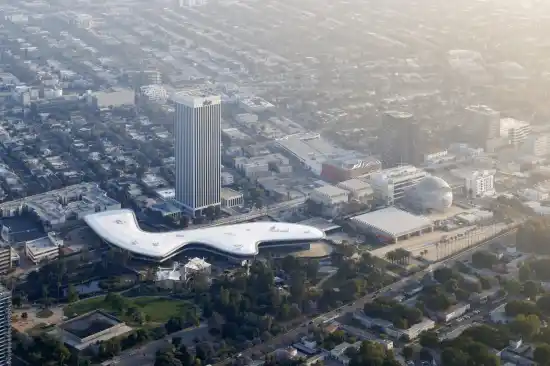
Aerial view of LACMA buildings, including David Geffen Galleries in context of Miracle Mile, photo © Iwan Baan
Because it has no edges, it just goes on forever. That sense of bigness continues in the inside where acres (a little over 2.5 to be precise) of concrete floor and ceiling flow around a group of blocks made of the same material and scattered around that continuous space.
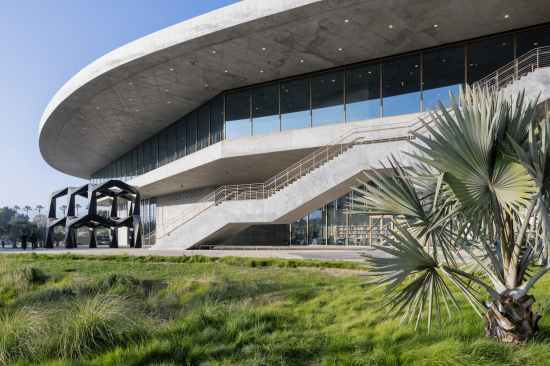
Exterior view northwest from Wilshire Boulevard with Tony Smith’s Smoke (1967) at left, David Geffen Galleries at LACMA, art © Tony Smith Estate/Artists Rights Society (ARS), New York, photo © Iwan Baan
It is the biggest trophy house I have ever seen, an avatar for the homes of the billionaires who paid for it and the ego of what is still one of the best museum directors in the world, Michael Govan.
As such, it is awe inspiring. It provides an aesthetic experience, especially inside, that is both exhilarating and awful in the way good art can be.
I just wish it was not the centerpiece of one of the most important public art museums in this country.
When Architecture Becomes the Exhibit
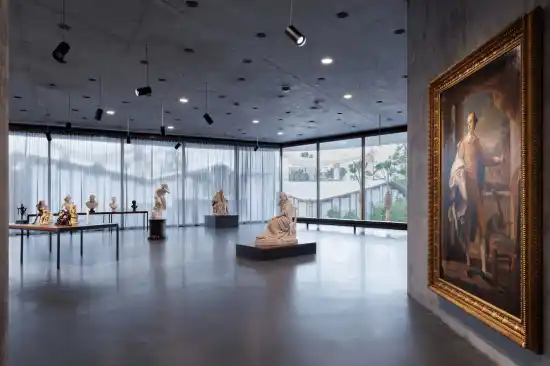
Classical Revivals in Europe and America with Pompeo Batoni’s Portrait of Sir Wyndham Knatchbull -Wyndham (1758–59) at right, David Geffen Galleries at LACMA, photo © Iwan Baan
The Geffen Wing is in actuality the home of a few objects and images scattered around its expanses. Some of those, especially the ones that are big and have bright colors, look pretty good there. Anything smaller and more subtle disappears, as do the multi-million Andreas Gursky photographs of oceans hiding somewhere behind the reflections in the glass covering those Photoshopped images.
Look at all the space I have, the Geffen Wing tells you; look at the uninterrupted views, look at how I have gotten rid of almost anything distracting (other than the clumsiest track lighting I have seen in any recent museum), look at the tasteful proportions and compositions of my master architect, Peter Zumthor, and then notice how expensive the pieces I have strewn around are.
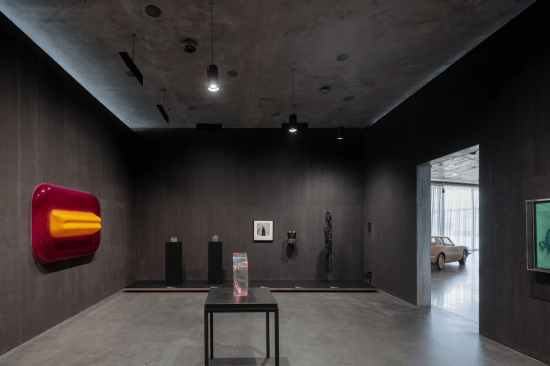
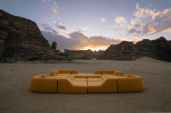
The Stuff of Alchemy: Plastic in Art , David Geffen Galleries at LACMA, photo © Iwan Baan
Walk into the concrete bunkers that are actually designed to contain art, and you get your fast mini-drama moment: a group of usually about a dozen pieces crammed into the room and related by area of origin, time, medium (drawing, say, or design), or the collector who gave them. They dance around walls that have been rubbed with different pigments of a complexity that would make Rothko jealous to tell a quick story.
Most of the time that message is a politically correct one about previously underrecognized artists or sites, but the strongest narratives are shown in the galleries devoted to two amazing collections of standard showstoppers given to LACMA in recent years: the Mr. and Mrs. Edward Carter donation of 17th century Dutch art and the A. Jerrold Perenchio bequest of Impressionist work.
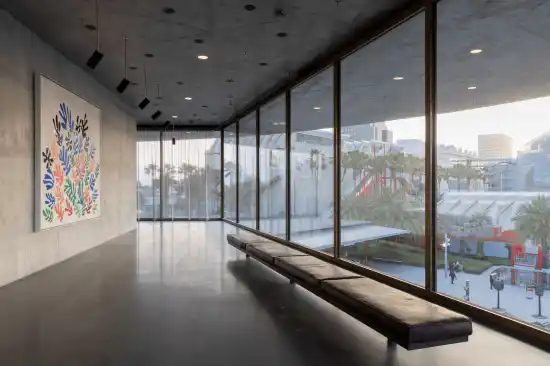
View southwest from exhibition level toward Resnick Pavilion and BCAM with Henri Matisse’s La Gerbe (1953) at left, David Geffen Galleries at LACMA, art © 2012 Succession H. Matisse/Artists Rights Society (ARS), New York, NY, photo © Iwan Baan
Get your hit, read the story, twirl around, and you’re out and on to the next booth. Each of these art moments is undistinguishable from the next beyond the different pigments and the remnants of what were meant in the original design to be clerestory lights and now are just a few slots above the slab that do absolutely nothing to lighten the rooms.
Monumental Space, Modest Rewards
That is about it for the Geffen Wing. You can find an education space and some support services in the blob’s feet. One of those supporting blocks also contains, if you can locate it, an elevator for those who do not want to or can’t climb the grand stairs that Zumthor appended to the volume.
At least that entrance object avoids the cliché of the skylit stair hall-cum-auditorium that centers almost every recent museum addition in recent years.
Some of my friends and many commentators talk about the amazing views from the second floor’s perimeter, but all I saw was the hodgepodge of buildings on and around Wilshire Boulevard and the cleaned-up landscaping of that thoroughfare itself.
You are not high up enough to get a good sense of either Reyner Banham’s Planes of Id or anything else of note. Only all the way at the rear, where the building abuts a dingbat apartment building, do you arrive at some found art in the form of views into people’s terraces.
A Museum Without a Landscape
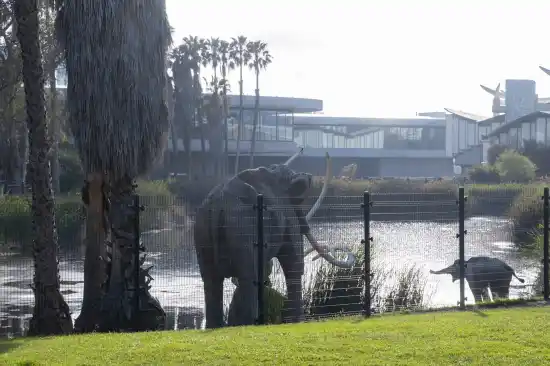
David Geffen Galleries at LACMA, view from the east including LACMA’s Pavilion for Japanese Art with La Brea Tar Pits’ Lake Pit and mammoth sculptures in foreground, photo © Iwan Baan
As for the spaces the museum forms around and under its Geffen Wing, I am at a loss to find any virtues. A friend told me some of the barren expanses under the roof serve very well as party and thus fundraising spaces.
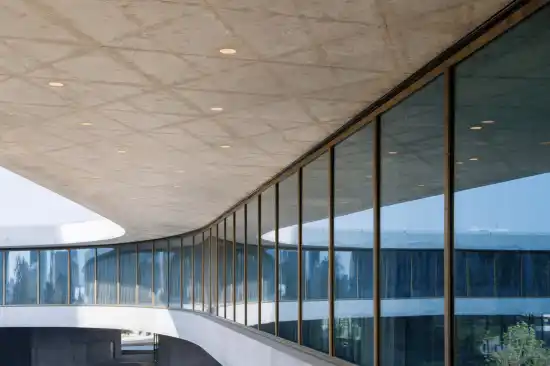
Exterior view of exhibition level, David Geffen Galleries at LACMA, photo © Iwan Baan
For the rest you get acres of concrete and other beige material interspersed with a few tongues of vegetation and some plop-art outdoor sculptures.
The contrast to the lush, if dilapidated —partially because they are so intensely used– grounds of the Tar Pits should be embarrassing to a museum that has fenced its expanded territory behind forbidding, tall fences.
Where the Art Succeeds—and Disappears
From a display perspective, the galleries have some good and bad aspects. As I note above, big and bold pieces really shine in the minimal blob-space, while pottery and even a beautiful Avanti car that has the bad fortune of being painted beige disappear.
In the square gallery rooms even small jewels can shine. In all the areas, any painting bigger than a person struggles with glare and shadows cast by its top moldings.
There is no wayfinding, which the museum says encourages you to wander and discover, but that makes it difficult to find, say, a bathroom.
The Limits of a Global Museum
I have no problem with the ahistorical hang that is supposedly grouped around the seven seas in which our globe’s continents float as they mix and meld cultures over time.
I think the original proposal by OMA, which kept linear galleries and then provided diagonal slashes through those spaces, would have made for better encounters.
The real issue, however, is that it turns out that LACMA does not have the holdings to support its pretentions of being a global art museum.
Its collection is patchy at best, with a few gorgeous and significant pieces floating a great deal of mediocrity, and that problem is worse especially in antiquities and arts from non-Western countries.
In a sense that problem validates Govan’s justification of the fact that the Geffen contains considerably fewer square feet than the buildings he tore down to make room for it by saying that they didn’t need more space, just better ones.
But then why showcase your defects in so many acres of emptiness?
Can the Geffen Wing Grow Into Itself?
Some of these issues might, of course, be teething pains. The museum will continue to collect, supposedly even more now that potential donors see the Big House where they work will be at home.
The empty galleries can fill with more activities, as they were when, during the opening days, the Museum juiced up the areas between the art works with performances of all sorts.
Future directors can come up with smarter ways to hang and place the work and might even replace those hideous fixtures.
I can imagine that it would be a fun exercise to see how many more galleries you could fit into the blob, or whether you could counterpoint the Zumthor designs to me deadening horizontality with a vertical stack of new art spaces.
A Great Building, the Wrong Museum
Don’t get me wrong, the Geffen Wing is impressive. It is big and bold, and Zumthor is a good architect who can control detailing and compositions like a master.
Was it worth three-quarters of a billion dollars’ worth of expenditure and a tremendous waste of carbon in tearing down some fairly recent buildings and pouring all that concrete to build a new one?
I will stand by my earlier assessment that it was not and that for a third or even half that amount of money Govan could have continued the brilliant work he did in the first few years of his directorship at LACMA by renovating, activating, and where necessary both compacting and extending spaces.
Now it is up to him or his successor to do the same with what already looks like ruin.