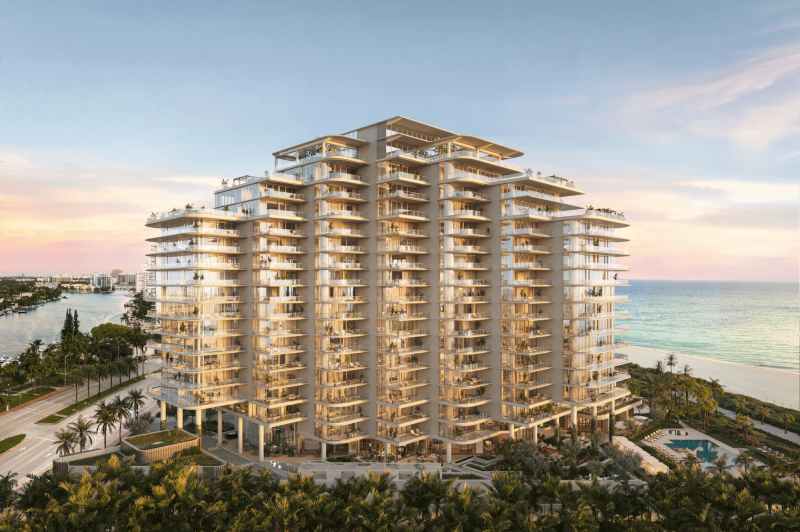
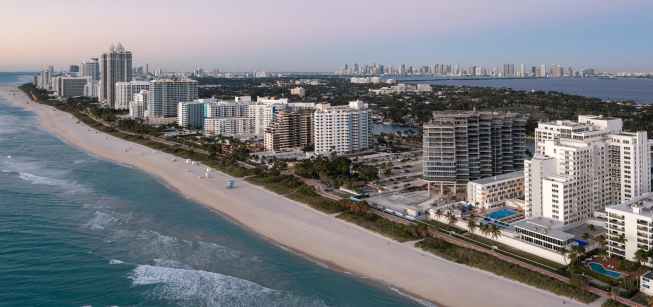
On Miami Beach’s Collins Avenue, the architecture has long behaved like a barrier. A near-continuous line of residential towers—many lifted on podiums packed with parking and amenities—forms what OMA partner Jason Long bluntly describes as a “concrete canyon,” severing the city from the ocean it sells. The Perigon, OMA’s first residential project on this stretch of coastline, begins as a critique of that condition. But rather than overturn the typology entirely, the project works from within its constraints—rearranging mass, circulation, and program to quietly undo the wall.
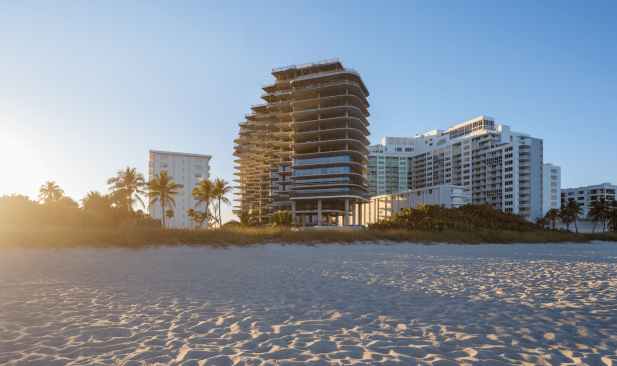
The Perigon, Photo by Jason ORear.
At first glance, The Perigon reads as a familiar figure: a mid-rise luxury condominium, roughly 200 feet tall, stretched across more than 300 feet of oceanfront. But its defining move is less about height than subtraction. The building lifts, splits, and pulls apart at its base, opening a porous ground plane that replaces the typical fortified podium with something closer to an urban landscape.
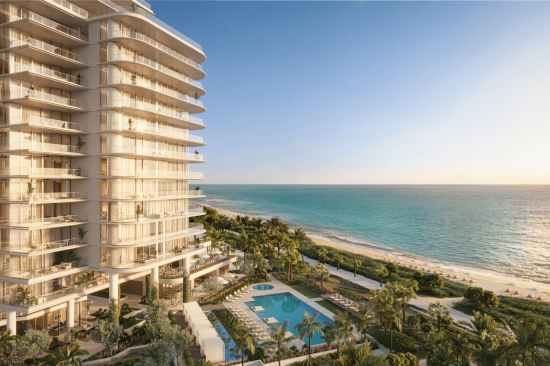
Beachfront view. Rendering courtesy The Boundary.
For OMA, the project is less a departure than an evolution. The firm has long engaged housing as a site of experimentation—from Rem Koolhaas’s seminal Maison à Bordeaux, which redefined domestic space through movement and sectional complexity, to more recent large-scale residential work in New York, Miami, and elsewhere.
Projects in Greenpoint, along Madison Square Park, and in Coconut Grove have explored permeability, unit organization, and the relationship between tower and ground.
The Perigon builds on those investigations, translating them into the highly codified—and often conservative—world of the Miami luxury condo.
“We’re reacting to the condition that’s there,” Long says. “You’re so close to the beach, but the experience along Collins is quite walled off. We wanted to make something that feels lighter—more open—even if it’s still a private residential building.”
That tension—between openness and exclusivity, between permeability and control—runs through the project. The Perigon is not a public building. It is, unequivocally, a high-end condominium. But OMA’s intervention is to reframe how such a building meets the city.
The Ground Plane as Architecture
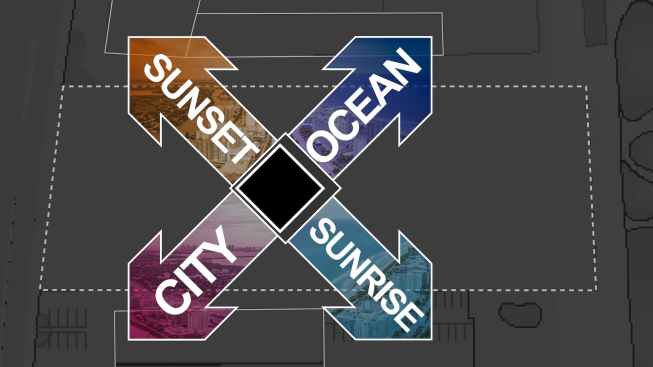
Site Plan. Courtesy OMA.
The most radical move at The Perigon is also the simplest: lifting the building to create space beneath it. This is not merely aesthetic. Miami’s floodplain regulations already require elevating habitable floors above a certain datum. But where most developers respond by thickening the base—adding parking decks and sealed-off amenity floors—OMA does the opposite.
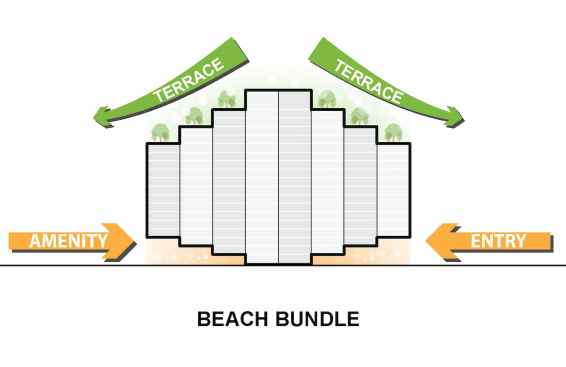
Concept elevation. Courtesy OMA.
The building’s ends are pulled up dramatically on columns, opening 40-foot-high voids that allow light, air, and views to pass through. Instead of concentrating amenities within a podium, the program is dispersed across the site: a clubhouse pushed toward the ocean, an entry pavilion tucked into the landscape, and a network of paths that weave between them.
Perigon. Photos by Jason ORear.
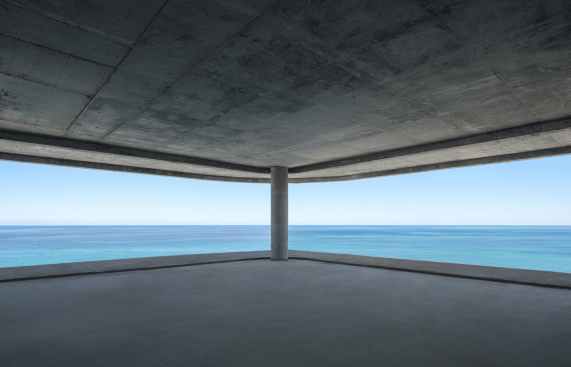
At the center of this strategy is what OMA calls the Sunrise Porch—a vast, shaded outdoor room carved beneath the lifted volume of the building. With a ceiling height approaching 40 feet, it operates less like a terrace and more like an urban-scale loggia: open to breezes, protected from the sun, and oriented toward the Atlantic.
“We wanted to create this openness around the base,” OMA AssociateYusef Al Denis explains, “which also creates these shaded outdoor spaces that are actually usable throughout the day.”
In a climate where outdoor space is often either overexposed or unusable due to wind, the Porch introduces a calibrated environment—one that makes exterior space livable throughout the day.
“The idea was to create outdoor space that’s actually usable,” the architects suggest—an implicit critique of Miami’s windswept amenity decks. Here, shade is not an afterthought but a primary spatial condition. The Sunrise Porch becomes a climatic device as much as a social one, mediating between the intensity of the beachfront environment and the desire for year-round outdoor living.
“The typical condition is a big base that creates a wall,” explains Denis. “We wanted to break that apart. By pulling the amenities out of the building, you free up the ground plane to become something more continuous—something you can move through.”
The result is less a building sitting on a site than a system of elements distributed across it. Circulation becomes landscape. Landscape becomes structure. The architecture dissolves into a series of zones—shaded porches, gardens, water features—that blur the line between indoor and outdoor space.
OMA describes the move as “liberating the ground plane,” but the implication is broader: in a market obsessed with penthouses, the most spatially ambitious work is happening at grade.
Tucked into the lower floors are six to seven standalone studio units—ranging from roughly 800 to 1,200 square feet—that can be purchased separately by residents as extensions of their primary homes. Conceived as flexible “auxiliary spaces,” they function as private offices, guest suites, or personal retreats, effectively decoupling domestic life into multiple, distributed rooms within the building.
Social Space, Repositioned
If the Sunrise Porch reframes the ground plane as architecture, the project’s social program extends that logic outward—literally pulling the most public-facing amenities away from the tower itself.
Rather than embedding restaurants and lounges within a sealed podium, OMA relocates them to the edge of the site, closest to the water. The oceanfront clubhouse houses a full-service restaurant, conceived not as an internal amenity but as a destination within the landscape—visually and spatially connected to the beach rather than buried within the building’s mass.
“There was an interest in liberating those programs from the base,” the architects note. “To bring them closer to the ocean, where they actually belong.”
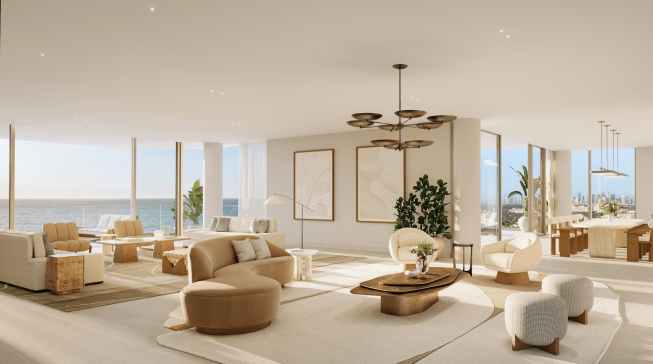
Great Room. Courtesy The Boundary.
The move is subtle but consequential. In most Miami condos, dining and social spaces are interiorized—controlled environments disconnected from climate and context. Here, they are re-sited as pavilions within the broader spatial field of the project, reinforcing the idea that the architecture extends beyond the tower footprint.
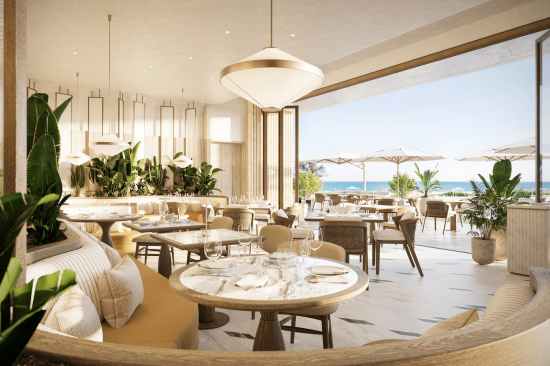
The restaurant Morning.
Stacked above the restaurant, however, is a very different kind of space: a speakeasy, deliberately concealed and more intimate in scale. Accessed discreetly and designed to feel enclosed—almost secretive—it offers a counterpoint to the openness of the Sunrise Porch and beachfront terraces.
The pairing is telling. One space is expansive, porous, and outward-looking; the other is compressed, inward, and social in a more private register. Together, they establish a gradient of experience—from exposure to retreat—that mirrors the project’s larger architectural agenda.
Reconfiguring the Condo Typology
Despite its conceptual ambitions, The Perigon remains grounded in the realities of residential development. As Long notes, “there’s a certain fixity” to condominium design. Units must stack efficiently. Views must be maximized. Balconies—especially in Miami—are non-negotiable.
OMA’s strategy is not to reject these constraints but to manipulate them.
The building is conceived as a series of slender volumes merged into a single form, creating a serrated plan that opens views in multiple directions. Unlike many beachfront towers that privilege ocean views exclusively, The Perigon deliberately frames both east and west vistas—toward the Atlantic and toward the Miami skyline.
“At night, the ocean is just black,” Long observes. “We wanted to give residents something else—to connect them back to the city.”
This dual orientation drives the building’s geometry. Units are arranged to capture cross-views, often allowing residents to look both toward the water and back across the island. At the ends of the building, OMA resists the typical subdivision into multiple units, instead creating “villa-like” residences with exposure on all four sides.
“These are almost like square homes in the sky,” Denis says. “You’re not just looking in one direction—you’re occupying a space with light and views all around.”
Even the entry sequence is rethought. Each unit is accessed directly from a private elevator, eliminating corridors and allowing OMA to choreograph the moment of arrival—what residents see first, how views are revealed, how interior space unfolds.
Balconies, Wind, and the Problem of Miami
If Miami’s architectural language is defined by one element, it is the balcony. Continuous terraces wrap most residential towers, often creating uniform façades that prioritize view over spatial variation. OMA engages this convention but introduces subtle disruptions.
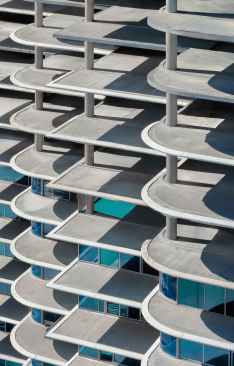
At The Perigon, balconies extend up to 12 feet deep, providing both outdoor living space and passive shading. But their geometry alternates—some curved, others rectilinear—creating a rhythmic façade that breaks down the building’s scale.
The Perigon.. Photo by Jason Orear.
More importantly, the building itself is fragmented. Rather than a flat slab, its articulated form interrupts wind flow, addressing a common problem in beachfront construction.
“In a lot of buildings, the wind just whips along the terraces and makes them unusable,” Long explains. “Here, the building’s discontinuity actually helps mitigate that.”
Material Experimentation in a Conservative Market
Miami’s residential construction is often characterized by a limited material palette—stucco, concrete block, and glass—driven as much by cost and construction practices as by design intent. At The Perigon, OMA pushes against that norm with a more experimental façade system.

Perigon. Photo by Jason ORear.
The building employs GFRC (glass fiber reinforced concrete) panels and slab-edge covers, giving the structure a sharper, more refined expression. The balcony edges taper to a thin, almost aerodynamic profile, emphasizing a sense of lightness across the façade, while vertical privacy screens introduce a subtle corrugation that reads as a fine, pinstriped texture. “It has this almost pinstripe quality to it,” says Jason Long. “That level of precision and consistency is something you just don’t get with stucco.”
The material allowed OMA to move beyond Miami’s typical palette of concrete block and stucco, where tolerances often require visual softness or concealment. “Here, these are really façade panels rather than a traditional wall system,” Long adds. “It’s a different way of building in this context—one that pushes the level of finish and durability.”
The material also enabled OMA to depart from Miami’s typical construction palette of stucco and concrete block. “Here, these are really façade panels rather than a traditional wall system,” Long adds. “It’s a different way of building in this context—one that pushes the level of finish and performance.”
Between Critique and Compliance
For all its innovation, The Perigon does not position itself as a radical departure from Miami’s development model. It remains a luxury product, complete with concierge services, private beach access, and high-end interiors by Tara Bernerd & Partners.
OMA is careful not to overstate the project’s public impact. “It’s not a free-for-all,” Long says. “It’s still a private building.”
But architecture’s influence often lies in subtler shifts. By rethinking how a condo meets the ground, how it frames views, and how it organizes its program, The Perigon introduces an alternative model—one that could ripple across future developments.
A New Model for the Beachfront Tower?
What emerges is a building that feels both familiar and slightly off—recognizable as a Miami condo, but operating according to a different logic.
The Perigon. Photo by Jason ORear.
And in a landscape where the ocean is often treated as a backdrop rather than a partner, that shift—however subtle—may be the most consequential move of all.
Project Credits
THE PERIGON / 5333 COLLINS
Status: Construction Documentation
Client: Mast Capital, Starwood
Location: Miami, Florida, USA
Site: Mid-Beach, on a narrow strip between Indian Creek and the Atlantic Ocean
CREDITS
Project Team:
Partner-in-Charge: Jason Long
Associate: Yusef Ali Dennis
Team: Shary Tawil, Younghae Lee, Alexander Kluefers, Yasamin Fathi, William Ross Reive, Alireza
Shojakhani
Executive Architect: ODP Architects
Structure: B&J Consulting Engineers
MEP: Osborn Engineering
Landscape Architect: Gustafson Porter+Bowman
Executive Architect (Landscape): Architectural Alliance Landscape
Interior Design: Tara Bernerd & Partners
Lighting: Schwinghammer Lighting
Civil Engineer: Schwebke-Shiskin & Associates
Traffic Engineer: Kimley-Horn and Associates
Kitchen: INMAN
Vertical Transportation: VDA
Code/Life Safety: SLS Consulting
Security: Skytech
Waterproofing: Paramount consulting and engineering
General Contractor: Moss
Continue the conversation at Elevate this December in Miami.
Join the industry’s top architects, developers, and brokers exploring what’s next in high-rise living at ARCHITECT’s Elevate Conference.