
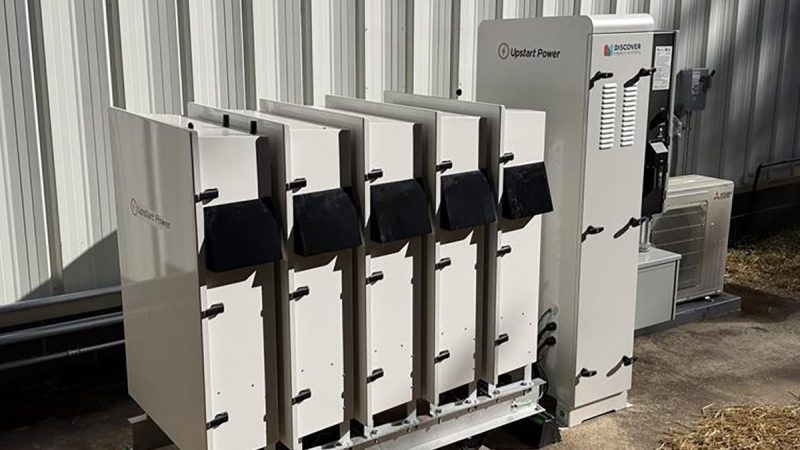
Back-up batteries can carry a building through brief disruptions. Conventional standby generators can keep power flowing during longer outages. But for architects working on resilient projects, those two options might not satisfy.
That’s where solid oxide fuel cells, or SOFCs, enter the picture.
A solid oxide fuel cell generates electricity through a chemical reaction between fuel and oxygen using a ceramic electrolyte, rather than through combustion. In propane-fueled systems, propane reacts with oxygen to produce electricity, with water, heat, and carbon dioxide as byproducts.
“The fuel cell and the battery replace what otherwise only an internal combustion engine home standby generator could do,” says Georg Bettenhauser, chief commercial officer at Upstart Power.
It’s an innovation that he says fills the gap between short-duration backup and conventional generators, providing cleaner power for longer periods. In this hybrid approach of pairing a fuel cell with lithium-ion batteries, the battery handles immediate loads, while the fuel cell acts as a steadier replenishment source when outages stretch on.
As for fuel, propane gives the technology a practical edge in applications where natural gas is unavailable and diesel is less desirable. Propane’s existing delivery infrastructure and cleaner profile make it a strong fit for long-duration backup.
“It’s a cleaner energy, you know it’s delivered to your door, you’ve got all the support mechanisms in place,” says Bert Warner, director of commercial development with the Propane Education & Research Council (PERC).
Bettenhauser also emphasizes propane’s role in long-duration resilience. With the right battery and inverter sizing, a fuel-cell-backed system can continue operating “practically for as long as you give it fuel,” Bettenhauser says.
For architects, the implications are not only operational but physical. SOFCs are quieter than conventional generators and the footprint is far smaller. “The unit is whisper quiet,” Bettenhauser says. “You have to put your ear to the box to hear whether it’s running.”
Of course, the real test is whether the technology can keep a building running when the grid goes down. Bettenhauser points to a residential project in Puerto Rico, where Upstart Power paired a fuel cell with a Tesla Powerwall and 6.7 kilowatts of solar, then took the house off grid for seven days. Only one member of the household knew the test was happening; the other did not realize the home had been disconnected from the grid. “We operated that house for seven days off grid,” he says, “without half of that household knowing that the grid was not connected.”
SOFCs are not yet mainstream, and neither Warner nor Bettenhauser suggests they will replace every generator or battery application. But as architects confront grid instability, electrification, and tougher resilience goals, propane-fueled solid oxide fuel cells are emerging as a potentially useful middle path.
For firms interested in how the technology is performing in real-world commercial settings, Propane Education & Research Council’s Alternative Technology Demonstration and Research Program offers a way to explore it further. The program includes funding for qualifying propane-fueled SOFC installations, helping project teams evaluate the technology while contributing to the case studies and performance data that could shape broader adoption. Learn more.


