On July 10, exactly five years after workers lifted Charlottesville’s bronze statue of Confederate General Robert E. Lee from its granite pedestal, one of America’s most influential architecture firms received a commission unlike any other.
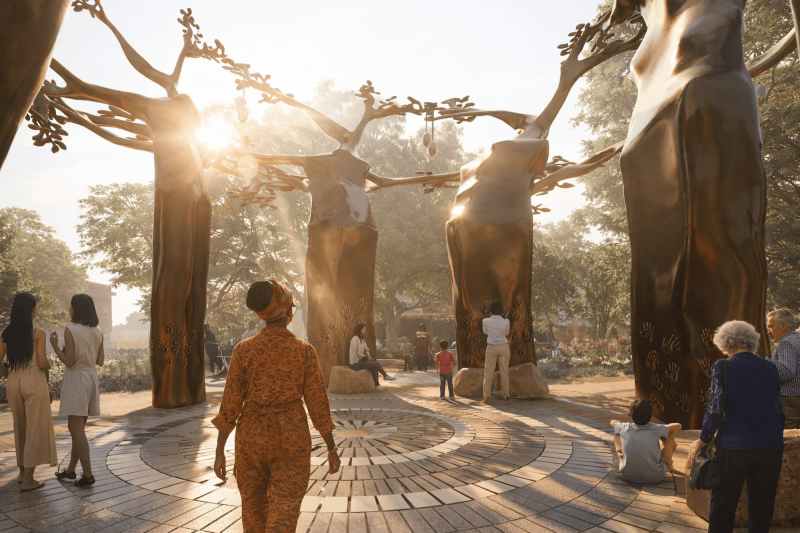
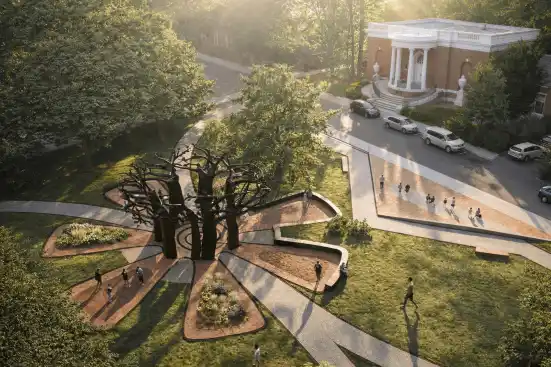
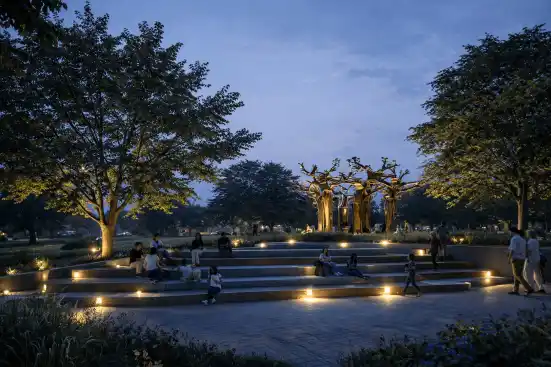
The nonprofit practice Model of Architecture Serving Society—better known as MASS—was selected to transform the melted remains of the monument into a new work of public memory. Working alongside Oakland-based sculptor Dana King, the firm will design ROOTED, a community-driven memorial that recasts bronze once used to glorify the Confederacy into a civic landscape dedicated to reflection, gathering, and democratic belonging.
It is an extraordinary assignment because it asks architecture to do something few buildings ever can: transform one of America’s most contested symbols into a place for civic life.
For nearly two decades, the Boston-based nonprofit has argued that architecture can serve as a form of civic repair. Its work ranges from hospitals in Rwanda and educational campuses to justice-centered projects such as the National Memorial for Peace and Justice in Montgomery, Alabama, and the Embrace in Boston. Through its Public Memory and Memorials Lab, MASS has become a leading voice in memorial design, working with communities to confront histories of violence, exclusion, and inequality through architecture rather than simply commemorating them.
Charlottesville may be its most consequential commission yet.
The project asks a question that extends well beyond Virginia: after a society dismantles a symbol of injustice, what should take its place?
For Charlottesville, the answer is not another monument but an entirely different idea of public space.
Designing What Comes After
Across the United States, hundreds of Confederate monuments have been removed over the past decade, particularly following the nationwide protests that erupted after the murder of George Floyd in 2020. Yet removal has often marked the end of the conversation rather than the beginning. Many statues now sit in storage while communities continue to debate what, if anything, should replace them.
Charlottesville chose another path.
Rather than treating the Lee monument’s removal as the final chapter, the city partnered with the Jefferson School African American Heritage Center to launch Swords Into Plowshares, an initiative that transforms the monument’s bronze into the raw material for a new civic landmark. Borrowing its name from the biblical image of turning instruments of war into tools of peace, the project seeks neither preservation nor erasure but transformation.
Its next chapter, ROOTED, emerged through an unusually democratic process. Nearly 1,000 residents evaluated three finalist proposals, with MASS receiving 64 percent of first-choice votes—a result that reflected broad community consensus rather than expert decree.
For Dr. Andrea Douglas, executive director of the Jefferson School African American Heritage Center and co-founder of Swords Into Plowshares, the process itself has always been as important as the finished memorial.
“We believe that the most impactful art emerges from genuine collaboration,” she said. “The extensive community engagement we’ve undertaken—with input from so many diverse voices—has been absolutely vital to this project. We’re thrilled to be working alongside such an accomplished and thoughtful design team. I am confident that we will create something lasting and meaningful.”
The Architecture of Repair
For MASS, the Charlottesville commission is not a departure but the culmination of a philosophy that has steadily expanded the boundaries of architecture.
Since its founding in 2008, the nonprofit practice has argued that design extends beyond the creation of buildings. Its projects—ranging from healthcare campuses in Rwanda to schools, museums, and memorials across the United States—treat architecture as a public process capable of improving health, advancing justice, and helping communities confront difficult histories. At the center of that work is the firm’s Public Memory and Memorials Lab, which collaborates with historians, artists, descendants, and civic leaders to create places where history remains visible without being frozen in a single narrative.
That approach found national recognition through the National Memorial for Peace and Justice in Montgomery, Alabama, developed with the Equal Justice Initiative. Rather than celebrating triumph, the memorial immerses visitors in the history of racial terror, using architecture and landscape to provoke reflection instead of reverence. It demonstrated that memorials could function less as monuments to the past than as catalysts for public dialogue.
Charlottesville presents an even more complex challenge.
Unlike Montgomery, where the memorial occupies a purpose-built site, Market Street Park already carries decades of contested meaning. Long before the deadly Unite the Right rally in August 2017 claimed the life of Heather Heyer, the Lee monument had become a national flashpoint over race, public space, and whose histories deserve celebration. Any new intervention would inevitably inherit that legacy.
“The opportunities like this are extraordinarily rare,” said Jha D Amazi, principal of MASS’s Public Memory and Memorials Lab. “To transform the very material of a monument is to acknowledge that history cannot be erased, but it can be reimagined. We are deeply inspired by the courage and persistence of everyone who made this moment possible over the past decade, and we are honored to contribute to a future shaped not by inherited symbols, but by shared values and collective imagination.”
That ambition explains why the Jefferson School African American Heritage Center paired MASS with Oakland sculptor Dana King, whose public art has long explored race, migration, memory, and belonging. Together they envision ROOTED not as another heroic statue but as an open civic landscape organized around welcome, gathering, beauty, and participation. Rather than asking visitors to look up at history, the project invites them to inhabit it.
“My hope is that in a few years, the park will be full of laughter and playfulness, conversations and dancing,” King said. “Because then, ROOTED will have done what it was intended to do—bring all kinds of people together in comfort, creating something we can all be wildly proud of.”
King’s vision reflects a broader transformation in memorial design. For centuries, monuments asserted authority through permanence, scale, and heroic representation. Increasingly, however, architects and artists are replacing singular figures with landscapes that encourage movement, reflection, and everyday use. Like Maya Lin’s Vietnam Veterans Memorial and the National Memorial for Peace and Justice, ROOTED measures success less by its symbolic power than by the public life it sustains.
Beyond the Monument
The Charlottesville commission arrives at a pivotal moment for both architecture and American public life. Over the past decade, the removal of Confederate monuments has become one of the country’s most visible acts of historical reckoning. Yet once the statues come down and the cranes depart, communities are often left with a more difficult question: What should take their place?
Charlottesville is among the first cities to answer that question not by replacing one monument with another, but by rethinking the role monuments play altogether.
Across the country, debates over statues honoring Confederate leaders, enslavers, and other controversial historical figures are increasingly shifting away from whether they should remain and toward what public memory itself should look like in the twenty-first century. That evolution has opened an entirely new frontier for architects, landscape architects, artists, and planners.
Rather than designing objects that proclaim a single historical truth, they are increasingly being asked to create places that accommodate multiple histories, invite dialogue, and evolve alongside the communities they serve. The goal is no longer to conclude historical debates but to provide civic spaces where those conversations can continue.
ROOTED embodies that shift.
The project does not promise reconciliation through design, nor does it suggest that architecture can erase historical trauma. Instead, it acknowledges that thoughtfully designed public space can provide the setting in which communities continue the difficult work of confronting the past while imagining a different future.
That marks a profound departure from the twentieth-century understanding of monuments. For generations, architecture measured success through permanence—through buildings and memorials that projected authority across generations. Increasingly, however, success is measured by something less tangible: whether public spaces encourage gathering instead of division, participation instead of spectacle, and shared ownership instead of exclusion.
Few firms have embraced that philosophy as consistently as MASS. From healthcare campuses in Rwanda to schools, museums, memorials, and civic landscapes across the United States, the practice has argued that architecture’s greatest value lies not simply in what it builds, but in the social relationships it makes possible. Charlottesville brings that body of work into perhaps the nation’s most scrutinized landscape.
Whether ROOTED ultimately succeeds will not be determined on opening day.
Its success will be measured years later—if children play beneath its trees without knowing they occupy one of the most contested sites in modern American history; if neighbors gather for concerts, conversations, protests, and celebrations; if the park becomes known less for the monument it once held than for the community it now sustains.
If that happens, Charlottesville will have demonstrated something that extends far beyond the fate of a single Confederate monument.
It will have shown that public memory is not fixed in bronze or carved in stone. It is continually reshaped by the places where people gather, the stories they choose to tell, and the communities they build together.
For MASS, that may be the commission’s most enduring lesson.
Architecture’s greatest legacy is not simply the monuments it leaves behind.
It is the civic life those places make possible.