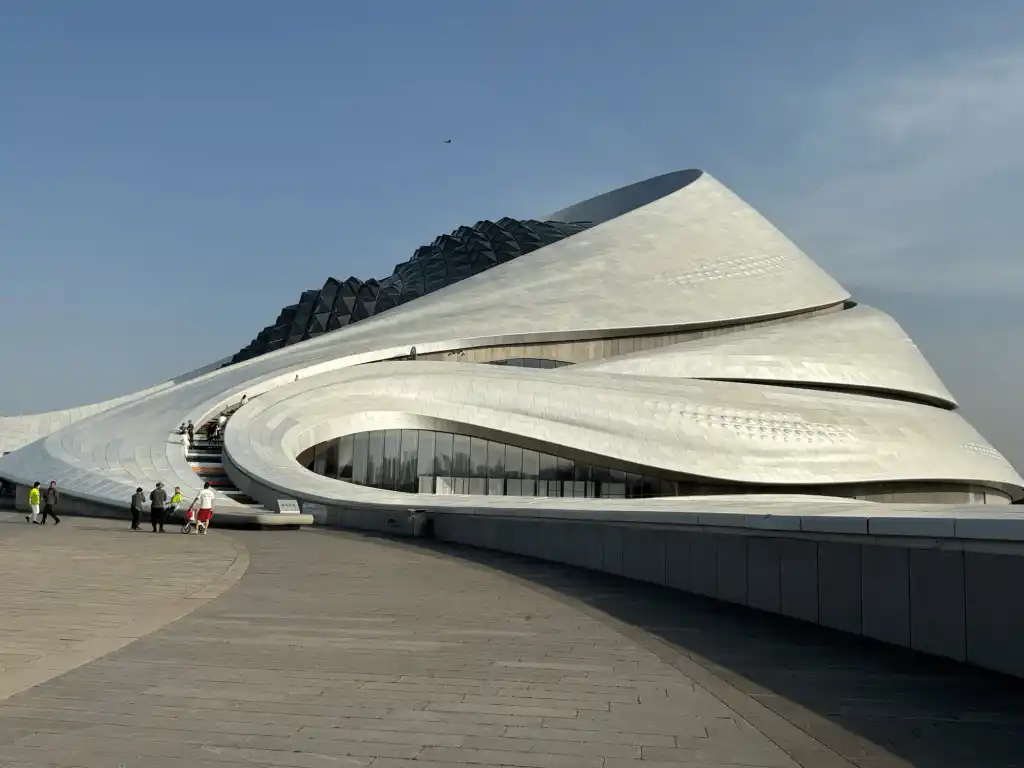
The Harbin Grand Opera House, designed by Ma Yansong and his firm, M.A.D., is one of the most astonishing buildings I have visited in recent years. What makes it even more remarkable is that the structure—M.A.D.’s first major cultural commission, completed in 2015—is poorly built, appears to have been barely maintained over the last decade, and is festooned with the banners, displays, and event clutter that plague many public buildings across China.
That the Opera House manages to sweep all of that aside—rising above it with such verve, surrounding visitors with exhilarating spaces, and activating a riverine landscape along the Songhua River designed by Turenscape—astonished me even more.
A Building That Shouldn’t Work
I was able to visit the building because Ma and his staff organized a tour of nine of the firm’s major projects. Of the buildings I saw, the Harbin project was the oldest and, perhaps because of its kick-out-the-jams exuberance and disregard for the niceties of how a building ultimately gets made, the most exciting.
It was also a symbol of what seems, to a frequent but still uninformed visitor, to be happening in China. The era of pell-mell growth is giving way to a period in which the country must step back, assess what it has built—both physically and socially—and determine what to do with those achievements.
China After the Boom
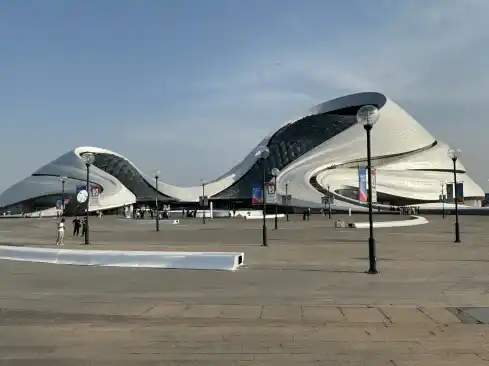
If the condition of the Opera House is any indication, that reassessment is not being especially well managed. Many of the museums I have visited recently in China are empty, and few are maintained with much care. Yet public appropriation is another story entirely.
I visited on a brisk spring Sunday, and the site was filled with picnickers, kite-flying families, amateur dancers, and just about every kind of public activity imaginable, even as the two concert halls sat empty.
A large part of the credit for this popular embrace belongs to the decision to design what is an almost 800,000-square-foot complex as an uprising of the land itself along the banks of the Songhua River.
A Landscape That Became Architecture
Turenscape, then led by the visionary Kongjian Yu—who tragically died last year in a plane crash in the Amazon—developed that concept into a meandering public landscape. The buildings merge not only with a secondary complex of museum and hotel, for which M.A.D. designed only the exterior, but also with the riverbank and the restored wetlands behind the site.
It is a public landscape that generates cultural activity rather than serving as a backdrop for it. Instead of placing an iconic building within a park, the designers made the park itself the generator of architecture.
Beyond Zaha
The Harbin project also reveals how Ma Yansong, after studying at Yale and working for Zaha Hadid, began developing his own architectural language following his first major commission, the “Dancing Towers” residential development outside Toronto.
If Hadid’s work used flowing lines to streamline structures, carving objects and voids from their accumulation, Ma adapted many of the same formal strategies toward different ends. His buildings are rooted as much in Chinese landscape painting and contemporary urban flows as they are in parametric design.
They rise, swell, and culminate in architectural forms. More importantly, they remain landscapes. Ma’s best projects are not objects sitting on the land; they are landscapes transformed into buildings.
Inside the Mountain
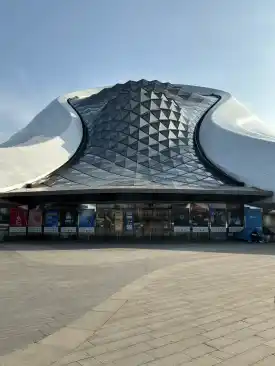
That approach is fully realized at Harbin.
Whether you arrive from the wetlands or from the tree-screened drop-off area, you ascend along sweeping curves. Visitors entering from the parking structure move through the mound itself, discovering an atrium filled with light before climbing upward from this cave-like space into the building proper.
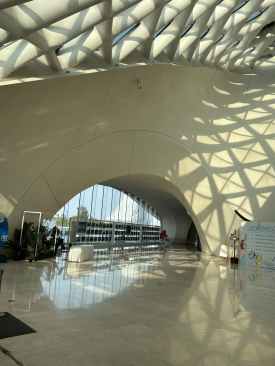
Inside, the caverns unfold into a continuous, sinuous sequence of arches, domes, and semi-domes. The movement settles toward the smaller 400-seat black-box theater while simultaneously rising toward what feels like an interior cliff face: a sculpted wall of wood containing the balcony foyers, linked by curling pathways that connect back to the main entrance level.
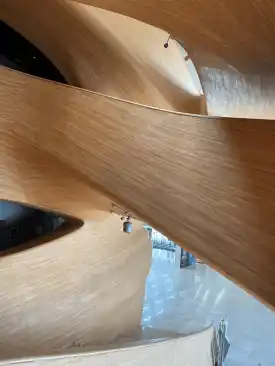
The experience is less like entering a building than moving through a geological formation.
The Room That Justifies Everything
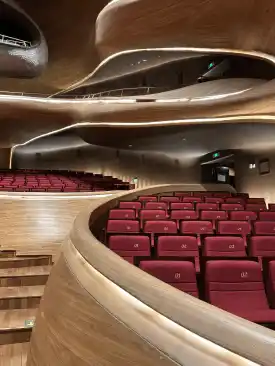
The 1,600-seat main hall continues the use of wood veneer, surrounding visitors with what appears to be a dense thicket of branches tracing the structural system that supports the auditorium.
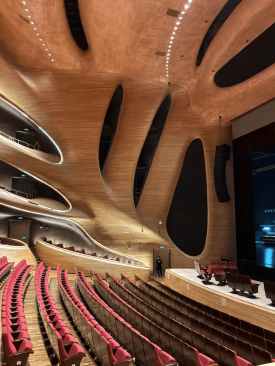
Walls, balconies, ceilings, acoustic treatments, and structure merge into a single continuous volume. The architects have carved seating sections from that volume rather than assembling them as discrete elements.
Functionally and formally, this room is the heart of the project.
Ma announces its importance on the exterior through the dramatic upward sweep of the roof, which rises to contain both the fly tower and auditorium while creating an outdoor viewing and performance platform above.
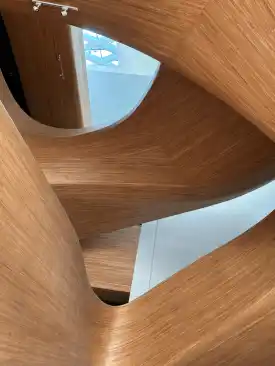
Visitors reach that platform as they would ascend a mountain—by circling upward along the building’s flanks. Along the way, hidden spaces reveal themselves: overlooks framing views of the river, intimate gathering spots tucked between structural layers, and moments where one can simply pause and study the folds and billows of the architecture.
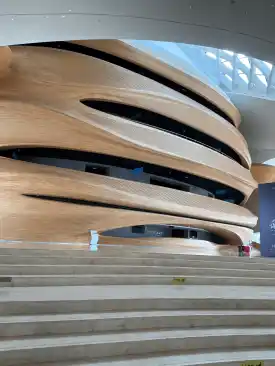
The building’s capacity to reveal new perspectives, coves, nooks, and visual surprises seems almost endless.
Cracks in the Dream
Yet as your eye and hand explore this landscape, signs of deterioration become impossible to ignore.
Cracks, creases, and delaminations appear throughout the building. Stains, discoloration, streaks, and patches interrupt the carefully sculpted surfaces. Heavy-framed windows are so murky that they sometimes obscure the views beyond.
Some of these flaws stem from M.A.D.’s ambition. The architects sought continuous curves that exceeded what technology and budget could comfortably achieve at the time. Others may reflect the firm’s relative inexperience on such a large and complex project.
Still more seem attributable to poor construction. Panels appear hastily installed. Edges fail to align. Alarms, lighting fixtures, and exposed pipes seem to have been added after completion with little regard for the overall design.
It does not appear that the windows have been thoroughly cleaned since the building opened. Fabrics show signs of wear. Finishes are frayed.
And then there is the clutter.
Advertisements from past performances linger throughout the building. Plastic tables sit abandoned as if waiting for meetings long since canceled. Sponsor banners and promotional displays crowd spaces that were clearly intended to be experienced as architecture.
Why the Flaws Don’t Matter
In my swept-off-my-feet state, those issues felt like minor irritations that were easy to overlook.
Whether returning audiences will feel the same is harder to say.
Having grown up around Europe’s aging cultural monuments, I have often watched renovations and additions diminish buildings rather than improve them. The Concertgebouw in Amsterdam comes to mind. Its tacked-on lobbies have compromised the integrity of the original structure.
I loved many of those weathered buildings despite their worn condition—and often because of it.
The Architecture of Weathering
For that reason, I am not convinced that the Harbin Opera House’s shoddiness diminishes its ambition, exuberance, or ultimate achievement.
The views and conclusions from this author are not necessarily those of ARCHITECT magazine.
Read more: The latest from columnist Aaron Betsky includes reviews of: The Bruce Springsteen Center | Zeitz MOCAA | The Fagan House |The Dries Van Noten Foundation | The Revenge of the Arch | Out There | The Shakers | The V&A Storehouse | Fins on Buildings | New Museum & The Studio Museum in Harlem | The Modern Museum | Monuments | Infrastructure | Interior Design | Viollet-le-Duc | Malibu High School | Architecture without Architects | Louis Kahn’s Fisher House | Meow Wolf | Generative AI | Frank Gerhy | Robert A.M. Stern | Lars Lerup | Princeton Art Museum | Victor Legorreta | Mexico City Underwater | On Vitruvius | On Olive Development | Calder Gardens | White House and Classical Architecture | Louis Kahn’s Esherick House | Ma Yansong’s Fenix Museum | The Cult of Emptiness | An Icon in Waiting | Osaka Expo | Teamlab | the Venice Biennale of Architecture | On Michael Graves | On Censorship or Caution? | Uniformity in Architecture | Book on Frank Israel | Legacy of Ric Scofidio| Fredrik Jonsson and Liam Young | DSR’s New Book | the Stupinigi Palace | Living in a Diagram | Bruce Goff | Biopartners 5 |Handshake Urbanism | the MONA | Elon Musk’s Space X | AMAA | DIGSAU | Art Biennales | B+ | William Morris’s Red House | Dhaka | Marlon Blackwell’s new mixed-use development | Eric Höweler’s social media posts,| Peter Braithwaite’s architecture in Nova Scotia,| Powerhouse Arts, | the Mercer Museum, | and MoMA’s Ed Ruscha exhibition.
Keep the conversation going—sign up to our newsletter for exclusive content and updates. Sign up for free.