
The Trump Administration has been loudly warning the American public about a so-called “Green New Scam”—a narrative it is using as cover to “permanently end” energy-efficient appliance and HVAC standards and roll back the 2024 International Energy Conservation Code (IECC).
Their message: Energy-efficient appliance and HVAC equipment standards “raise costs and disrupt consumer choice,” while updating to the 2024 IECC “would increase residential construction costs by more than $9.2 billion annually compared to the 2006 code levels.” This, they say, would saddle homebuyers with as much as $14,000 in extra construction costs with a 10- to 20-year payback period.
Simultaneously, they point to the energy demands of AI and hyperscale data centers to justify keeping aging coal plants open and incentivizing new fossil-fuel power plants, all while actively stifling clean energy development.
This administration’s narrative is the real scam. By relying on outdated and cherry-picked numbers, the administration is attempting to strip away policies that have in fact saved consumers trillions of dollars, all to prop up the flailing fossil fuel industry.
Here are the facts:
The $9.2 Billion and $14,000 Fiction
To arrive at that $9.2 billion cost and $14,000 per new home increase with a 10- to 20-year payback period, the administration uses a mathematical sleight of hand. They are calculating the cost of jumping to the 2024 IECC all the way from the outdated, 20-year-old 2006 IECC.
The problem? Almost no one in America builds to the 2006 code anymore. Today, only Oklahoma uses the 2006 IECC as a statewide minimum, and even there, most major local jurisdictions have adopted newer versions. The majority of U.S. states have adopted the 2018 or 2021 IECC, with a growing number of jurisdictions adopting the 2024 standards or their equivalent.
When you look at the facts—a jurisdiction transitioning from the 2021 to the 2024 IECC—the cost of the upgrade in a home purchase is roughly $2,000 to $3,000, according to analyses by the Department of Energy (DOE) and the Pacific Northwest National Laboratory (PNNL).
Furthermore, the annual energy savings pay off that initial cost in about 2.5 years. Better yet, if that $2,000 to $3,000 is rolled into a standard 30-year mortgage, the monthly utility bill savings exceed the slight increase in the monthly mortgage payment. The homeowner will usually see a net-positive monthly cash flow in the very first year.
The $3.48 Trillion Success Story
Why is the administration so eager to roll back building energy codes and eliminate appliance and HVAC standards when efficiency is reducing U.S. energy demand and saving Americans trillions of dollars in the process?
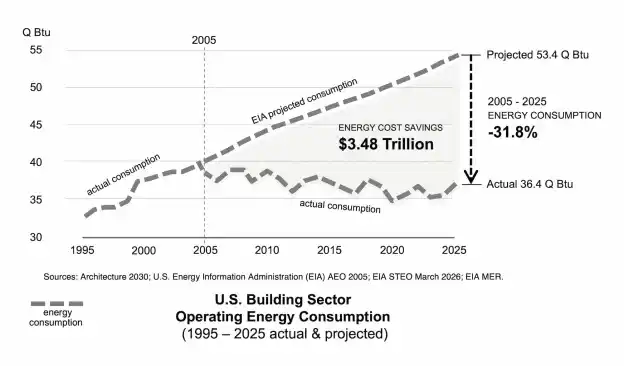
Back in 2005, the Energy Information Administration (EIA) projected that between 2005 and 2025, the U.S. building sector would increase its energy consumption by 34.8% (growing from 39.6 to 53.4 Quadrillion Btu [QBtu]).
Instead, the exact opposite happened. Driven primarily by the adoption of energy-efficient building codes, appliance and equipment standards, and smarter planning and building design, energy consumption during that 20-year period didn’t increase—it decreased by 31.8% from projected 2025 levels to 36.4 QBtu. This happened even as the building sector grew by over 70 billion square feet.
This remarkable decoupling of building sector growth from energy use was achieved through a transformation in how we design and build. Thoughtful urban planning and site design optimize building orientation, maximizing natural light and reducing the need for mechanical climate control. Architects increasingly embraced passive design strategies—using the sun and thermal mass to warm spaces in winter, while leveraging natural ventilation, shading, and high-performance envelopes for summer cooling.
Additionally, accelerating the shift toward building electrification—replacing fossil-fuel combustion with highly efficient heat pumps and induction technology—has exponentially compounded these energy reductions. Paired with the growing use of biobased materials, architecture has fundamentally changed the energy demand of the American built environment.
The financial result of this design and efficiency boom is staggering: $3.48 trillion in total consumer building operations energy cost savings over that period. Even the Department of Energy’s own 2017 report confirmed that just the appliance and equipment standards adopted through 2016 would save consumers “more than $1 trillion by 2020 and more than $2 trillion by 2030.”
In 2025 alone, efficiency measures have saved American energy consumers about 16.96 QBtu from 2005 projections, or $249 billion dollars.
The administration often claims these mandates must be scrapped because they make appliances too expensive for everyday Americans, but once again, historical data proves this is not the case. Retrospective studies by the DOE’s own Lawrence Berkeley National Laboratory have repeatedly found that in many cases retail prices actually fall after new standards take effect.
Driven by manufacturing innovation, high-efficiency components become the mass-produced baseline. That is why a 2017 refrigerator uses 75% less energy, holds 20% more food, and costs half as much to buy as it did in 1973. And the savings are only accelerating: according to the DOE’s 2025 data, appliance standards now save the average American household $576 every single year on their utility bills—and a new refrigerator standard finalized in 2024 is projected to save consumers an additional $36 billion over the next three decades.
In reality, the administration’s plan to axe these standards does not save consumers money. To the contrary, it will significantly increase energy consumption to the ultimate detriment of the consumer.
The AI and Data Center Smokescreen
To justify bailing out aging coal plants and building new coal and gas plants, the administration claims that the rise of AI and hyperscale data centers will overwhelm the grid unless we double down on fossil fuels. But a look at U.S. electricity generation from 2010 to 2025 tells a completely different story.
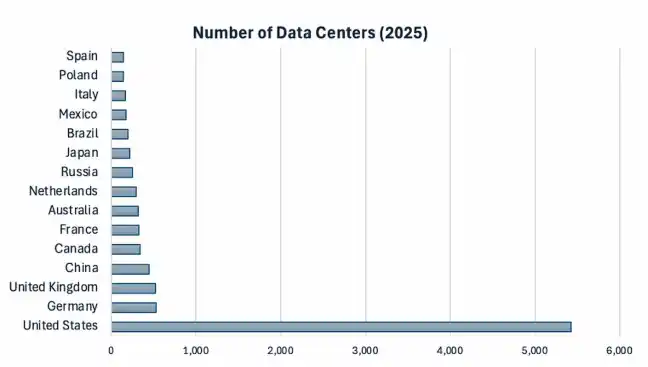
Note: Number of data centers according to late-2025 data from Cloudscene.
Over that 15-year span, the U.S. built the largest fleet of data centers in the world—significantly larger than Europe and China combined, including about half the world’s hyperscale facilities. Yet total U.S. grid electricity demand grew by a modest 332,984 MkWh.
Meanwhile, the U.S. saw a massive 627,452 MkWh surge in added non-CO2 generation (mostly wind and solar). Renewable energy growth was so large that it didn’t just meet the entire growth in grid demand—including the boom in hyperscale data centers and AI—it successfully replaced 294,466 MkWh of fossil fuel generation.
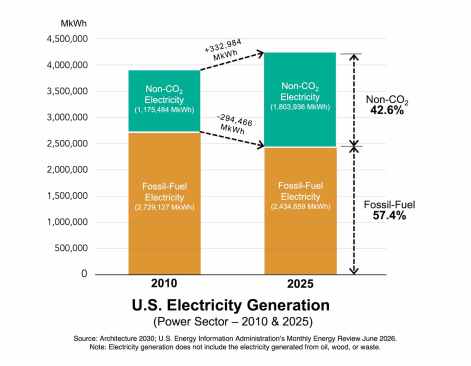
How did the grid handle the massive construction boom and the electrification of the economy without relying on new coal? Because the massive energy efficiency gains in the building sector offset most of the new electricity demand and clean energy continues getting cheaper.
So, what is the REAL new scam here?
The “Green New Scam” narrative is a calculated effort to prop up the dying fossil fuel industry. The administration wants the American public to believe energy efficiency is an expensive luxury by weaponizing outdated numbers from 2006.
In reality, they are dismantling the exact codes and standards that have kept the grid stable, allowed renewable energy to flourish, and saved American consumers trillions of dollars.
The real scam isn’t about protecting consumer choice. It’s about increasing building energy consumption, saddling Americans with higher energy bills, sacrificing public health, slowing the transition to renewables, and enriching the flailing fossil fuel industry at the expense of the consumer.