I was reminded of how beautiful and even meaningful ruins can be when I recently visited the Jinhua Architecture Park –or what is left of it.
The words of the theoretician Susan Stewart came to mind: “Anomalies in the landscape of the present, ruins… stand poised between the forms they were and the formlessness to which, in the absence of restoration, they are destined. They lose their original purpose and have the singularity of artworks, yet they are severed irremediably m their contexts of production. In the present they are fused, almost always destructively, with their immediate natural environments. They call for an active, moving viewer –often a traveler with a consciousness distinct from that of a local inhabitant—who can restore their missing coordinates and names.” Jinhua Park calls for such a viewer.
The park was conceived by the artist Ai Weiwei as a linear landscape populated by seventeen pavilions from architects around the world. Completed between 2004 and 2007, the project assembled works by architects from around the world, including Pritzker winners past and perhaps future, such as Wang Shu, Tatiana Bilbao, Yung Ho Chang, Toshiko Mori, Herzog & de Meuron, and Liu Jiakun, into what amounted to an international exhibition of contemporary architecture spread along the banks of the Yiwu River.
The whole was part of the redevelopment of Jinhua’s Jindong New District by Herzog & de Meuron. At its most banal, the Park was an amenities zone for this huge residential district.
The pavilions were conceived as usable buildings—a café, teahouses, exhibition spaces, a bookstore, a newsstand, and bathrooms. However, depending on who you talk to, operators were never found, the city did not take care of the park or, what seemed most evident to me, a change in political and economic direction led to a focus on development elsewhere in the city, leaving the Park without sufficient users.
The structures that have survived the lack of attention and maintenance most intact are the ones that eschewed a focus on use in favor of monumentality.
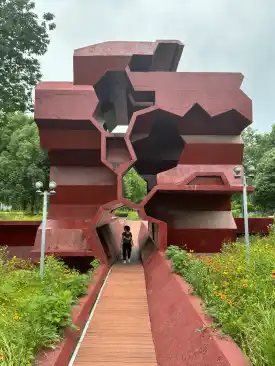
Herzog & De Meuron Zen Space.
The most evident structure in that category is the steel tower Herzog & de Meuron designed to tower over everything around them. The red-painted plates that pile up over a narrow gateway sunken a few feet below surface level might allude in an abstract manner to the roofs and decorations you can find in Chinese temples, but mainly they lead your eye up and around, reverse a sense of solidity and openness as they turn, and make this triumphal arch into an enigma that seems even more fitting now that whatever meaning the Park might once have had is long gone.
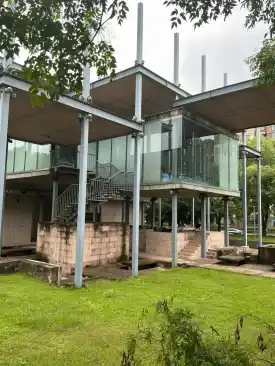
Liu Jiakun Teahouse.
Against this massiveness Liu Jiankun offer delicacy in the form of five tea houses he lifted off a grassy field on a steel structure. Though I have a hard time imagining tea being served there with any of the kind of ritual such pavilions usually house, the objects dancing around one of the large clear areas in the Park, their translucent skins and roof stained into colors that echo the grass below, work now as signs of occupation and contemplation rather than the real thing.
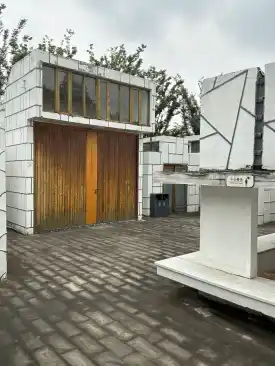
Yung Ho Chang Comprehensive Space.
The combination of their lightness and their inaccessibility, despite the metal stairs leading up to them, evoke English garden follies.
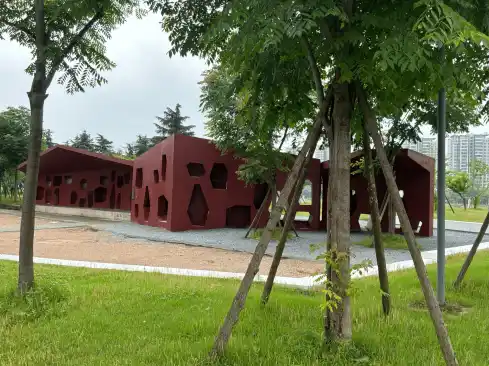
HHF Playground.
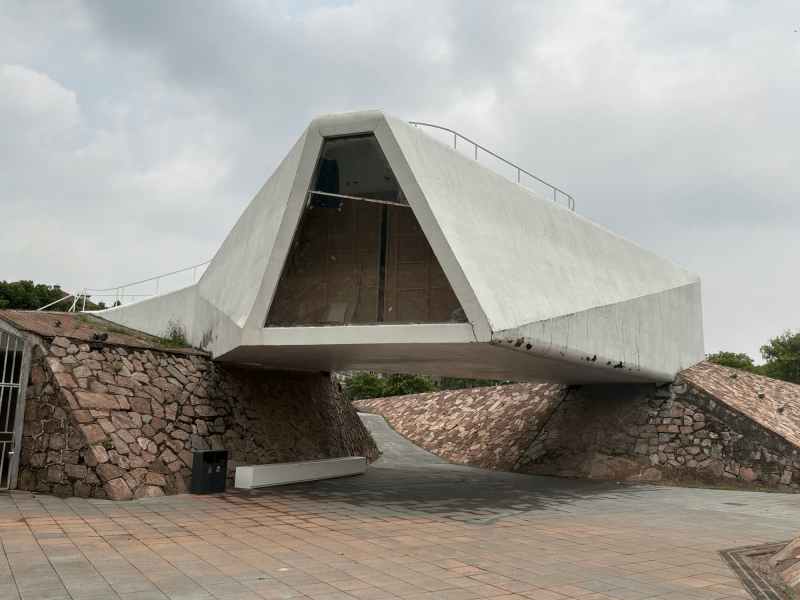
FR-EE’s (Mexican architect Fernando Romero’s old firm) red bridge was also intended as a tea house, but its angular shape signs the structure of spanning with no purpose.
Similarly, Christ and Gantenbein’s Ancient Tree, a mushroom of concrete planes drooping over the ground, is less successful, perhaps because it was always intended as a sign, in this case of nature.
Against these only partially unintended monuments, those designs that are unfinished by design promise a future while letting you think on the ambitions of the past.
Johan de Wachter and FünDC designed a steel scaffolding whose vertical members ascend past glass pavilions hovering a floor up from the ground. It was intended to be, and for a while was, a restaurant, but now it is another indication, this time of modernism as an always unfinished project through which both time and activities flow.
Zhang Yonghe’s Comprehensive Space, a village of pavilions clad in a nervous rhythm of ceramic tiles and extending themselves with clerestory towers, overhangs, and cut-outs, lets you imagine a village for small people, perhaps either children or gnomes who only come out exactly when there is nobody in the Park.
It might take a village, but if there is no community to make, perhaps we can have a monument to such an effort.
There are other beautiful objects on site that seem stranger without their uses, but they are less able to evoke something beyond themselves.
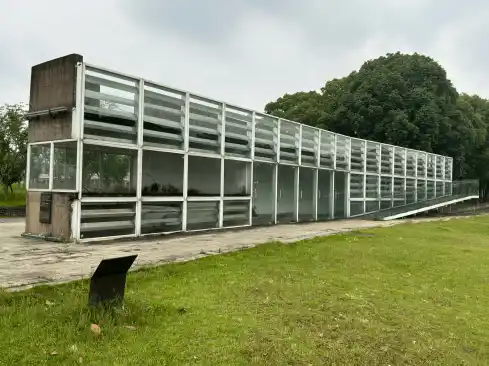
Toshiko Mori Newstand.
I loved Toshiko Mori’s linear Newspaper Café, especially the way in which its long shape extends out and splits into a lower and cantilevered upper part, as if it was waving the newspapers that are now long gone.
Wang Xing Wei and Xu Tian Tian’s toilet are equally expressive but forlorn objects, their heads gesturing to the sky but their entrances boarded up. Wang Shu’s Coffee House is an essay in reused brick with little affect.
Tatiana Bilbao lifted a space meant for exhibitions on two stone-clad mounds. It’s L-shape is distorted in every proportion, leaving it to gesture rather inelegantly, in my opinion, over the landscape. It mirrors Michael Maltzan’s Book Bar, a rhomboid cut through with small windows and poised on a smaller base.
As you meander along the course of the river you weave in and out of open and planted area, encountering ith the seventeen objects preening, gesturing posing, or just standing silently in their abandoned playground, waiting for somebody to admire the skill that went into designing and making them.
They now serve as markers rather than as activators, and I would suggest that the best thing that could happen to them is that their boarded up or cracked doors and windows could be removed, whatever hazards decay has created remediated, and that they are then left for us to explore as relics of themselves in the manner Stewart has suggested.
After visiting Jinhua Architecture Park, I felt like one of those English romantic poets who went to the ruins of places such as Tintern Abbey, but also like one of the painters who went to the mountains, crags, and waterfalls of China and fixed them on scrolls with just a few brushstrokes.
I am neither poet nor painter enough to follow in their footsteps, but I would suggest that future miners into the meaning of the humanmade Chinese landscape of the turn of the Millennium might find greater inspiration here than in the slick and grand expressions of our current economy and ideology.