Walk through almost any major international furniture fair and the machinery of the design industry quickly becomes visible. Established manufacturers occupy enormous stands, familiar designers introduce new collections, buyers move from appointment to appointment, and thousands of objects arrive beautifully finished, photographed, priced, branded, and ready to enter the global marketplace. Trade fairs are exceptionally good at showing us what the design industry looks like at a particular moment.
They are less reliable at revealing how an unfamiliar designer becomes part of that system in the first place.
At Maison&Objet’s September 2026 edition, taking place September 10–14 at Paris Nord Villepinte, that question may be more interesting than any individual chair, lamp, textile, or table on display. The fair has increasingly positioned itself not simply as a marketplace for finished products but as an intermediary between emerging creative practices and the commercial infrastructure that can transform an experimental idea into an international career. Nowhere is that role more visible than in the Design District, a concentrated environment within the fair devoted to young designers, experimental studios, emerging companies, and new approaches to making.
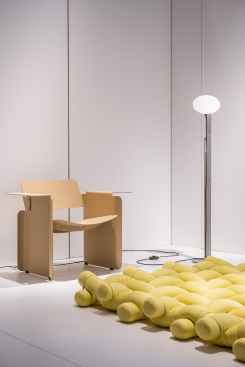
Rising Talent: 1148 Photo courtesy Anne Emmanuelle Thion.
The district brings together several of Maison&Objet’s talent-development initiatives, including Future On Stage, which introduces young companies to the international marketplace, and the Rising Talent Awards, which this September focuses on South Africa. But perhaps the clearest indication of what Maison&Objet is trying to accomplish can be found in the people overseeing the district itself. Its artistic directors are Hall Haus, the young French collective founded by Abdoulaye Niang, Sammy Bernoussi, Teddy Sanches, and Zakari Boukhari, whose own trajectory demonstrates how quickly the boundaries between emerging designer, entrepreneur, curator, and cultural producer are disappearing.
Hall Haus was first identified and supported by Maison&Objet in 2021. Five years later, the collective is not simply exhibiting at the fair. It is helping determine how a new generation of designers is presented there.
That transition—from emerging talent to cultural gatekeeper—is important because it suggests a larger change taking place within design. For much of the 20th century, the international furniture industry operated through relatively established pathways. Designers developed objects; manufacturers produced them; retailers sold them; magazines publicized them; museums eventually canonized some of them. Geography mattered enormously. Milan, Paris, London, Copenhagen, New York, and a relatively small number of other cities possessed the manufacturers, schools, galleries, publications, fairs, and cultural institutions capable of turning designers into international names.
That system has not disappeared. But the designers entering it are increasingly unwilling to remain within its traditional boundaries.
From an Object to an Entire World
Hall Haus is an unusually good example. Its practice encompasses furniture, installations, scenography, artistic direction, visual identity, cultural programming, and events. Instead of treating those activities as separate disciplines, the collective approaches them as components of the same project. An object is rarely conceived without consideration of the environment around it, the narrative attached to it, the audience that will encounter it, and the cultural references that give it meaning.
The approach was already evident in the Curry Mango chair, a 2021 project that Hall Haus describes as foundational to its practice. The chair brought together references that conventional design history might have placed at opposite ends of the cultural spectrum. Hall Haus looked toward the inexpensive Quechua chair associated with accessible popular culture while simultaneously referencing Marcel Breuer’s P3 chair and the tubular-steel language of the Bauhaus.
The combination was more than a formal exercise. For generations, design culture established fairly rigid hierarchies between objects considered worthy of museums and those dismissed as anonymous, ordinary, commercial, vernacular, or cheap. A Breuer chair could enter the permanent collection and the history book. A mass-produced plastic chair might appear on millions of balconies, sidewalks, campgrounds, and backyards without its designer ever being known.
Hall Haus treats both as sources of legitimate design intelligence. Rather than choosing between the modernist canon and popular culture, it allows them to collide. Even the name Curry Mango becomes part of the project, helping construct an identity around the object that extends beyond its physical form.
The collective continued that exploration with the DKR chair, created in 2022 and presented at Maison&Objet in January 2023.
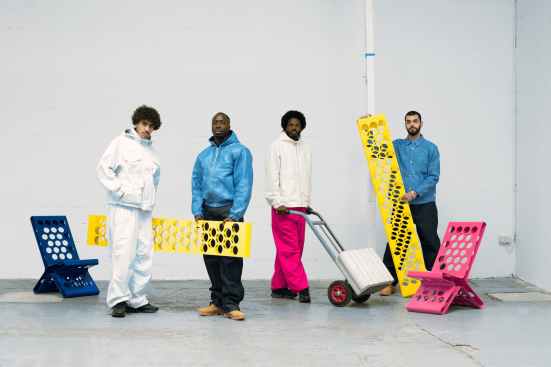
Hall Haus. Photo courtesy Marion Gomez Copie.
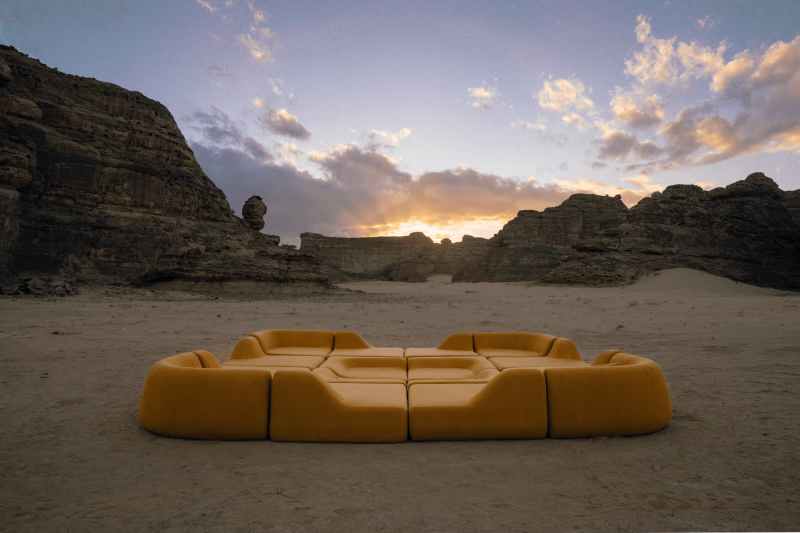
But another project, Haus Dari, demonstrates more clearly how far its definition of furniture can expand. Developed following an invitation connected to AlUla, Saudi Arabia, the project drew from the traditional majlis, where carpets and movable cushions establish informal social environments, while also referencing the relaxed geometry of Michel Ducaroy’s famous Togo sofa for Ligne Roset. Hall Haus transformed those references into a roughly 36-square-meter seating landscape—a giant piece of furniture that operates almost as a room.
What makes these projects compelling is not the search for a single recognizable Hall Haus style. In fact, stylistic purity seems almost beside the point. The collective operates instead through translation: popular culture meets canonical modernism; European furniture history encounters North African and Middle Eastern traditions; an object becomes an environment; furniture becomes architecture.
That fluidity increasingly resembles the conditions under which younger designers actually work.
Architecture and design schools continue to organize themselves around recognizable disciplines—architecture, interiors, industrial design, graphic design, landscape architecture—while professional organizations and awards often reinforce the same categories. But clients and audiences increasingly experience design differently. A hotel is simultaneously architecture, furniture, lighting, graphics, landscape, food, sound, technology, branding, and service design. A retail environment can also function as a gallery, restaurant, event venue, media platform, and social club. Even a chair launched by a young studio may require photography, storytelling, social media, exhibition design, packaging, and an entire visual universe before anyone notices it.
For emerging designers, designing the object can therefore be only half the job. The other half is designing the context in which that object becomes meaningful.
Hall Haus pushed that proposition further through its work with Lafayette Anticipations in Paris. Instead of simply placing furniture inside the cultural institution, the collective created Hall Haus Design Days, developing programming across the building that incorporated installations, invited projects, music, performance, furniture, and cultural events. The members effectively became designers, producers, programmers, scenographers, and curators at once.
From Trade Fair to Talent Incubator
The shift also points toward a changing role for international design fairs themselves. Historically, fairs were primarily commercial infrastructure. Manufacturers rented stands, launched products, wrote orders, met distributors, entertained clients, and cultivated relationships with architects, interior designers, retailers, and the press. All of that remains fundamental to Maison&Objet, which is first and foremost an enormous marketplace.
But the most influential fairs have also become talent-discovery systems, and Maison&Objet has made that function increasingly explicit.
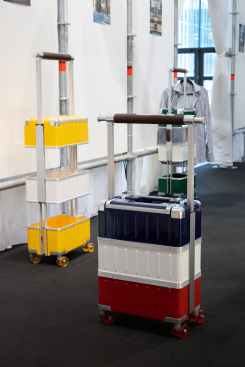
Future on Stage.
Its Future On Stage initiative places three young companies before an audience of buyers, journalists, retailers, manufacturers, designers, and specifiers. The September 2026 edition highlights Baguette Studio, Risette, and LightMass, emerging enterprises working across different areas of contemporary design. The importance of the program lies not merely in giving each company exhibition space. It provides access to the network surrounding that space.
Design history tends to celebrate the moment of creative invention—the sketch, prototype, breakthrough material, or radical new form—but successful design rarely happens through creativity alone. A designer needs somebody capable of manufacturing the work, someone willing to distribute or sell it, journalists and photographers capable of communicating it, clients prepared to specify it, and eventually people willing to live with it. The mythology of the solitary designer can obscure the enormous ecosystem required to turn an idea into an industry.
For an emerging practice, access to that ecosystem can matter almost as much as the object itself.
A fair compresses much of it into a few days and a few hundred meters of exhibition space. A young designer can meet a retailer in the morning, a journalist at lunch, a potential manufacturer in the afternoon, and another designer at a party that evening. None of those encounters guarantees anything. Collectively, however, they can accelerate a career in ways that are difficult to reproduce online.
That role has become more important as the conventional route into professional design has fragmented. Young studios may now begin on Instagram rather than through a manufacturer. They can fabricate limited editions themselves, collaborate with local workshops, crowdfund production, sell directly to consumers, stage temporary installations, work between commercial commissions and cultural projects, or build an audience before they ever establish a conventional business.
Digital culture has dramatically democratized visibility. It has not necessarily democratized access.
Anyone can post an image of a prototype. Far fewer people can put that prototype in front of an international retailer, a major manufacturer, a museum curator, or thousands of professional visitors in Paris. That is where the physical design fair retains enormous power. In an increasingly digital industry, it remains a place where virtual attention can become a physical relationship—and potentially a commercial one.
South Africa and a Changing Design Geography
The question of access becomes even more significant in the 2026 Rising Talent Awards, where Maison&Objet has turned its attention to South Africa and seven emerging designers and studios. The program is notable not simply because it brings another national design scene into a European fair, but because it reflects how dramatically the old geography of international design is changing.
For much of modern design history, influence was narrated as though it moved outward from a remarkably small number of European and North American centers. Milan produced Italian design; Copenhagen helped define Scandinavian modernism; Paris mediated luxury and the decorative arts; London became a center for experimental design culture; New York linked design to an enormous consumer market. Other regions frequently supplied raw materials, craft traditions, manufacturing capacity, or aesthetic inspiration, but the institutions deciding what counted as important contemporary design remained heavily concentrated in Europe and North America.
That map has become increasingly difficult to sustain.
Contemporary South African design alone reveals why. Designers there work within a complicated network of indigenous traditions, colonial and apartheid histories, extraordinary craft knowledge, sophisticated contemporary art and fashion scenes, industrial production, economic inequality, global media, and rapidly changing cities. The resulting work does not conform to a single national aesthetic, nor should it.
Among the designers selected by Maison&Objet, Ashleigh Lloyd works with materials including rope to produce sculptural seating and lighting, transforming familiar techniques and materials into objects that can read almost architecturally.
Meetlo Studio, founded by Oageng Manana and Tshegofatso Ramothibe, investigates relationships between cultural inheritance and contemporary design.
Simphiwe Mlambo approaches objects through technical as well as conceptual experimentation, while Tanisha Neill, founder of NISH, explores suspended volumes and compositions that introduce movement and spatial ambiguity into the experience of objects.
What connects such practices is less a recognizable South African style than a willingness to reconsider how materials, cultural references, craft, and contemporary production can interact.
That distinction matters because international exhibitions have historically had a complicated relationship with national identity. World’s fairs organized architecture through national pavilions. Museums classified objects geographically. Governments promoted design as a form of cultural diplomacy and economic development. Design weeks became associated with cities, and certain countries successfully constructed international identities around furniture, fashion, architecture, and craft.
The system produced powerful cultural shorthand: Scandinavian design, Italian design, Japanese design.
It could also create a trap. Designers from countries outside the established centers were often expected to perform their geography in ways that European or American designers were not. A Danish designer could simply design a chair. A designer from an underrepresented region might find themselves expected to explain what the chair revealed about national identity, craft heritage, colonialism, local materials, globalization, or cultural authenticity.
The more interesting interpretation of Maison&Objet’s South African program is one that permits designers to move beyond that burden. Local identity remains relevant, as do inherited craft knowledge, materials, and techniques, but they can operate as resources rather than restrictions. A weaving technique can carry generations of knowledge while producing an object that looks entirely contemporary. A designer can engage cultural memory without producing nostalgia. Local fabrication can coexist with global distribution.
The relationship between local and international design becomes reciprocal rather than hierarchical.
Why Craft Looks Increasingly Like the Future
This new geography also complicates another persistent assumption in design culture: that craft represents the past while technology represents the future.
Contemporary designers increasingly reject that opposition. Across international fairs and design weeks, weaving, carving, ceramics, metalworking, glassmaking, embroidery, casting, and other forms of skilled hand production are appearing alongside digital fabrication, computational tools, artificial intelligence, advanced materials, and sophisticated industrial manufacturing. The two worlds do not necessarily compete. They frequently reinforce one another.
There are practical reasons for this renewed interest. Local craft can shorten supply chains and make use of materials ignored by industrial production. Small-batch manufacturing allows experimentation without the enormous tooling investments required for mass production. Repairable objects can remain useful longer. Designers can modify processes rapidly because the distance between designer and maker is smaller.
But craft offers something else that is becoming increasingly valuable: difference.
Design now circulates in a visual culture saturated with frictionless images. Rendering software can create extraordinarily persuasive environments that do not exist. Artificial intelligence can generate endless variations of objects in seconds. Social media can make unrelated interiors produced thousands of miles apart begin to resemble one another.
Physical materials remain stubbornly less compliant. Wood moves. Clay shrinks and cracks. Metal bends. Glass breaks. Fibers stretch. Pigments behave differently on different surfaces. A craftsperson understands those variables not as abstract data but as accumulated bodily knowledge.
Materials resist, and that resistance produces information.
This helps explain why craft can appear unexpectedly radical within contemporary design. It introduces irregularity into systems optimized for sameness. It preserves knowledge that cannot always be separated from the person making the object. And it offers young designers a route into production that does not necessarily require an enormous industrial partner.
The growing visibility of designers working between craft and contemporary production in South Africa and elsewhere should therefore not be understood simply as a revival of tradition. It represents a search for alternative forms of design intelligence.
A More Complicated Global Design Map
South Africa is part of a much broader redistribution of attention. Over the past decade, international design audiences have become increasingly aware of practices emerging from Mexico, Brazil, Colombia, India, Nigeria, Lebanon, Saudi Arabia, the United Arab Emirates, Thailand, South Korea, and numerous other places that once occupied relatively peripheral positions within the mainstream design press and fair circuit.
This does not mean Milan, Paris, Copenhagen, London, and New York are disappearing as centers of influence. They retain extraordinary concentrations of manufacturers, schools, museums, galleries, publications, capital, retailers, collectors, and cultural institutions. Paris’s continued importance is precisely why appearing at Maison&Objet can matter.
What is changing is the idea that those places possess a monopoly on legitimacy.
Digital communication has accelerated that transformation. A designer in Johannesburg, Mexico City, Beirut, or Mumbai no longer needs to wait for a Milanese manufacturer or European magazine to make a project visible internationally. Work can circulate globally almost immediately. Designers can build audiences themselves, contact collaborators directly, sell work online, and participate in cultural conversations occurring thousands of miles away.
Paradoxically, that makes the physical fair more rather than less interesting.
The internet is extremely good at circulating images. It is much less successful at communicating weight, texture, comfort, scale, smell, joinery, structural stability, or the thousands of other qualities through which we actually experience objects. You can look at 10,000 chairs online. At a fair, you can sit in one. You can turn it over, inspect the joint, touch the surface, ask where the material came from, discover who fabricated it, and find out whether the beautiful prototype visible on a screen actually works.
More importantly, you can meet the person who made it.
That is the real currency of a fair such as Maison&Objet. It distributes not simply objects but relationships and attention.
And attention is one of the design industry’s most valuable resources.
Who Gets a Seat at the Fair?
The distribution of that attention is not neutral. International fairs are expensive. Floor space costs money. Travel costs money. Shipping prototypes across borders costs money. Building an installation, producing samples, hiring photographers, printing materials, and taking a small studio away from paying work for a week all cost money.
Those realities inevitably favor established companies and designers who already possess financial resources or live within countries with stronger design infrastructures.
Programs such as Future On Stage and the Rising Talent Awards attempt to intervene in that imbalance by creating protected space within a massive commercial environment for designers who might otherwise struggle to appear there. They cannot eliminate the structural inequalities of the international design economy, but they can change who enters the room.
Once that happens, the effects can compound.
A retailer can discover a studio and place an order. A manufacturer can propose a collaboration. A journalist can introduce a designer to a larger audience. A curator can remember a name for a future exhibition. Designers can discover one another and eventually work together. What appears during the fair as a temporary booth can become the beginning of a professional network that lasts for years.
Hall Haus itself provides evidence of how that process can work. Maison&Objet identified the collective early, when it was still establishing its practice. The relationship continued as Hall Haus developed projects, collaborations, and a larger cultural presence. By 2025, its work had entered the collections of France’s Mobilier National, and the collective had moved from being a participant in the fair’s emerging-design ecosystem to becoming artistic director of the Design District.
There is a significant difference between giving a young designer exhibition space and giving that designer institutional authority.
Maison&Objet has effectively done both.
Hall Haus is now helping determine which stories the fair tells about emerging design and how those stories are presented. That shift is perhaps the most convincing argument for the importance of talent programs: the institution has not simply showcased a new practice. It has allowed that practice to participate in shaping the institution.
What Comes After the “Emerging Designer”?
There is an irony embedded in the design industry’s obsession with the word emerging. We speak constantly about emerging designers, emerging studios, emerging markets, and emerging talent, as though everyone is moving toward a fixed center that has already been established.
But many of the designers receiving that label are not particularly interested in arriving at the old center.
They are building different professional models. They sell directly to consumers. They collaborate with craftspeople instead of conventional factories. They produce limited editions. They design exhibitions rather than waiting for galleries to invite them into one. They become curators and cultural programmers. They build audiences online. They move among furniture, architecture, fashion, music, graphics, art, and performance without worrying excessively about which discipline owns the territory.
Hall Haus is particularly representative of that generation because its cultural identity and professional identity are both difficult to reduce to a single category. Its work moves freely among references that previous generations of design criticism might have separated into high and low, European and non-European, mass-produced and handcrafted, commercial and cultural.
Rather than resolving those contradictions, the collective works inside them.
That ability to translate among different worlds may become one of the defining design skills of the next decade. Designers are increasingly expected to operate across cultures, technologies, disciplines, materials, and scales. They must understand global production while responding to local conditions. They may use artificial intelligence and handcraft within the same project. They must navigate environmental limits, cultural histories, new business models, changing patterns of consumption, and technologies that are transforming not only how objects are made but how quickly they can be imagined.
In that environment, the most successful designer may not be the person with the most recognizable formal signature. It may be the person most capable of connecting things that previously appeared unrelated.
The Design District at Maison&Objet suggests that emerging designers already understand this. What is taking shape is not simply a younger version of the existing design establishment. It is a culture that is more geographically dispersed, more culturally hybrid, more comfortable moving between craft and technology, less obedient to disciplinary boundaries, more entrepreneurial, and increasingly skeptical of the assumption that innovation always travels from the center outward.
There will still be thousands of products to see when Maison&Objet opens in Paris this September: chairs, lamps, tables, rugs, ceramics, textiles, accessories, and enough beautifully staged objects to exhaust even the most committed visitor. That abundance remains part of both the pleasure and the commercial purpose of the fair.
But the objects worth watching most closely may not necessarily be the ones arriving from the companies we already know.
They may be the imperfect prototype made by a studio few visitors have heard of, the woven light that carries generations of material knowledge into an unfamiliar form, the young company trying to turn an experimental idea into an actual business, or the collective that entered the fair five years ago as an emerging talent and now finds itself deciding who should come next.
Design fairs have always been machines for distributing objects. Their more consequential role today may be distributing attention: determining which designers meet manufacturers, which experiments reach retailers, which names reach journalists and curators, and ultimately which ideas become part of the larger story of design.
For much of the last century, that story was written from a surprisingly small number of places. Maison&Objet’s Design District suggests that the next chapter will be much harder to locate.
The future of design may still pass through Paris. It is simply no longer guaranteed to begin there.this is a text for the rest of the story