The architecture profession’s prolonged business slump is deepening, and the latest figures suggest that a meaningful recovery remains elusive. After months of uneven performance and tentative signs of stabilization, architecture firms experienced another setback in September, as declining billings, weakening design contracts, and increasingly cautious clients reinforced concerns about the industry’s economic outlook.
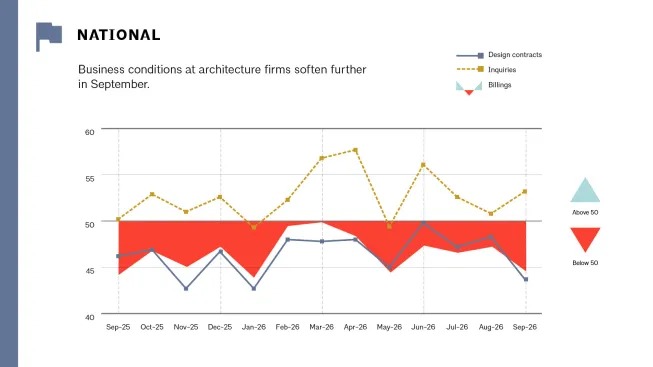
The September AIA/Deltek Architecture Billings Index (ABI), released October 21 by the American Institute of Architects (AIA), fell to 44.7, down from 47.2 in August. The decline represents the largest share of firms reporting falling billings since May, underscoring the persistent challenges facing an industry struggling with sluggish demand, difficult financing conditions, and uncertainty over when stalled projects might move forward.
Because the ABI measures changes in billings, rather than their dollar value, any score below 50 indicates that more firms are reporting declining billings than increasing billings. September’s reading, therefore, points not simply to another disappointing month but to a broader deterioration in business conditions.
Perhaps more troubling is the widening disconnect between prospective work and projects actually moving into design. Inquiries for new projects rose modestly to 53.2, suggesting that clients continue to explore development opportunities. Yet the index for newly signed design contracts fell to 43.7, indicating that those conversations are increasingly failing to translate into actual commissions.
For architecture firms, that distinction is critical. Interest in future projects may be holding up, but without signed contracts, inquiries offer little immediate relief for practices managing staffing, overhead, and increasingly unpredictable workloads.
“This is an increasingly difficult environment for architecture firms,” said AIA Chief Economist Richard Branch. “Weakening billings are being compounded by a soft economy, challenging project financing and growing caution among clients. With fewer projects moving forward, there is little reason to expect a meaningful improvement in business conditions in the near term.”
A Recovery That Looks Increasingly Uneven
The national figures conceal significant regional differences, revealing an architecture market in which geography continues to play an important role in determining business prospects.
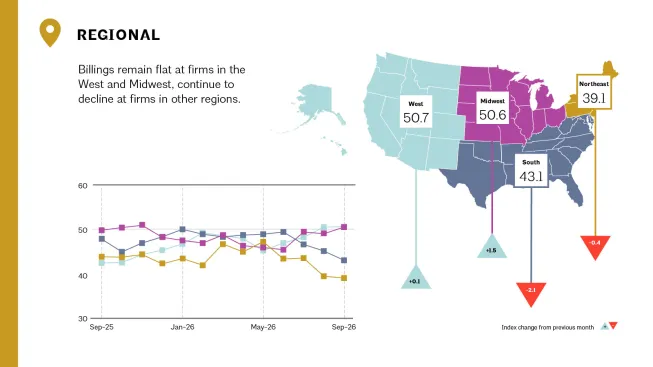
The Northeast remains the industry’s weakest region, with an ABI score of just 39.1. The reading indicates widespread declines in billings among firms in the region and reflects a particularly difficult operating environment for practices dependent on new commissions.
Conditions in the South also continued to deteriorate, with the regional index falling to 43.1. The weakness in these two regions contrasts with comparatively stable conditions in the Midwest and West, where scores of 50.6 and 50.7, respectively, indicate essentially flat to modestly improving billings.
The divergence suggests that the downturn is neither geographically uniform nor inevitable for every firm. But with two major regions reporting substantial contractions, the relatively stable performance elsewhere has not been sufficient to lift the national index back into positive territory.
The regional figures, calculated as three-month moving averages, also suggest that the challenges are more persistent than a single month’s fluctuations might indicate.
Multifamily Housing Continues to Lose Ground
Differences among building sectors are equally revealing.
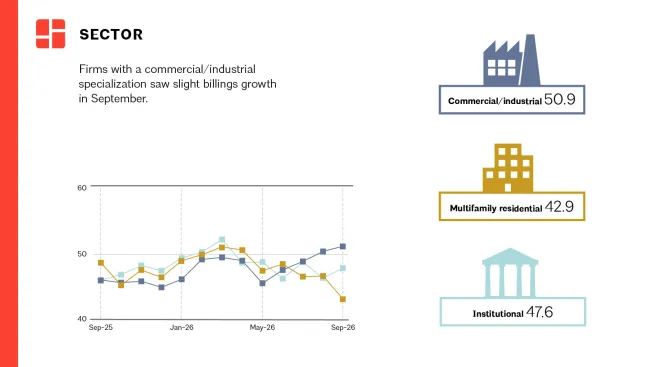
Commercial and industrial architecture provided one of the few encouraging signals in September. Firms specializing in these projects reported an index of 50.9, marking a second consecutive month of modest growth. Although hardly evidence of a robust expansion, the performance demonstrates that certain categories of development continue to generate work even as the broader market struggles.
The picture is considerably darker for multifamily residential architecture.
With an index of 42.9, multifamily firms reported another month of declining billings, extending a period of significant weakness that has intensified since earlier this year. The sector’s difficulties are especially apparent in the shrinking volume of work already under contract.
At the end of March, multifamily residential firms reported average project backlogs of 6.2 months. By September, that figure had fallen to 4.8 months, a decline of nearly 23 percent in just six months.
The contraction is particularly consequential because backlogs provide a measure of how much work firms have secured for the months ahead. As existing projects advance toward completion, a diminishing backlog leaves firms increasingly dependent on new commissions to sustain their operations.
Institutional architecture, traditionally a source of relatively steady work, has also weakened. The sector recorded an ABI score of 47.6, indicating that billings continued to decline, although institutional firms retained some of the industry’s strongest backlogs.
Mixed-practice firms, defined as those without a single building sector accounting for at least half their billings, experienced the weakest sector performance, with an index of 41.5.
Taken together, the sector figures reveal a market in which diversification alone does not necessarily provide protection from declining demand. While commercial and industrial work has offered a modest counterweight, weakness across institutional, multifamily, and mixed practices continues to weigh on the profession.
The Backlog Cushion Is Getting Thinner
Despite September’s disappointing billings figures, architecture firms have not yet exhausted their reserves of future work.
Average project backlogs stood at 6.2 months at the end of the third quarter, compared with 6.6 months at the end of the first quarter. The decline is relatively modest, suggesting that many firms still have several months of committed work to carry them through the current slowdown.
But the distribution of that work is becoming increasingly important.
Large firms, defined as practices with annual billings of $5 million or more, reported stable backlogs of 8.1 months. Institutional firms also maintained comparatively strong pipelines, averaging 8.0 months of work.
Those figures suggest that firms with substantial existing commissions may be better positioned to absorb a prolonged period of weak demand, even as their current billings decline.
Smaller practices offered an unexpected bright spot. Firms with annual billings below $250,000 reported an increase in average backlogs from 3.1 months to 3.8 months between the end of the first and third quarters. Although their pipelines remain considerably shorter than those of larger practices, the improvement suggests that some smaller firms have managed to secure additional work despite the broader downturn.
The contrast with multifamily residential firms is striking. Their backlogs have contracted substantially, leaving them with fewer months of committed work than the industry average.
For practices already facing declining billings, the erosion of backlogs raises a difficult question: How long can existing projects sustain operations if new contracts continue to weaken?
More Inquiries, Fewer Commitments
One of the most revealing aspects of September’s report is the gap between project inquiries and signed design contracts.
The inquiries index of 53.2 indicates that interest in potential projects remains relatively resilient. Clients are still approaching architects, discussing possibilities, and considering new development.
But the design contracts index of 43.7 tells a different story.
The nearly 10-point gap between the two measures highlights a central problem facing the profession: prospective projects are not converting into firm commitments at a pace sufficient to support stronger business conditions.
The distinction also complicates the interpretation of improving inquiries. While an increase in prospective work can sometimes signal the beginning of a recovery, the weakness in signed contracts suggests that any improvement in actual billings could remain some distance away.
Branch’s assessment points to the combination of economic softness, financing difficulties, and client caution as obstacles to moving projects forward.
For architecture firms, the consequences extend beyond immediate revenue. Prolonged uncertainty makes it more difficult to forecast staffing requirements, allocate resources, and plan investments in business development or practice expansion.
Even firms with healthy backlogs must consider what happens when those projects are completed and the pipeline of replacement work remains thin.
An Industry Waiting for Confidence to Return
The September ABI does not suggest that architecture firms are facing identical challenges. Commercial and industrial practices are showing modest growth, large and institutional firms continue to maintain substantial backlogs, and some smaller firms have strengthened their pipelines.
Yet those pockets of resilience are increasingly overshadowed by the weakness of the broader market.
With the national index at 44.7, design contracts at 43.7, and multifamily residential work continuing to deteriorate, the profession faces a difficult final quarter of 2026.
The immediate challenge is not simply generating interest in new projects. September’s inquiries figures suggest that interest already exists. The greater obstacle is converting that interest into funded, signed commissions capable of sustaining firms beyond their current backlogs.
And while the industry’s remaining pipeline of work offers some protection, it cannot indefinitely compensate for a prolonged decline in new contracts.
The latest ABI therefore raises a more consequential question than when billings will finally return to growth: whether the projects now being discussed will advance quickly enough to prevent today’s weakening demand from becoming tomorrow’s deeper contraction.
For now, the evidence points to an architecture profession still waiting for clients to move from possibility to commitment—and with increasingly little reason to expect that shift anytime soon.