For decades, architects have searched for ways to repair social fragmentation. They have designed plazas, libraries, parks, and mixed-use districts to bring people together.
Yet loneliness, polarization, and social isolation continue to grow across much of the world.
The Icelandic Pavilion at the 2027 Venice Architecture Biennale offers an unexpected alternative: the swimming pool.
Titled SOAK: Rituals of Collective Belonging, Iceland’s contribution examines the country’s bathing culture. It presents the geothermal pool as a model for social cohesion in a disconnected age.
Commissioned by Iceland Design and Architecture and curated by Marcos Zotes, partner at Basalt Architects, the exhibition explores how architecture can foster belonging through everyday rituals. Its focus is not on monuments or iconic buildings, but on shared experiences.
A Response to the Biennale Theme
The proposal arrives at a fitting moment.
The 2027 Biennale, curated by Wang Shu and Lu Wenyu, carries the theme Do Architecture—The Possibility of Coexistence in the Face of Real Reality. The exhibition calls for a return to architecture’s social, physical, and material foundations.
Rather than emphasizing theory or technological spectacle, the curators encourage architects to examine how the built environment supports daily life.
Iceland’s pavilion answers that challenge by focusing on one of the country’s most familiar institutions.
The Pool as a Democratic Space
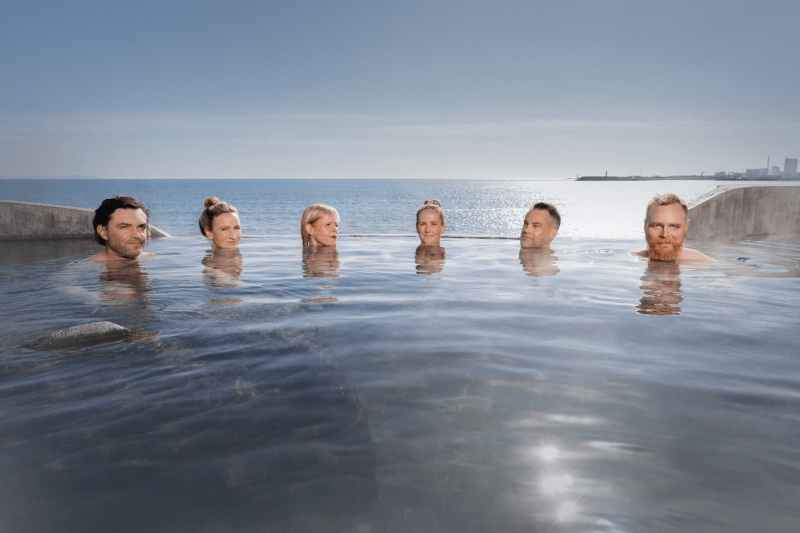
At the heart of the exhibition is a provocative idea: the geothermal pool may be one of the last truly democratic spaces in society.
Unlike workplaces, private clubs, social media platforms, or commercial venues, public pools place people on equal footing.
Generations mix. Professional identities fade. Conversations emerge between strangers.
The architecture encourages a type of social interaction that has become increasingly rare.
“In SOAK, the Icelandic Pavilion is framed as a laboratory for the future of the everyday,” said Marcos Zotes, curator of the exhibition and partner at Basalt Architects.
“By showing that infrastructure can be both functional and social, we hope to shift the conversation from how we build to how we coexist. If people can find common ground in a geothermal pool, what prevents them from finding it elsewhere in the city?”
Water as Social Infrastructure
The exhibition presents water itself as a form of civic infrastructure.
In this view, architecture is less about enclosure and more about connection. Water becomes a medium that dissolves social barriers and creates opportunities for encounter.
The argument feels especially relevant today.
As digital technologies increasingly mediate human interaction, architects and planners continue to search for spaces that support genuine public engagement.
The Icelandic pavilion suggests the answer may already exist in overlooked civic rituals.
Rooted in Icelandic Culture
The exhibition is deeply rooted in Iceland’s geography and cultural identity.
Abundant geothermal resources have made public pools a defining feature of Icelandic life. Heated by naturally occurring hot water, these facilities serve communities across the country.
Over time, they have evolved from recreational amenities into social institutions and architectural landmarks.
“By focusing on the geothermal pool as a ‘third space’—neither home nor workplace—the exhibition opens an important discussion about public space and social cohesion,” said Halla Helgadóttir, commissioner of the Icelandic Pavilion and managing director of Iceland Design and Architecture.
She noted that Iceland’s bathing culture is recognized by UNESCO as Intangible Cultural Heritage. Access to geothermal water has allowed communities throughout the country to operate public pools for decades.
Many of these pools are notable architectural landmarks. More importantly, they function as vital social infrastructure and play a central role in Icelandic daily life.
The Importance of the Third Space
The idea of the “third space” has become increasingly influential among urbanists and sociologists.
The term describes places that exist outside the home and workplace. Such environments are often considered essential to civic life.
Many cities have seen traditional third spaces disappear under economic and social pressures.
Iceland’s bathing culture, however, has preserved a strong version of the concept.
The pavilion argues that this model may offer lessons far beyond Iceland’s borders.
The Team Behind SOAK
The exhibition brings together experts from architecture, exhibition design, interactive media, and illustration.
Leading the effort is Basalt Architects, a Reykjavik-based practice known internationally for projects such as the Blue Lagoon.
Founded in 2009 by Sigríður Sigþórsdóttir, the firm has built a reputation for architecture that responds to Iceland’s volcanic landscapes and geothermal environments.
Its work often explores the relationship between nature, wellness, and the built environment.
Joining Basalt is Gagarin, an experience-design studio known for museums, visitor centers, public installations, and immersive exhibitions.
The firm combines storytelling, technology, and spatial design to create engaging public experiences.
The team also includes artist, author, and illustrator Rán Flygenring.
Her books and illustrations have explored Icelandic swimming culture. Her work adds a human perspective and grounds the pavilion’s ideas in everyday experience.
Together, the collaborators aim to create an immersive environment that examines bathing culture as a social ritual embedded in architecture, infrastructure, and collective memory.
Expanding the Definition of Architecture
What makes SOAK especially compelling is its expanded definition of architecture.
Rather than celebrating a single building, the pavilion examines a network of spaces, behaviors, and cultural practices.
Its focus is not an iconic structure, but a civic ecosystem.
In doing so, it reflects a broader shift in architectural discourse. Increasingly, architects are placing greater value on participation, care, and social relationships.
A Different Kind of Future
The pavilion also aligns closely with Wang Shu and Lu Wenyu’s vision for the 2027 Biennale.
Their curatorial theme challenges architecture to reconnect with local culture, material reality, and lived experience.
Iceland’s geothermal pools offer a powerful example of that approach. They are practical, cultural, environmental, and social at the same time.
At a moment when many architecture exhibitions focus on climate technology, artificial intelligence, and speculative futures, Iceland proposes something more immediate.
The answer to social fragmentation, the pavilion suggests, may not lie in new technologies or grand urban visions.
It may be waiting in a hot pool, surrounded by neighbors.