In the world of commercial interior design, few materials impact the human experience as profoundly as carpet. It is the literal foundation of a space, influencing everything from acoustic comfort and thermal insulation to brand identity and occupant wellbeing.
However, specifying the right carpet is both an art and a science. Whether you are designing a high-traffic transit hub or a boutique hospitality lounge, understanding the materials and methods of today’s carpet manufacturing is essential to ensuring your project performs, looks great, and supports a sustainable planet for years to come.
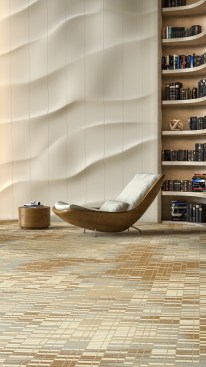
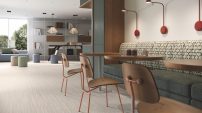
GridPulse, by Mohawk Group Hospitality – Durkan, a broadloom example
The Power of Soft Surface
Before diving into the technicalities, it helps to define why we use carpet. Today’s contract flooring isn’t just an interior finish; it’s a high-performance building tool.
- Ergonomics and comfort: Carpet provides a soft, flexible surface that reduces leg fatigue and enhances physical comfort.
- Acoustics: In open-office plans or education environments, carpet’s ability to absorb sound is a primary driver of productivity and focus.
- Safety: Soft surfaces provide a higher coefficient of friction, reducing slip-and-fall risks and providing impact attenuation.
- Sustainability: From carbon-neutral manufacturing to healthy material transparency, many of today’s commercial carpet options support the most rigorous green building standards.
The Three Pillars of Commercial Carpet: Broadloom, Modular, and Rugs
In the contract market, many manufacturers work within three primary formats:
1. Broadloom
Manufactured on power looms in standard widths (typically 12 feet), broadloom is the traditional choice for wall-to-wall installations. It is ideal for large-scale patterns that need to remain intact across a floorplate and for environments where a seamless, “singular piece” look is the priority. In luxury hospitality or aviation, the supple “hand” of broadloom remains the gold standard.
2. Modular (Carpet tile)
Now the most prevalent format in commercial interiors, modular carpet offers squares or planks (typically 24×24 inches or 12×36 inches) that provide infinite design flexibility. The primary benefits here are functional: ease of installation, access to underfloor utilities, and simple selective replacement for maintenance.
3. Area rugs
Rugs serve as anchors within a space, defining zones of intimacy or gathering. In the “resimercial” era, rugs bring a sensory aesthetic and domestic comfort into the workplace. They can be hand-tufted to size or cut down from broadloom rolls with a finished serged or bound edge.
Systems Thinking: Designing with Intent
One of the most effective ways to utilize modular carpet is through “systems thinking.” Rather than picking a single tile, designers can specify collections that coordinate ground textures, transitional patterns, and accent colors.
Using a systems approach allows you to design for:
- Communicating space types: Use a neutral ground for desking areas and a bold pattern overlay for collaborative hubs.
- Wayfinding: Create intuitive pathways through color shifts without the need for physical signage.
- Thinning the pattern: Intermix ground textures with patterned tiles to “dissolve” or “bleed” a design across a floor.
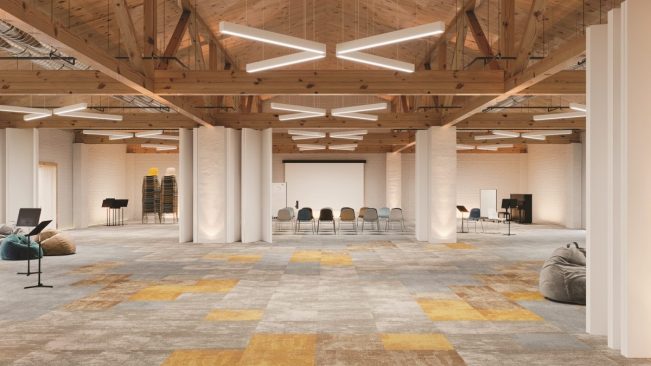
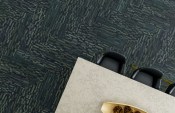
Chromatic Cadence, by Mohawk Group, a Precision Dye Injection (PDI) example
Construction: Woven vs. Tufted
How a carpet is made determines its lifespan. There are two primary construction methods in the commercial world: woven construction and tufted construction.
Woven construction
Woven carpet is a slow, craft-oriented process where face yarns are interlaced with stuffer and filling yarns on a traditional loom. Because the yarn is literally locked into the backing, it is incredibly durable.
- Wilton: Known for flat, needle-point textures and directional grids—perfect for timeless, high-traffic areas like airplanes or trains.
- Axminster: The closest machine-made equivalent to a hand-woven rug. It can incorporate up to 32 colors in a single design, making it the favorite for luxury hotels and casinos.
Tufted construction
Representing 90% of the commercial market, tufting is a high-speed process where needles stitch fiber through a primary backing. These loops are then secured with a secondary backing and latex polymers. Today’s tufting technology now allows for “organic” pattern placement that mimics the look of expensive hand-woven textiles at a fraction of the cost.
The Deep Dive into Fiber: Why Nylon Reigns Supreme
Specifiers must understand fiber fundamentals, as the yarn type dictates maintenance and appearance retention. While natural fibers like wool offer a renewable, luxury aesthetic, nylon is the workhorse of the commercial industry.
The advantages of nylon
Nylon is an elastic, resilient polymer. It resists crushing, handles high traffic with ease, and is practically impenetrable when engineered correctly.
Pro tip: Look for “Tricor” technology. The latest generation of Nylon fiber uses a modified-delta shape with a triangular hollow core. This shape diffuses light to hide soil while providing a stronger structure to resist crushing. It also offers permanent stain resistance inherent to the fiber itself.
Dyeing methods: Carrots vs. Radishes
How the color is applied matters:
- Solution dyed (the Carrot): Pigment is added to the molten polymer before extrusion. The color is the same all the way through, making it “bleach-fast” and resistant to fading in high-UV areas.
- Yarn/Piece dyed (the Radish): White yarn is dyed after it is made. The color sits on the surface. This offers more color variety but is more susceptible to fading.
- Precision Dye Injection (PDI): High-definition digital printing where dye is injected deep into the pile. This allows for infinite custom patterns and complex color gradients.
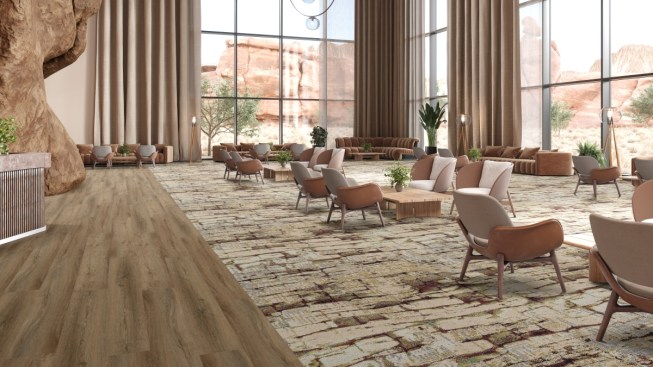
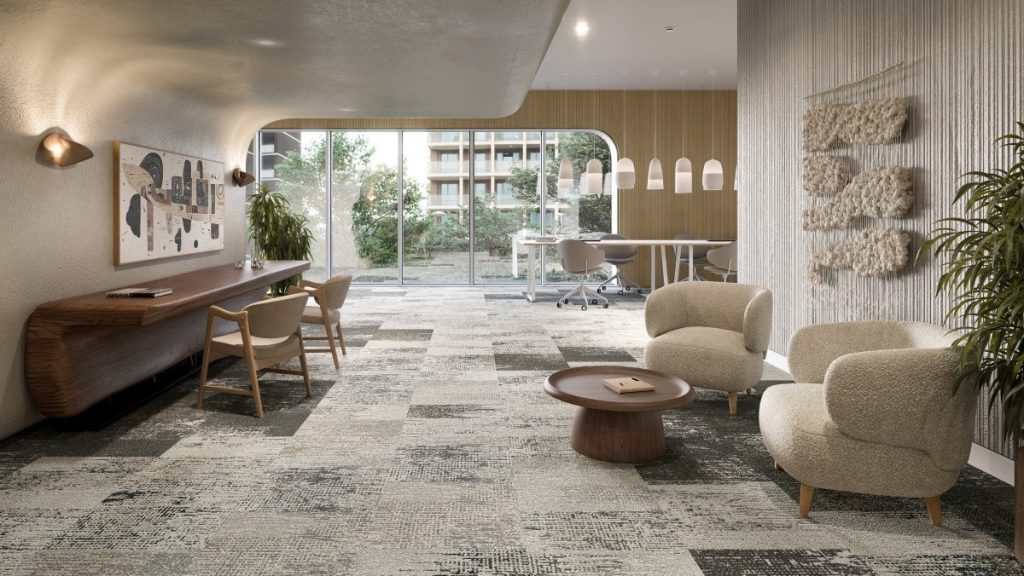
Natureverse by Mohawk Group Hospitality – Durkan, a Precision Dye Injection (PDI) example
Face Construction: More Than Just Weight
When reviewing a spec sheet, don’t just look at Face Weight (the ounces of yarn per square yard). You must also consider:
- Gauge: The spacing between needles (e.g., a 12th Gauge machine has 12 yarn ends per inch).
- Stitches per inch: The density of the tufts along the length.
- Pile height: Lower pile heights are generally better for heavy foot traffic and rolling loads.
The Texture Vocabulary
- Loop pile: The most durable, available in Level or Multi-Level heights.
- Cut pile: Loops are cut for a plush, fuzzy texture.
- Tip shear: A best of both worlds where part of the loop is shaved for pattern definition and a luxury feel.
Backings: The Unsung Heroes
The backing is the foundation of your carpet.
- Primary backing: The fabric the yarn is tufted into (usually a woven polypropylene for broadloom or non-woven for modular).
- Secondary backing: The layer that provides dimensional stability. For high-performance environments, consider an attached cushion backing. This can increase the life of the carpet face by 50% while providing superior underfoot comfort and acoustic insulation.
When to add a barrier?
If your project has extreme moisture issues in the slab or requires significant sound attenuation between floors (like a dormitory), specify a moisture or sound barrier. An attached underlayment is almost always superior to a loose-laid one in a commercial setting.
Installation: The Final Vision
A great specification can be ruined by poor installation planning.
- For Broadloom: Consider seam placement. Avoid seams in high-traffic zones or under heavy furniture.
- For Modular: The options are endless—Monolithic, Quarter-Turned, Ashlar, Brick, or the popular “Multi-Directional/Random” layout. Random layouts are the most efficient for long-term maintenance, as a single damaged tile can be replaced without matching a specific orientation.
The Innovation of the Dry-Tab System
For “Red List Free” or historic preservation projects, consider a dry-tab/floating installation. These use sticker-like tabs to connect tiles to each other rather than the floor. This eliminates volatile organic compounds (VOCs) from wet adhesives and protects the subfloor.
Navigating the Specification
A professional specification (Section 096800 in MasterSpec) should always include:
- Style and color names
- Fiber type and dye method
- Physical construction (gauge, stitches, weight)
- Flammability and smoke density (must be Class 1/A)
- Attic stock: Always purchase an extra 10% for future repairs.
Sustainability: Designing for 2026 and Beyond
Building materials contribute to roughly 40% of global carbon emissions. As specifiers, we have a responsibility to reduce the material footprint of our projects.
When evaluating carpet, look for these “Green” markers:
- NSF 140: The industry standard for life-cycle sustainability.
- Declare labels: Like a “nutrition label” for building materials, showing if a product is Red List Free.
- EPDs and HPDs: Technical disclosures regarding environmental and health impacts.
- Reclaim programs: Ensure your manufacturer has a program (like Mohawk Group’s ReCover) to take back old carpet and divert it from landfills.
The most sustainable strategy? Specify for longevity. A carpet that performs and looks beautiful for fifteen years is far more sustainable than one that must be replaced in five.
Carpet is a complex, engineered textile that holds the power to transform the built environment. By understanding the nuances of fiber, construction, and backing, you can specify with confidence—creating spaces that are as durable as they are beautiful. Discover the possibilities.