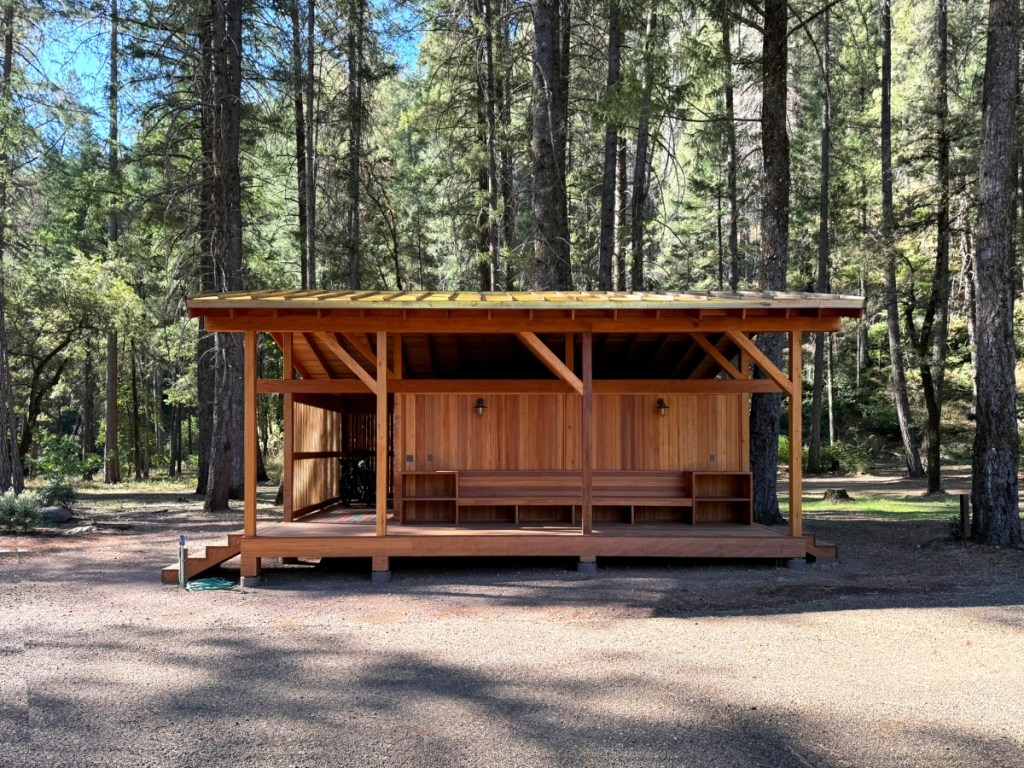
Before Max Obata specified redwood for a house on the Northern California coast, he went to see where it came from. Obata and his partner, Tyler Noblin, co-founders of the San Francisco firm Obata Noblin Office (ONO), walked into the forest where they watched how selective harvesting works as a series of decisions made tree by tree.
This visit changed their understanding of a material some consider ancient and almost sacred. New-growth redwood harvested locally and carefully, they learned, could offer a way to design with wood that felt both regionally grounded and responsive to California’s climate realities. “You go out and you see that there’s actually a much more thoughtful process,” Obata says.
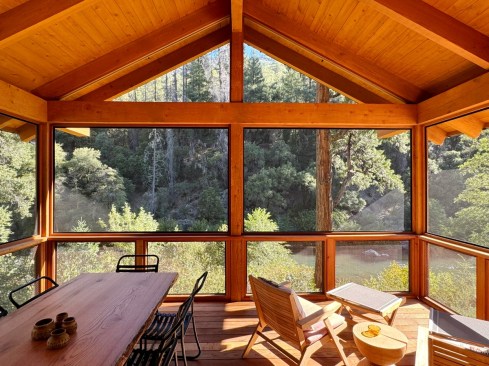
That lesson has become increasingly important as architects in California contend with wildfire risk, stricter Wildland-Urban Interface requirements, and the pressure to design buildings that can withstand more extreme climate conditions without abandoning natural materials. ONO’s philosophy is built around what Obata describes as material honesty—a sensibility shaped by the Scandinavian and Japanese firms where he and his partner worked earlier in their careers. In California, that design language now has to be reconciled with fire.
“It’s trying to marry that thesis of material with the realities of fire and climate change,” Obata says.
For Obata, the answer is not to stop using wood but to understand where and how it can be used. Under WUI requirements, certain wood siding products can still be specified when they are part of a compliant assembly, including a noncombustible layer beneath the cladding. In practice, that means the performance of the wall depends as much on detailing as it does on species selection.
When evaluating wood or wood-adjacent products marketed as WUI compliant, Obata’s team looks at flame-spread ratings, ember testing, and how the product will meet the ground. That last point is critical. Wind-driven embers are one of the primary ways wildfires ignite buildings, often collecting at the base of a wall or in vulnerable crevices. As a result, the firm often considers a concrete, stone, or other noncombustible base below wood siding.
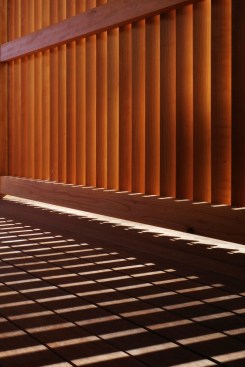
Seal House, a 2,250-square-foot residence on Bolinas Lagoon in Stinson Beach, became a proving ground for those ideas. Designed as a retreat for an intergenerational San Francisco family, the house is organized around a central courtyard that shields outdoor space from prevailing ocean winds while drawing light and views through the home. Shared spaces open to the courtyard on three sides, while the bedrooms sit behind a more solid wall for privacy.
The design team reduced the palette to a few essential elements: redwood, glass, a terrazzo-like aggregate floor, and landscape. The result is a house organized around light, shadow, and material restraint. Redwood carries much of that character, recalling the weathered surfaces of Sea Ranch and the regional work of William Wurster while giving the house a contemporary clarity.
“We wanted to do something where the material really harkened back to the midcentury projects that we loved,” Obata says.
For Obata, the value of wood is not only visual; it’s the warmth, scent, and acoustic softness the material brings.
“There’s a smell to redwood,” he says. “There’s a sort of acoustic absorption to it.”
That sensory quality is part of a larger belief: Buildings feel more grounded when their materials belong to the place where they are built. Obata points to older cities in Europe and Japan, where local stone, wood, and craft traditions give architecture a rootedness that can be difficult to replicate with imported materials.
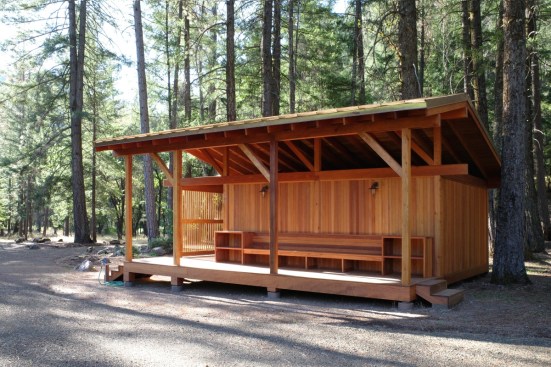
“When you go to places and the building material is of that place, you can tell,” he says. “Maybe it’s subconscious, but you know when something was built from material that was harvested there.”
Since Seal House, the firm has used redwood on several more projects, including decking, siding, and structural timbers. Obata especially likes heartwood for decking and redwood siding detailed with shiplap, tongue and groove, or nickel-gap profiles that create shadow between boards. He is less inclined to use new-growth redwood for interior floors because of its softness, though reclaimed redwood can work well for denser accent flooring.
That growing comfort with the material has also shaped how Obata talks about it with clients. Rather than treating redwood as a finish selected from a sample, he wants clients to understand the full chain of decisions behind it. For some, that education begins in the forest. Obata has taken clients to visit sawmills and walk through the woods, where they can see how the material is harvested and processed before it becomes part of a house. “They actually get to see how something is put together,” he says. “It’s pretty incredible.”