American universities are rarely built anymore.
New science buildings are constructed. Student centers are renovated. Campuses expand incrementally. But the creation of an entirely new university—especially one designed from the ground up around artificial intelligence, entrepreneurship, and advanced technology—is almost unheard of.
Yet that is precisely what the Walton family is attempting in Bentonville, Arkansas.
Members of the family behind Walmart—including Tom Walton, Steuart Walton, and Alice Walton through the Alice L. Walton Foundation—have unveiled plans for a new STEM-focused university that aims to welcome its first class in 2029. More remarkable than the academic mission itself, however, is the architectural ambition behind it.
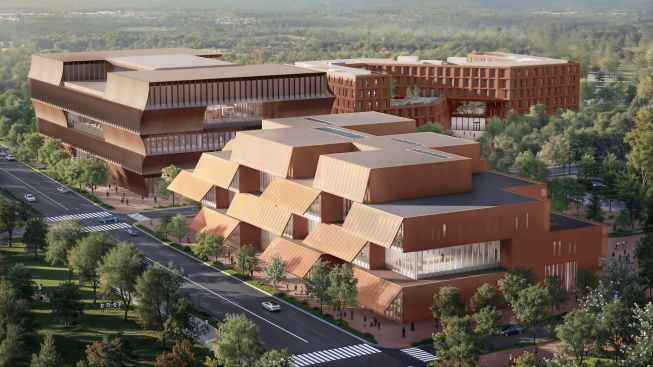
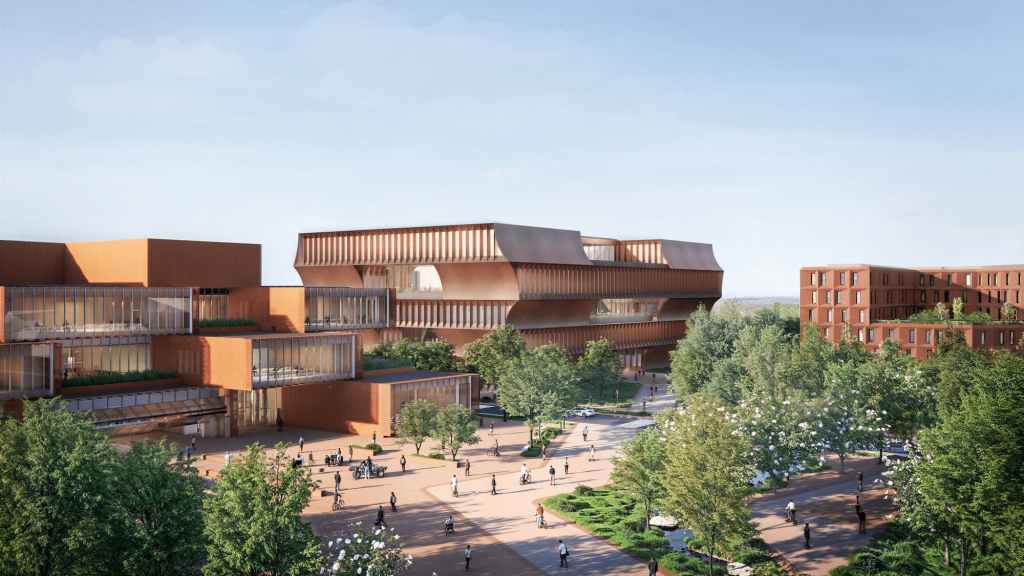
Designed by BIG and Polk Stanley Wilcox, the STEM-focused university establishes an entirely new world-class learning institution in Northwest Arkansas. Positioned as an extension of downtown Bentonville onto the site of the former Walmart Home Office, the campus comprises three distinctive buildings connected by a spine of active public plazas and green spaces: a makerspace envisioned as a flexible innovation hub that anchors campus life; an academic building designed to create dialogue across disciplines; and student residences organized around generous outdoor courtyards.
The family has selected BIG–Bjarke Ingels Group to design the 422,000-square-foot campus, which will rise on the site of the former Walmart Home Office and become the latest addition to a constellation of cultural, medical, educational, and civic projects reshaping Northwest Arkansas.
The project represents something larger than another university commission. It is part of an increasingly visible effort to transform Bentonville from the hometown of a retail giant into a 21st-century knowledge economy—and architecture is being deployed as one of the principal tools.
A Campus Without Walls
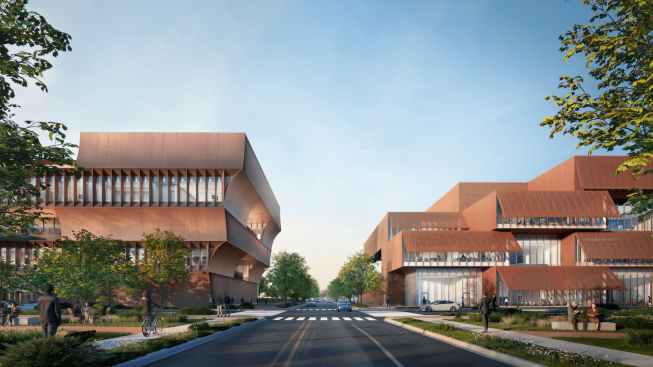
Situated between Bentonville's downtown square to the northeast and Gateway Park to the southwest, the campus is organized around a historic rail line that ran diagonally through the city. Drawing inspiration from Bentonville’s abundant urban parks, the design brings nature back to the site through outdoor gathering spaces that weave student and city life together within the surrounding Ozark region landscape.
Unlike the traditional American campus, which often separates itself from surrounding neighborhoods, BIG’s master plan seeks to dissolve the boundary between university and city.
Situated between downtown Bentonville and Gateway Park, the campus is organized around a historic rail corridor and stitched together through plazas, landscapes, and public spaces that extend the city’s growing park network. Rather than functioning as an isolated enclave, the university is conceived as an extension of downtown itself.
“We’re eager to bring the vision of Bjarke Ingels Group to Bentonville to help us make this new university a reality,” Tom Walton said. “The master plan and building designs they have given us are bold, imaginative, and highly practical all at once. They will inspire our students and faculty while complementing Bentonville’s urban and natural landscape.”
Occupying two city blocks, the first phase consists of three buildings: an academic building, a makerspace, and a 400-bed student residence hall. Together they provide approximately 422,000 square feet of space and establish the physical framework for a university designed around rapid technological change.
For BIG founder Bjarke Ingels, the challenge was less about creating an isolated academic environment than erasing the barriers that traditionally separate higher education from everyday life.
“The new STEM university in downtown Bentonville seeks to bridge the disconnect that often exists between academia and the working world around it,” Ingels said. “For the new campus, we have sought to break down the boundaries between campus and community through a lively new integrated neighborhood for faculty and citizens alike.”
He continued:
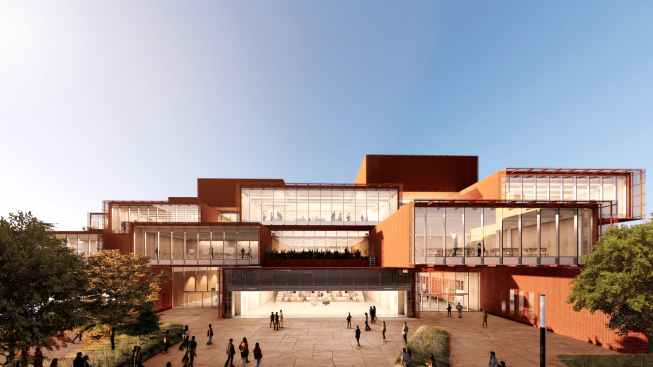
“The makerspace is conceived as an inhabited showcase, displaying a culture of physical experimentation and rapid prototyping to the passing citizens. It is our hope that this integration of the campus into the community will make higher education as accessible as possible, academically as well as socially. We are honored to work with the Walton family on imagining the future academic environment for a new kind of urban university in the heart of Bentonville.”
Architecture as Economic Development
The project arrives amid a broader transformation underway across Northwest Arkansas.
“The new STEM university in downtown Bentonville seeks to bridge the disconnect that often exists between academia and the working world around it. For the new campus, we have sought to break down the boundaries between campus and community through a lively new integrated neighborhood for faculty and citizens alike. The makerspace is conceived as an inhabited showcase, displaying a culture of physical experimentation and rapid prototyping to the passing citizens. It is our hope that this integration of the campus into the community will make higher education as accessible as possible, academically as well as socially.
Over the last decade, Bentonville has emerged as one of the country’s most surprising centers of architectural patronage. What began with the establishment of Crystal Bridges Museum of American Art has expanded into an ecosystem that now includes the Alice L. Walton School of Medicine, the Heartland Whole Health Institute, extensive park systems, and a future health-and-wellness campus.
Taken together, these projects suggest something uncommon in American urban development: a coordinated attempt to use architecture and institutions to shape a city’s future identity.
Alice Walton views the university as part of that larger cultural project.
“Bjarke Ingels Group is making an important contribution to Bentonville’s growing collection of contemporary architecture and landscape design projects,” she said. “Each has its own strong identity, but they all harmonize, showing that BIG and the other acclaimed architects working on these campuses understand that these designs need to have a sense of place of our region, and be welcoming to our community.”
Increasingly, Bentonville appears less like a corporate headquarters town and more like an experiment in regional placemaking—a place where museums, parks, health care, education, and architecture are being orchestrated into a single civic vision.
Reinterpreting Ozark Architecture
While BIG is known for highly expressive forms, the Bentonville campus takes a notably restrained approach.
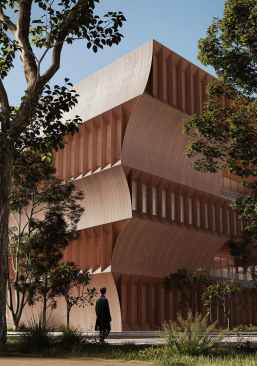
Across SW E Steet, the academic building is conceived as an efficient stack of bars that alternate directions on every floor, creating interior terraces and breezeways that evoke the dogtrot style of home common in Ozark vernacular architecture. A daylit atrium and dramatic staircase welcome students, faculty, staff, and visitors, while classrooms, labs, and offices are interspersed throughout the building to foster collaboration. The porous spaces between the bars create visual connections across floors.
Instead of monumental gestures, the three buildings derive much of their character from local architectural traditions and materiality.
The makerspace, clad in weathering Corten steel, consists of stacked and interlocking volumes whose industrial vocabulary reflects the region’s manufacturing heritage. Large expanses of glass expose workshops, laboratories, and communal areas to the street, turning experimentation itself into a form of public theater.
Across the street, the academic building draws inspiration from Ozark vernacular architecture. Alternating bars create breezeways reminiscent of traditional dogtrot houses, while curved metal facades reinterpret the timber joinery found in historic log structures throughout Northwest Arkansas. Clerestory windows flood a central atrium with daylight, reducing dependence on artificial lighting while creating visual connections between classrooms, laboratories, and offices.
The residence hall adopts a figure-eight configuration that creates two elevated courtyards above a shared dining hall and amenity spaces. One receives morning sun; the other captures afternoon light. Nearly every room is oriented outward toward surrounding parks and campus greens.
“For the new STEM university in Bentonville, we’ve designed a campus that supports the full student experience,” said Thomas Christoffersen, partner at BIG. “Each of the three buildings – the residence hall, academic building, and makerspace – fosters a different element of campus life, from study and collaboration to experimentation and innovation.”
“Just as the buildings connect the different aspects of the collegiate experience, they also naturally connect the campus to downtown Bentonville through warm, natural materials suited to the Ozark region: weathered steel for the industrial makerspace, copper that will age gracefully over time for the refined academic building, and red-hued cement panels for the residence hall.”
Building for an AI Era
Perhaps the most unusual aspect of the project is that it is being designed around the assumption that technology will change faster than architecture.
The university intends to embed artificial intelligence throughout its academic programs, teaching methods, and institutional operations. As a result, flexibility became a central architectural requirement.
Laboratories, classrooms, offices, and collaborative spaces are deliberately interwoven rather than compartmentalized. The buildings are intended to evolve alongside emerging technologies and changing educational models.
Dr. David Mazyck, president of the new institution, sees the university as both an educational platform and an economic catalyst.
“Reflecting Bentonville’s culture of warmth and openness, the university will serve as an inviting gateway for companies and enterprises to engage with students, co-create innovation pipelines, and build incubators that catalyze sustained economic impact,” he said.
That emphasis on industry partnerships reflects a growing shift occurring throughout higher education. Increasingly, universities are being asked not merely to educate students but to generate ecosystems of innovation, entrepreneurship, and economic development.
A New Kind of Company Town?
The larger question hanging over the project is whether Bentonville is becoming something unprecedented in contemporary America.
Historically, industrial fortunes created company towns. Steel built Pittsburgh. Automobiles transformed Detroit. Oil reshaped Houston.
In Bentonville, however, the descendants of a retail empire appear to be pursuing something different: the deliberate construction of a knowledge city.
Architecture is central to that strategy.
Museums attract talent. Trails and parks improve quality of life. Medical schools strengthen health care. Universities cultivate future entrepreneurs. Together, they create the ingredients of an innovation ecosystem that many cities spend decades attempting to assemble.
Whether Bentonville ultimately becomes the “Stanford of the Ozarks” remains to be seen. But with BIG now designing the physical framework for a new AI-focused university, the Waltons are making a wager few American philanthropists have attempted in generations.
They are not merely funding buildings.
They are attempting to build a city.
PROJECT FACTS
Size: 422,372 sq ft
Location: Bentonville, Arkansas
Client: Walton family members
Collaborators: Polk Stanley Wilcox Architects, Walter P Moore, CCC – Crossland Construction, Legends Ownership
Representation, Buro Happold, CCI, HEI – Henderson Engineers, Heintges, JME Design, KGM Architectural Lighting, LERA
Consulting, Lerch Bates, RFD, Schuler Shook, Studio 08, Threshold Acoustics, EDSA, UES
BIG TEAM
Partners-in-Charge: Bjarke Ingels, Thomas Christoffersen
Senior Project Manager: Aran Coakley
Project Manager: Michelle Stromsta
Project Leaders: Chris Tron (Makerspace Building), Nicholas Reddon (Academic Building + Student Residences)
Technical Lead: Dina Mahmoud
Project Coordinator: Ethan Floyd
Project Job Captains: Hector Romero (Academic Building), Lucia Sanchez Ramirez (Makerspace Building), Yasamin
Mayyas (Student Residences)
Team: Anirudh Chandar, Artem Chouliak, Ben Caldwell, Cooper Raposo, Crystal Wenjie Wang, Eliza Austin, Einat Lubliner,
Evan James Hotary, Foad Sarsangi, Gary Polk, Gyeom Chung, Haoran Yuan, Hint Sakdanaraseth, Jan Casimir, Jan
Leenknegt, Jason Wu, Jeff Tao, Jialin Yuan, Kai Huang, Margaret Tyrpa, Mateo Deza, Mama Wu, Minjung Ku, Nasiq Khan,
Naser Fakhouri, Novak Djogo, Omer Khan, Ricardo Palma Prieto, Ryan Harvey, Samuel Bager, Spencer Hayden, Suji Lee,
Sung-hwan Um, Vi Madrazo, Yuwei Yang