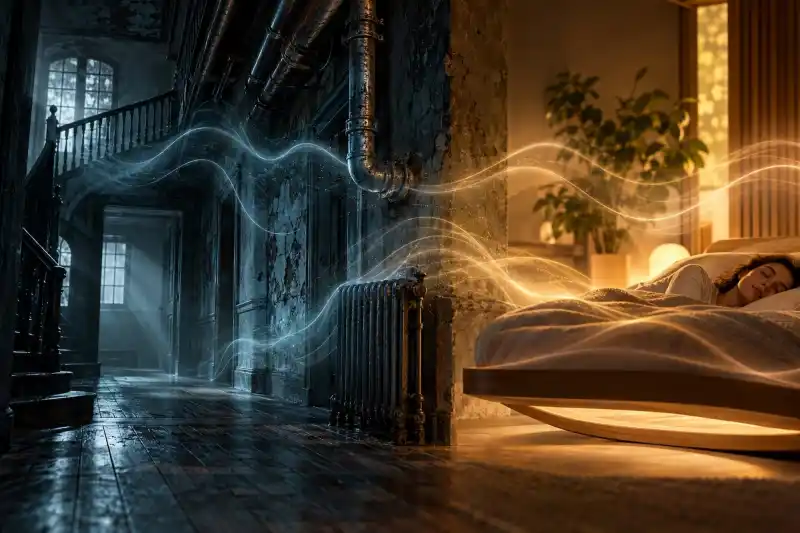
As Halloween approaches, we are reminded of what makes physical environments unsettling. Common attributes that induce unease include darkness, unfamiliarity, and decay. Recently, scientists have uncovered another, lesser-known factor.
In a study in Frontiers in Behavioral Neuroscience, researchers exposed participants to low-frequency sound, known as infrasound, which falls below the conventional threshold of human hearing.
Although participants could not reliably determine when the infrasound was present, those exposed to it exhibited higher cortisol levels and reported greater irritability, disinterest, and sadness. The signal was apparently imperceptible, yet these participants’ bodies appeared to detect it.
The research team hypothesizes that infrasound is the primary culprit behind paranormal experiences. “Consider visiting a supposedly haunted building. Your mood shifts, you feel agitated, but you can’t see or hear anything unusual,” explains McEwan University scientist Rodney Schmaltz. “In an old building, there is a good chance that infrasound is present, particularly in basements where aging pipes and ventilation systems produce low-frequency vibrations.”
The small experiment requires replication for further validation. Still, the study’s findings raise a compelling question: How do buildings affect human occupants through imperceptible vibrations?
In general, vibration is a primary design concern. Humming mechanical equipment, oscillating pumps and plumbing, and railroad and roadway vibrations can be nuisances for building occupants. Architects and engineers try to keep these effects below comfortable thresholds. However, a threshold of conscious awareness is not necessarily the same as a threshold of physiological response.
The human body has several overlapping sensory systems. The cochlea registers airborne sound; mechanoreceptors in the skin, muscles, and joints detect touch and vibration; and the inner ear’s vestibular organs sense acceleration, orientation, and balance. A low-frequency stimulus might therefore be inaudible yet still produce tactile or vestibular information that the body registers.
Emerging research suggests that these subtle signals can influence building occupants. A 2025 University of Bath experiment studied the physiological effects of wind-based vibrations. Participants performed office tasks in a motion simulator that reproduced wind-induced movement in tall buildings.
Increasing acceleration and frequency were associated with diminished cognitive performance, lower self-reported performance, and greater effort. Notably, most simulated conditions met typical building-vibration criteria.
A smaller 2024 pilot study examined vertical floor vibration. Participants completed visual-search tasks while exposed to vibrations derived from real-world conditions. As the vibration levels increased, participants required more time to identify visual targets.
Like the prior study, these vibrations remained within commonly accepted design limits. “Strong evidence is emerging that the current set of building design standards proposing limits for vertical floor vibration are unreliable and not fit for purpose,” argue the study’s authors.
Transportation is another category of vibration exposure. A 2023 systematic review entitled “Health effects of railway-induced vibration combined with railway noise” found that research on this type of vibration consistently points to annoyance and self-reported sleep disturbance. However, evidence for diagnosed disease remains insufficient.
The lower-perceptible vibration levels in these findings suggest a “perceptual borderland”—a liminal domain of weak signals that are barely detected, yet may still induce particular physiological stresses. This notion also raises the question: must liminal vibration always be detrimental, or can it also yield positive effects?
Human cultures have long attributed restorative capacities to rhythm and resonance. In sacred spaces across India, for example, active meditation and repetitions of the Pranava Mantra create an enveloping field of collective vocalization and anatomical vibration.
Natural systems also produce low, repetitive vibrations. In an apihouse, a small wooden structure containing enclosed beehives beneath or beside resting platforms, occupants encounter the insects through sound, scent, and tiny structural tremors without direct contact.
A 2025 preliminary study randomly assigned participants either to spend ten minutes in an active apihouse or to hear a recording of bees while seated in a similar setting. Anxiety scores declined significantly in both groups. The hive’s dominant frequencies, ranging between 237 and 416 hertz, were audible rather than infrasonic, and the experiment does not prove that beehive vibrations are therapeutic. However, the study offers a provocative model of interspecies exchange.
Designers are exploring therapeutic vibration delivered through furniture. Vibroacoustic chairs, mattresses, and tables typically employ transducers to transmit low-frequency sound directly into the body. Researchers have investigated such devices for relaxation, pain management, and symptoms of Parkinson’s disease. However, a comprehensive review of vibroacoustic therapy found the evidence too sparse and inconsistent to identify a reliably therapeutic frequency or dose.
Rocking beds have also been analyzed for potential health effects. In a 2019 study, participants slept on a bed moving laterally at 0.25 hertz, or one cycle every four seconds. Compared with sleeping on a stationary bed, the gentle rocking shortened the transition into non-REM sleep, strengthened deep sleep, reduced wake time, and improved overnight memory retention.
A 2026 follow-up involving people with poor sleep found that the same 0.25-hertz movement reduced sleep fragmentation and time awake while improving sleep efficiency and subjective sleep quality. Another small experiment used weak mattress vibrations synchronized with the sleeper’s heartbeat and reported increases in slow-wave activity and memory retention.
Although these are examples of beneficial subaudible vibration, they are not equivalent to filling a room with infrasound. Nevertheless, they show that context and agency must be considered alongside vibration frequency and amplitude. Harmful building vibration is frequently irregular, unexplained, chronic, and imposed. In contrast, therapeutic vibration is generally controlled, predictable, localized, and chosen.
In general, vibrations should be minimized in most occupied spaces. That said, specialized interior environments might incorporate opt-in movement: rocking beds, suspended relaxation chairs, vibroacoustic furniture, or responsive surfaces with precisely controlled frequency and amplitude. The evolving science of vibration’s effects on the body should inspire more collaborations among architects, designers, and scientists.
Resonance is nothing new in the designed environment, and low-level oscillations are common in buildings. However, we are beginning to appreciate how even these minute signals can influence human health and well-being.