The architecture industry’s long-running business slowdown showed little sign of breaking in August, as firms once again reported declining billings and became increasingly pessimistic about what lies ahead.
The AIA/Deltek Architecture Billings Index (ABI) registered 47.2 in August, keeping the closely watched measure of architecture-firm activity below the 50-point threshold that separates increasing billings from declining ones. While the share of firms reporting weaker billings eased slightly compared with July, the larger picture remained stubbornly negative.
More concerning is what is happening further up the project pipeline.
Inquiries into new projects barely remained in positive territory, registering 50.8, while newly signed design contracts fell to 48.3. That combination suggests that clients may still be exploring potential projects, but fewer are committing to moving them forward—an important distinction for firms trying to gauge whether the current slowdown is nearing an end.
The August numbers also reveal an industry that is becoming less confident that conditions will improve quickly. At the end of the first quarter, 21 percent of architecture firms expected their billings to decline in the coming months. By the end of the third quarter, that share had risen to 29 percent.
The deteriorating outlook comes as architecture firms continue to contend with the consequences of inflation and elevated borrowing costs, which can make real estate development more expensive and complicate financing for projects already struggling to pencil out.
“Architecture firms are caught between stubborn inflation and higher borrowing costs,” said AIA Chief Economist Richard Branch. “The Federal Reserve’s latest rate increase may help ease inflationary pressures over time, but in the near term it adds another headwind for projects already facing a difficult financing environment.”
A Stark Regional Divide
The national figure masks striking differences across the country.
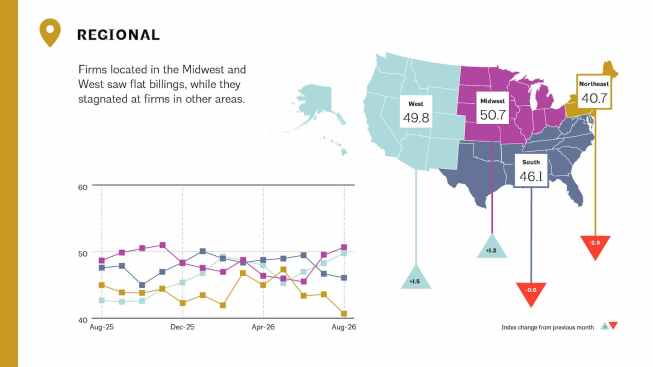
For the first time in nearly a year, firms in the Midwest moved back into growth territory, recording a regional ABI of 50.7. Firms in the West were essentially flat at 49.8, putting the region just below the threshold for growth.
Conditions were considerably weaker in the South, where the index stood at 46.1.
But the most dramatic deterioration occurred in the Northeast.
The region’s ABI plunged to 40.7, its lowest level since 2020. The figure suggests that the national architecture slowdown is being experienced very differently depending on where firms operate, with Northeast practices facing particularly severe pressure.
Because regional and sector ABI figures are calculated using three-month moving averages, they should not be read as a snapshot of a single month. Still, the magnitude of the Northeast decline makes it one of the most consequential signals in the August report.
Commercial Work Offers a Rare Bright Spot
There were also significant differences among building sectors.
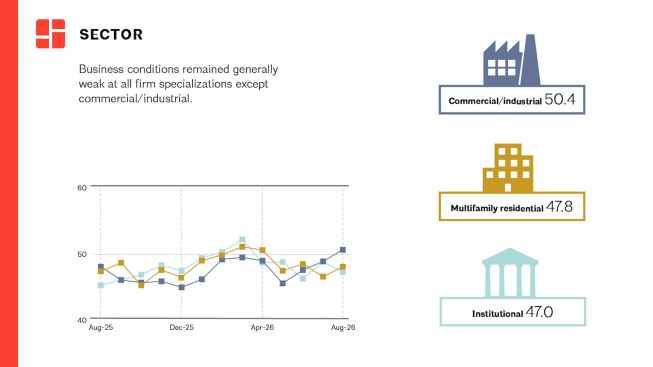
Commercial and industrial practices posted an index of 50.4, making them the only major sector tracked by the ABI to move into growth territory.
Multifamily residential firms remained below the line at 47.8, while institutional practices came in at 47.0.
Firms with mixed practices—those that do not receive at least half their billings from one of the ABI’s primary building categories—reported by far the weakest sector reading, at 42.5.
Taken together, the sector numbers complicate any simple narrative about the architecture economy. Commercial and industrial work showed signs of stabilization, but multifamily and institutional practices continued to contract, while diversified firms reported especially weak conditions.
The Pipeline Remains the Bigger Problem
Architecture billings are generally viewed as a leading indicator for the construction industry because design work occurs well before projects reach the job site. For that reason, the ABI’s measures of inquiries and contracts can be as revealing as the headline billings number.
August’s 50.8 inquiries index indicates that clients have not stopped considering new projects. But with design contracts at 48.3, those conversations are not consistently translating into signed work.
That gap matters.
A healthy volume of inquiries can provide firms with reasons for optimism, but without contracts those potential commissions do little to strengthen backlogs or produce future revenue. The continued contraction in design contracts therefore suggests that hesitation among clients remains firmly embedded in the market.
The financing environment provides one explanation. Higher borrowing costs can fundamentally alter the economics of development, particularly for projects dependent on debt. Projects that appeared feasible under cheaper financing can be delayed, redesigned, scaled back, or abandoned when the cost of capital rises.
That leaves architecture firms exposed well before construction companies or material suppliers feel the full impact.
An Economy Sending Mixed Signals
The broader economic picture offers few clear answers.
Employment in architectural services continued to expand, with the sector adding 700 positions in July, suggesting that firms have not responded to weaker billings with a wholesale retreat from hiring.
At the same time, inflation moved higher again in August. The Consumer Price Index increased 0.4 percent from July, following a rise of just 0.1 percent the previous month. On an annual basis, prices were 3.4 percent higher, with gasoline and energy costs among the biggest contributors to the increase.
That creates an uncomfortable contradiction for architecture practices.
Firms are operating in an economy that continues to generate employment while simultaneously confronting inflation, expensive credit, cautious clients, and a project pipeline that remains difficult to predict.
The ABI’s regional disparities make the picture even more complicated. A Midwest firm experiencing the first signs of growth in nearly a year is confronting a markedly different market from a Northeast practice operating amid the region’s weakest billings since 2020.
Yet the most telling number in the August report may not be 47.2.
It may be the 29 percent of firms that now expect their billings to decline.
After an extended period of soft business conditions, architecture firms appear to be adjusting their expectations accordingly. Inquiries have not disappeared, employment has not collapsed, and portions of the commercial market are still growing. But clients remain reluctant to sign contracts, financing remains difficult, and nearly every major sector continues to operate below the threshold for billings growth.
For an industry accustomed to looking months or even years ahead, August’s ABI offers an increasingly difficult message: the work may still be out there, but getting clients to commit to building it remains the problem.