For much of the 20th century, architects and designers treated the home as a laboratory for the future. New materials, new technologies, standardized components, and carefully choreographed floor plans promised not merely to change how people lived, but to make their lives fundamentally better.
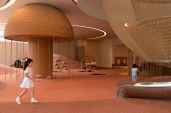
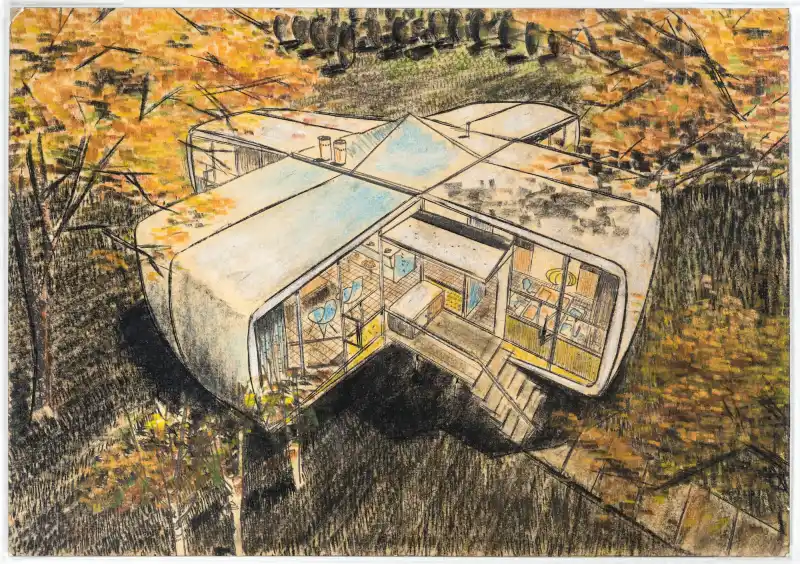
Two exhibitions at the Los Angeles County Museum of Art revisit that promise—and the contradictions embedded within it. Home of the Future, 1925–1985: Designing Domestic Utopias examines six decades in which designers repeatedly reinvented domestic life, while the concurrent The Kitchen and Its Discontents narrows the lens to perhaps the most ideologically loaded room in the house.
On view through March 14, 2027, The Kitchen and Its Discontents begins with a simple complication of the modernist narrative. The kitchen was historically a site of women’s labor, but it was also a place where women participated in design research and developed critiques of domestic culture itself.
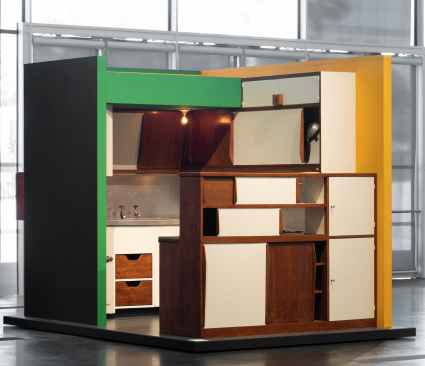
Charlotte Perrriand and Le Corbusier. Kitchen for an apartment in Le Corbusier's Unite d'Habitation, designed 1948-50.
At the center of the exhibition are two influential kitchens from LACMA’s collection: Margarete Schütte-Lihotzky’s kitchen for the New Frankfurt social housing program in Germany, designed between 1926 and 1930, and the kitchen created by Charlotte Perriand and Le Corbusier between 1948 and 1950 for the Unité d’Habitation in Marseille.
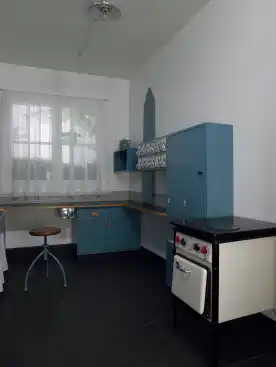
Schutte Lihotzky Frankfurt Kitchen. Photo courtesy Wikipedia.
Both projects transformed the kitchen into a subject of intense design consideration. Efficiency, modularity, standardization, and the organization of movement became tools through which architects hoped to improve everyday life.
Schütte-Lihotzky’s celebrated Frankfurt Kitchen in particular approached domestic work almost scientifically. Developed for a massive public housing program, its compact arrangement sought to minimize unnecessary movement and rationalize the repetitive tasks involved in preparing meals and maintaining a household.
Two decades later, Perriand and Le Corbusier addressed similar questions within the radically different framework of the Unité d’Habitation, the enormous Marseille housing block that attempted to reorganize collective urban life vertically. Here again, the kitchen became part of a broader architectural proposition about how modern people ought to live.
But LACMA’s exhibition is less interested in simply celebrating these canonical examples of modern design than in questioning the assumptions beneath them.
Both kitchens applied modern principles of efficiency and modularity to domestic space with the stated goal of improving women’s lives. Yet making housework more efficient did not necessarily challenge the assumption that women would continue doing it.
That tension gives The Kitchen and Its Discontents its title—and its contemporary relevance.
Curated by Britt Salvesen, curator and department head of LACMA’s Wallis Annenberg Photography Department and Prints and Drawings, and Staci Steinberger, curator of Decorative Arts and Design, the exhibition expands beyond architectural objects to include photographs, prints, and advertisements from the museum’s collection.
Together, these works complicate the immaculate image of the modern kitchen.
Instead of treating domestic space as an abstract exercise in rational planning, they turn toward what actually happens there: work, repetition, consumption, frustration, family life, disorder, and the inevitable messiness that architecture can organize but never entirely control. The kitchen emerges not simply as an achievement of modern design but as what LACMA describes as a “contested space for labor and living.”
That argument becomes particularly resonant alongside Home of the Future, 1925–1985: Designing Domestic Utopias.
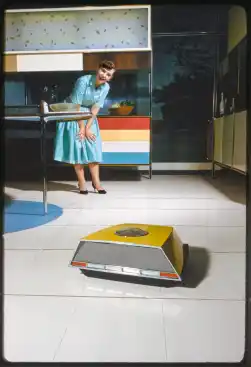
Bob Lerner, Anne Anderson in RCA Whirlpool Miracle Kitchen, 1959, kitchen designed 1956. Photo 1959, printed 2026.
The two exhibitions effectively examine opposite sides of the same modernist dream. For much of the last century, the future of the home was imagined through architectural innovation. Designers proposed new ways of cooking, cleaning, storing possessions, organizing families, and occupying space. Domestic architecture became a vehicle through which technological and social progress could be made visible.
The kitchen offers a particularly revealing test of those ambitions because it forces design ideals into contact with everyday labor.
A perfectly organized cabinet can reduce the number of steps required to prepare dinner. A modular system can make a small apartment function more efficiently. A carefully planned kitchen can alter relationships between cooking, dining, and family life.
But design cannot, by itself, determine who cooks dinner.

Rick Guidice for NASA Cutaway of Torus Wheel Habitat, 1975.
That may be the most provocative connection between LACMA’s two exhibitions. The 20th-century home of the future was often presented as a collection of technological and architectural solutions. Yet domestic life repeatedly proved resistant to being solved.
A century after Schütte-Lihotzky began developing the Frankfurt Kitchen, its underlying questions remain remarkably familiar: Who performs domestic labor? Who benefits from efficiency? And when architects promise a better way of living, whose life are they actually designing?
Perhaps the most enduring lesson of the modern home is that designing the future is easier than changing the way we live in it.