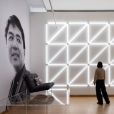
For decades, Juhani Pallasmaa traveled with an unusual piece of luggage. Whenever he left Finland, the architect, writer and theorist often brought along an enormous empty suitcase. He would return with it full—not with clothes or souvenirs, but with books.
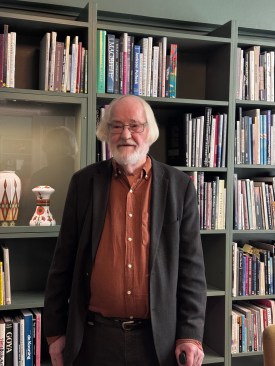
Juhani Pallasmaa
At first, he bought books on architecture and art. Then came photography, cinema, philosophy, psychology, neuroscience, literary essays and poetry: books encountered while lecturing, teaching, traveling, serving on juries or working abroad, as well as volumes recommended by friends and colleagues. Over a lifetime, the suitcases added up.
“I have hand carried some 10,000 books for my library from abroad,” Pallasmaa has written. “This amounts to several tons of books carried from various countries from six continents.”
Together with books purchased in Finland or sent to his office as gifts, they eventually became a personal library of roughly 12,000 volumes. Now, at 89, one of architecture’s most influential living thinkers has given the collection away.
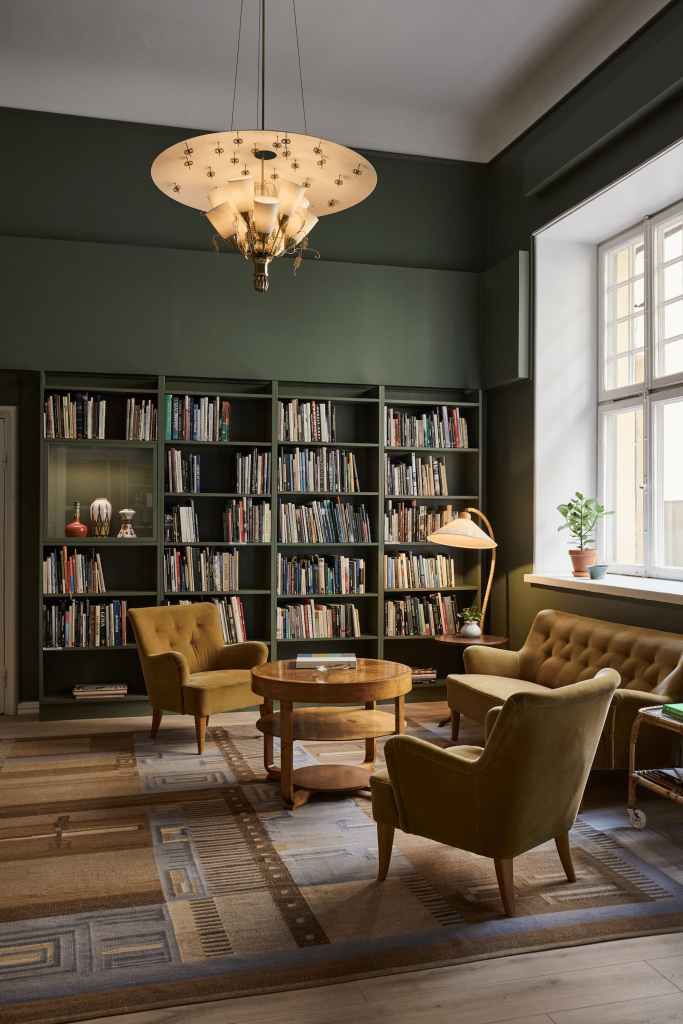
Pallasmaa donated his library to the Architecture & Design Museum Helsinki, where roughly 1,200 volumes—about a tenth of the collection—have been assembled as the Juhani Pallasmaa Reference Library. The books occupy the second floor of Eteläranta 6, a historic Jugend apartment overlooking Helsinki’s South Harbour that the museum has transformed into a temporary space for exhibitions, conversations, workshops and experimentation as it prepares for an entirely new museum nearby.
Visitors can take Pallasmaa’s books from the shelves and read them there, though they cannot check them out. The distinction matters. This is not a sealed archive of an eminent architect’s intellectual possessions but a working room in which strangers can enter the world of ideas that shaped him.
On one level, the donation is an extraordinary archival gift. On another, it is something considerably more intimate: Pallasmaa has donated a map of his mind.
At a moment when architectural knowledge is increasingly encountered through screens, search engines, social media feeds, PDFs and artificial intelligence, the collection feels almost defiantly physical. Here are thousands of objects that had to be discovered, purchased, carried, opened, touched, remembered and lived alongside. The library proposes that knowledge is not simply information we retrieve, but something we inhabit.
A Library as Intellectual Self-Portrait
There may be few architects for whom a personal library seems more inseparable from the work.
Pallasmaa is routinely described as an architect, but that designation has never quite contained him. Born in Hämeenlinna, Finland, in 1936 and educated at the Helsinki University of Technology, he has spent more than six decades moving among architecture, writing, criticism, teaching, exhibition design and cultural theory. He has designed buildings and exhibitions, directed the Museum of Finnish Architecture, taught internationally and written some of the profession’s most widely read theoretical texts.
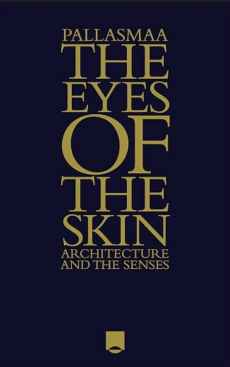
His best-known book, The Eyes of the Skin: Architecture and the Senses, became an architectural classic by challenging one of modern architecture’s deepest habits: its privileging of vision. Architecture, Pallasmaa argued, is not primarily something we look at; we encounter it with our entire bodies. We hear rooms, touch door handles and register floors through our feet. Materials carry smells, darkness alters our perception of distance, and acoustics tell us something about spaces we cannot see. Memory, imagination and bodily experience become inseparable from the physical environment.
The argument seems almost familiar today partly because Pallasmaa helped make it familiar. His library, however, reveals where such thinking came from: It did not emerge from architecture alone.
“As a consequence of my early circle of friends outside the sphere of architecture—painters and sculptors, writers and poets, composers and musicians, philosophers and scientists—I became interested in the world beyond my planned profession,” Pallasmaa writes in a reflection on the meaning of his books.
That sentence may be as useful a key to his career as anything he has written specifically about buildings. Architecture, in Pallasmaa’s world, becomes richer precisely when it stops talking exclusively to itself, and his library makes that argument physical.
The collection began accumulating while Pallasmaa was still young. As an architecture student in the 1960s, he traveled extensively to organize exhibitions of Finnish architecture for the newly established Museum of Finnish Architecture. Later came lectures, teaching appointments, juries, visiting professorships, extended stays abroad and international design commissions.
“On my countless trips, I had the habit of leaving to my journey with an extra huge, empty suitcase,” Pallasmaa recalls, “and returning with the large suitcase filled with books.”
The image is especially apt for one of architecture’s great theorists of embodied experience: Pallasmaa was quite literally carrying knowledge around the world. Ten thousand books represent several tons of paper, ink, cloth, glue and cardboard. His intellectual life gradually produced a physical environment; his thinking occupied space.
The Books He Never Read
There is an intriguing admission in Pallasmaa’s account of the collection: He has not read all the books.
“I have not had the time to read all my books,” he acknowledges. In an age obsessed with efficiency, that might sound like an admission of failure. What is the purpose of owning a book one never finishes—or perhaps never begins?
Pallasmaa’s answer turns the conventional understanding of a library on its head. “Their mere presence has been emotionally and intellectually important for me,” he writes. “Books are magical objects.”
For Pallasmaa, a library is not simply a storage system for information, nor is a book merely a container whose value is extracted by reading from the first page to the last. Books can exert influence through proximity, establishing an atmosphere around thought. Their presence, he argues, can orient consciousness, strengthen thinking and enrich one’s experience of life until they “really become part of your persona.”
It is difficult not to hear the architect in that description. Pallasmaa is effectively describing books as architecture: They surround and orient us, accumulate memory and acquire meaning through repeated encounters over time. A library, in this sense, is not simply something a person owns. It is a room the mind inhabits.
Among 12,000 volumes, one book carries particular significance. It is a book about Fra Angelico, the 15th-century Dominican friar and painter, given to Pallasmaa in the late 1950s by his friend Juhana Blomstedt, the painter and eldest son of Pallasmaa’s teacher and mentor, architect Aulis Blomstedt. Pallasmaa considers it the first book in his library.
Whenever beginning an architectural project, Pallasmaa says, he would return to Fra Angelico—not to study Renaissance perspective or borrow an architectural detail, but to change his own psychological state. The buildings depicted in Fra Angelico’s paintings, he writes, “appear as human beings,” and looking at them would “soften my sense of self and thinking.”
It is a remarkable architectural ritual. Before solving a program or asserting himself as an architect, Pallasmaa looked at a painting to recalibrate himself, using another discipline to introduce a measure of humility into the design process.
That ritual may explain the 12,000 books better than any inventory could. His library was never merely a reference database. Its function was intuitive, emotional and psychological; a book could alter architectural thinking without offering a single architectural solution. What mattered was not simply what Pallasmaa could learn from it, but what encountering it might do to him.
The Architecture of the Unrelated
The subjects Pallasmaa eventually collected reveal the same expansive approach. Architecture and art were only the beginning. Photography, cinema, philosophy, psychology, neuroscience, literary essays and poetry followed.
Cinema offered a way of considering architecture as an experience unfolding through time. Psychology and neuroscience opened questions about perception and emotion, while poetry and literature offered other ways of thinking about memory, atmosphere and human experience. These fields were not subjects adjacent to architecture; in Pallasmaa’s thinking, they became fundamental to understanding it.
His collection consequently challenges the self-referentiality of a profession in which architects can easily spend their lives reading other architects, studying buildings, looking at architectural photographs and speaking primarily to one another. Pallasmaa’s thinking moves across disciplinary boundaries, suggesting that some of architecture’s most consequential ideas may originate precisely where architects are least accustomed to looking.
That proposition feels particularly urgent today. Architecture has never had access to more information. A student with a laptop can reach more drawings, photographs, essays, maps and historical documents than many previous generations could have encountered in a lifetime. Digital archives have democratized knowledge, search engines have collapsed geographic distance, and artificial intelligence can summarize texts, retrieve references, synthesize information and generate architectural images almost instantaneously.
The benefits are enormous, but information has also become increasingly detached from physical encounter. Images flash past and disappear. References are collected without necessarily being remembered. Search engines answer the questions asked, while algorithms anticipate what we might want to see next, creating an intellectual environment organized around relevance, speed and similarity.
Pallasmaa’s library operates according to nearly the opposite logic. A book can sit on a shelf for decades waiting to become relevant, while another might be discovered accidentally while searching for something else. Neuroscience encounters poetry, cinema meets architecture, philosophy rubs against photography. Meaning develops through proximity and accident.
A physical library therefore permits something search engines are not particularly good at producing: productive irrelevance. You encounter what you were not looking for.
For architects, that distinction matters. The profession has become extraordinarily efficient at circulating architecture among architects, with buildings photographed in similar ways, published on similar platforms and discussed through familiar vocabularies. Pallasmaa’s shelves suggest another possibility: Sometimes the architect needs to escape architecture.
A Library Inside an Experiment
The physical setting of the reference library gives that argument another dimension.
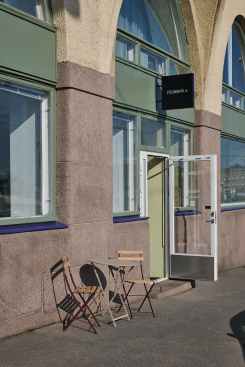
Eteläranta 6 occupies a Jugend, or Finnish Art Nouveau, building designed by architect Mauritz Gripenberg and completed in 1904. Its windows look directly toward the site of the future Architecture & Design Museum, whose plans visitors can explore through a model and 3D experience. The space operates simultaneously as a temporary museum, a public forum and a preview of the institution’s next chapter.
“Eteläranta 6 gives us a unique opportunity to engage the public in a dialogue about the development of both the museum and urban culture,” says Pilvi Kalhama, director of the Architecture & Design Museum Helsinki. “This is invaluable to us as we move towards the new museum.”
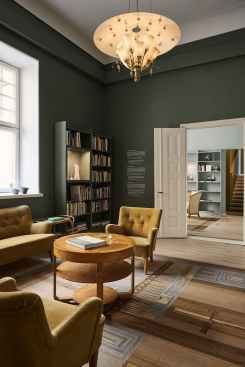
That ambition is expressed not only through programming but through the architecture of the temporary space itself. Studio Joanna Laajisto designed the interiors according to principles of preservation, minimal demolition and reuse. Rather than polishing away evidence of age, the project retains signs of wear and details that might once have been treated as imperfections. Almost all the furniture and materials have been reused, while bespoke pieces incorporate salvaged materials from built-in furnishings removed from the former Museum of Finnish Architecture.
The three floors shift in atmosphere as one moves through them. Softly toned event and exhibition spaces occupy the ground floor; Pallasmaa’s library is darker and more intimate; above it are brighter workshop and meeting spaces.
“This project showed that when the client and designer share the same vision, circularity becomes not a constraint but the greatest driver of creativity,” Laajisto says.
There is an obvious correspondence between that approach and the intellectual argument of Pallasmaa’s library. Both resist the assumption that value depends on novelty. Materials can be reused, buildings can accommodate new lives, and books acquired decades earlier can suddenly produce new associations.
The museum has further layered the rooms with objects from its collection, selected by Collection Specialist and Exhibition Curator Harry Kivilinna. Glass by Gunnel Nyman, Timo Sarpaneva, Tapio Wirkkala and Nanny Still appears alongside ceramics by Rut Bryk, Kyllikki Salmenhaara and A. W. Finch. In the library, a ceiling light designed by Paavo Tynell in 1947 for the Arabia factory anchors the room.
The effect is not of a pristine new cultural interior but of accumulated Finnish design culture brought back into circulation. Objects, furniture, architecture and books from different periods coexist without being flattened into a single aesthetic statement. Their age is not disguised; it becomes part of the argument.
From Preservation to Transmission
The museum’s decision to make the library accessible is central to the gift’s significance. The approximately 1,200 volumes on display were selected to introduce visitors to the thinkers, friends and sources of inspiration important to Pallasmaa while conveying the breadth of his curiosity about cultures, art and ideas. Librarian Suvi Juvonen coordinated the project on behalf of the museum.
The books are meant to be handled and read in the room, transforming the donation from preservation into transmission. Pallasmaa is not merely asking an institution to keep his books safe; he is allowing strangers to enter an intellectual environment he spent a lifetime constructing.
That principle extends throughout Eteläranta 6. The museum intends the building to operate as a platform for dialogue rather than simply another exhibition venue. An Open Podcast Studio will launch programming in October 2026, bringing architects, designers and other practitioners into public conversations about cities, architecture and contemporary culture. A Community Residency program will provide Helsinki-based collectives, associations and working groups with free space for meetings and collaborative work, some of which will open outward through workshops and discussions.
The museum is, in other words, using a temporary building to experiment with what a museum might become before its permanent one exists. That makes the placement of Pallasmaa’s library particularly apt. A conventional archive looks backward, preserving evidence of what has already happened. This library can also look forward. A student might encounter an author by accident, a designer might discover an unexpected connection, or a young architect might pull out a volume that changes the direction of a project.
The collection can continue doing for others what it did for Pallasmaa: generating associations.
Books as Friends
There is a warmth in the way Pallasmaa describes books that separates his collection from the traditional image of the scholar’s archive. He does not speak about them primarily as evidence of erudition but almost as companions.
“Books are your best friends and they are almost like human beings,” he writes, “and their presence enriches, orients and activates your mind.” He goes further: “A good selection of books around you creates a sense of rootedness and activates your imagination.”
Rootedness is an architectural word, suggesting location, belonging, orientation and connection to place. In Pallasmaa’s description, the library becomes a kind of intellectual home. One shelf may represent something understood 30 years ago, another a subject barely begun. A book given by a friend remains physically present; one purchased during a trip carries the memory of a city; another waits unopened for the future moment when it may suddenly become useful.
Over decades, such a collection becomes a constructed interior of memory. That may be why giving away a personal library can feel more intimate than giving away drawings. Drawings document what an architect made; a library can reveal what made the architect.
That distinction also gives the gift particular relevance to architectural education. Students today are expected to understand climate change, embodied carbon, computation, artificial intelligence, social inequality, housing policy, construction technology and increasingly complex regulatory environments. The profession’s expanding responsibilities encourage specialization because no individual can master everything.
Pallasmaa’s library proposes something seemingly contradictory: Architects may ultimately know more about architecture by refusing to become narrowly architectural. Poetry, painting, neuroscience, cinema, psychology, philosophy, craft and music all offer ways of understanding how human beings perceive, remember and inhabit the world. None provides a straightforward technical solution to a building problem, but that is precisely their value. Architecture is ultimately made for human beings whose lives cannot be reduced to programs, specifications or construction details.
Seen this way, Pallasmaa’s collection is less a curriculum than an argument for intellectual permeability. His shelves demonstrate what can happen when architectural thinking remains open to ideas originating elsewhere. In an increasingly specialized profession, the library offers a quiet warning against intellectual isolation: One of architecture’s most limiting boundaries may be the one it draws around itself.
The Last Suitcase
Pallasmaa has often instructed his students not to go to bed without “a few good books on the night table.” Today the phone has largely replaced the book beside the bed, while the infinite scroll has displaced the finite page. Our information environments increasingly erode some of the conditions his library celebrates: slowness, accident, adjacency, contemplation and the possibility of being changed by something we did not know we were looking for.
His library makes an argument for another kind of attention, one built around patience rather than immediacy. A book can sit unopened on a shelf for years without demanding a click, measuring engagement or competing for attention, only to be rediscovered at precisely the right moment and unexpectedly change the direction of a thought.
There is something moving about imagining all those journeys: a younger Pallasmaa leaving Helsinki with an empty suitcase and returning from exhibitions, lectures, visiting professorships, juries, design commissions and cities around the world with that same suitcase heavier.
One book became ten, ten became a hundred, and hundreds eventually became thousands. Over decades, the accumulation grew into an intellectual landscape—12,000 small doors into other people’s minds. For most of Pallasmaa’s life, those books surrounded one architect. Now they have entered a museum that is itself trying to become more open, porous and conversational.
It would be easy to understand the donation primarily as a celebration of printed books at a moment when physical media appears increasingly vulnerable, but nostalgia is too small an interpretation. Pallasmaa is giving away something larger: a method.
His library argues that architecture begins long before an architect starts drawing, in everything that architect has noticed—paintings seen, poems remembered, films watched, cities walked, conversations absorbed, friendships cultivated, cultures encountered and books carried home. Knowledge does not always arrive through mastery; sometimes it accumulates quietly through proximity, and sometimes an intellectual detour turns out to have been the destination.
“Books are magical objects,” Pallasmaa writes. After carrying several tons of them across six continents, he has earned the right to say so.
For more than half a century, one of architecture’s most important thinkers kept looking outside architecture in order to understand it. Now, inside a temporary museum space built around reuse, dialogue and experimentation, he has placed the evidence on the shelves and invited the rest of us to start reading.