For years, architects and engineers have been getting increasingly precise about the carbon hidden inside buildings.
Concrete can be counted. Steel can be counted. Glass, aluminum, mechanical systems, construction processes, and the energy required to operate a building can increasingly be translated into carbon numbers. Those calculations have helped transform embodied carbon from a relatively obscure environmental concern into one of the central questions facing the building industry.
Landscape architecture presents a more complicated equation.
A landscape generates carbon emissions when stone is quarried, concrete is poured, soil is moved, materials are transported, irrigation systems run, and maintenance crews return year after year. At the same time, that landscape may be doing something a conventional building generally cannot: storing carbon in trees, vegetation, and soil.
How should the profession account for both sides of that ledger?
The American Society of Landscape Architects is proposing an answer.
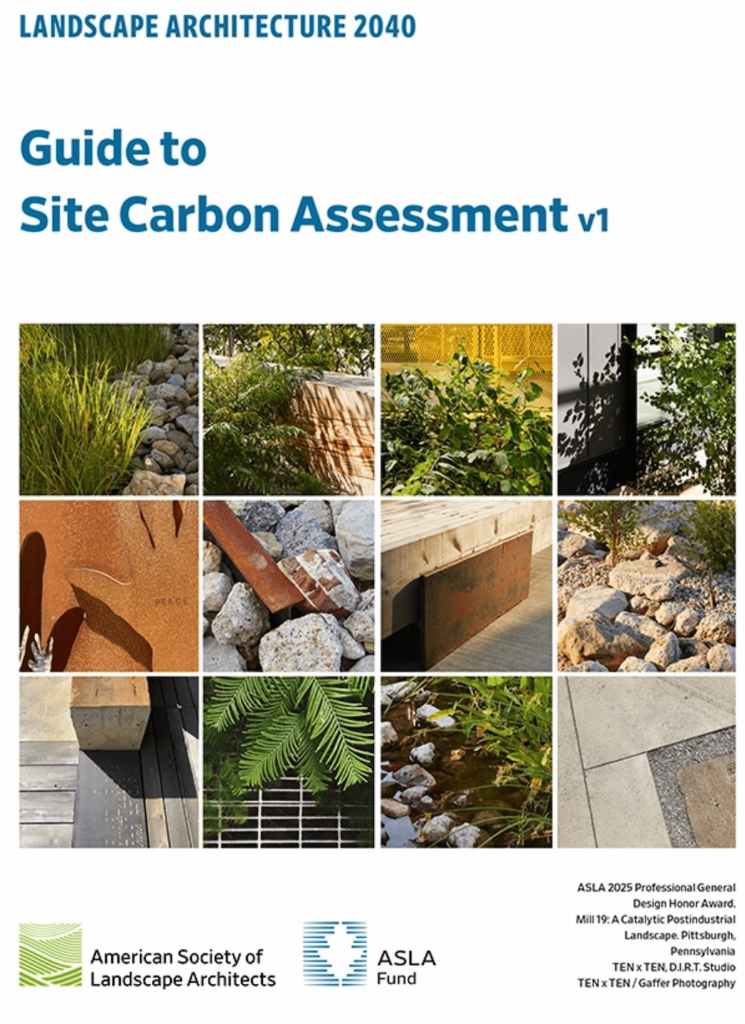
ASLA has released Landscape Architecture 2040: Guide to Site Carbon Assessment v1, which the organization describes as the first standardized methodology for assessing embodied carbon, operational greenhouse gas emissions, and carbon storage across landscape projects.
Download Landscape Architecture 2040: Guide to Site Carbon Assessment v1 from ASLA.
More than another carbon calculator or sustainability checklist, the guide attempts to establish a common accounting system for the climate consequences—and benefits—of landscapes. Crucially, it recognizes carbon storage as a distinct phase in the life-cycle assessment of a project.
ASLA calls that new phase Landscape Carbon Storage, or B9.
The designation addresses a fundamental gap in conventional carbon accounting. Plants, trees, and soils can sequester carbon over time, but that benefit has not been consistently incorporated into assessments used across the architecture, engineering, and construction industry.
“With this new guide, landscape architects can now lead site carbon assessments. We will be able to measure the emissions impacts of projects in the same way. But also, crucially, we will be able to calculate the carbon drawdown benefits of sites. To date, this has been left out of architecture, engineering, and construction (AEC) industry carbon assessments,” said Meg Calkins, FASLA, a co-editor and writer of the guide.
That distinction matters because planting trees does not automatically make a landscape low carbon.
A plaza paved with carbon-intensive materials has an embodied-carbon footprint before anyone walks across it. A park may require excavation, grading, drainage infrastructure, concrete, steel, lighting, irrigation, and years of maintenance before its trees mature enough to store substantial amounts of carbon.
The challenge is to put those impacts and benefits onto the same ledger.
From Carbon Claims to Carbon Accounting
The guide divides that ledger into several categories.
Embodied carbon includes emissions associated with extracting raw materials, manufacturing and transporting products, construction, replacement, and eventual deconstruction. Operational emissions include the energy and resources required to power, water, and maintain a site.
The methodology then accounts for carbon stored in bio-based products such as wood and, most significantly, the carbon sequestered by plants, trees, and soils.
Together, the categories offer something closer to a carbon balance sheet for a landscape.
That could allow designers to ask more consequential questions early in the design process. Is the carbon cost of a material justified? Could a lower-carbon alternative accomplish the same goal? Is preserving mature vegetation more beneficial than replacing it? How long will new planting take to compensate for construction emissions?
And perhaps most importantly: When designers say a landscape is helping mitigate climate change, can they demonstrate it?
“This comprehensive guide demystifies each step of a site carbon assessment. It provides detailed guidance to firms that don’t know where to start with carbon assessments. It also enables firms already conducting assessments to standardize methods, so studies are comparable and repeatable,” said ASLA President Brad McCauley, FASLA, PLA.
Those last two qualities—comparable and repeatable—could ultimately determine the guide’s significance.
Carbon calculations become considerably more useful when projects can be measured against previous projects, industry averages, and performance targets. Without those comparisons, knowing that a landscape produced a certain quantity of emissions tells a designer relatively little about whether that performance is good or bad.
Building a National Benchmark
ASLA says the methodology will provide the foundation for the landscape architecture profession’s first national carbon benchmarking pilot next year.
If firms begin evaluating projects using compatible methods, the resulting data could eventually allow parks to be compared with parks, plazas with plazas, campuses with campuses, and streetscapes with streetscapes.
“The field of landscape architecture is now fully aligned with best practices for measuring greenhouse gas emissions used by architects and engineers. This guide sets the stage for collecting standardized site data, so the landscape architecture community can undertake the first national carbon benchmarking pilot next year. Benchmarking is key to establishing an industry-wide baseline we can start to reduce our emissions and increase our carbon sequestration against,” said Alejandra Hinojosa, Affil. ASLA, a co-editor and writer of the guide.
The move reflects a larger transformation across the design professions. Sustainability was once discussed largely through individual strategies: use recycled materials, reduce water consumption, preserve habitat, plant trees. Increasingly, designers are being asked to demonstrate the actual performance those decisions produce.
For landscape architects, that calculation is particularly complex because landscapes operate across both physical systems and time.
A concrete wall arrives with much of its embodied carbon already emitted. A tree behaves differently: its climate value can increase as it grows. Soil can store carbon but can also release it when disturbed. Vegetation can become a long-term carbon sink, but its performance depends on species, climate, management, lifespan, and what happens to its biomass later.
Landscape carbon, in other words, cannot be measured only on opening day.
Putting the Site Into the Carbon Conversation
The guide also attempts to bring landscape architecture into closer alignment with the carbon-accounting systems developing across architecture and engineering.
It supports the goals of the cross-disciplinary ECHO Project, an effort to create greater consistency in carbon accounting among planning, architecture, landscape architecture, civil and structural engineering, and mechanical, electrical, and plumbing disciplines.
That coordination is increasingly important as project teams attempt to understand the carbon impact of whole developments rather than individual buildings.
A highly efficient building does not exist independently of its parking, paving, infrastructure, grading, planting, and surrounding landscape. Likewise, a low-carbon landscape cannot erase the emissions generated by a carbon-intensive building.
The more useful question is what the entire project emits—and what it stores.
ASLA’s methodology is designed to work with existing carbon-assessment tools rather than replace them. The guide identifies platforms including Pathfinder, Carbon Conscience, C.Scale, and One Click LCA Infrastructure while establishing a methodology for defining what gets counted, documenting assumptions, and producing comparable results.
For firms new to carbon assessment, that provides a place to begin. For those already performing assessments, it provides a way to standardize their work.
A 2040 Deadline
The guide is part of ASLA’s broader Climate & Biodiversity Action Plan, which calls for landscape architecture projects to achieve zero greenhouse gas emissions and double carbon sequestration from business as usual by 2040.
The plan also calls on the profession to protect and restore biodiversity, provide measurable ecosystem and economic benefits, address climate and biodiversity injustices, and improve the equitable distribution of environmental investment.
But its carbon goals expose a basic challenge behind almost every climate pledge: you cannot credibly reduce what you do not measure.
Measurement alone, of course, does not guarantee improvement. A carbon assessment can reveal that a project performs poorly without making it better. Carbon sequestration can be projected without ensuring that vegetation survives long enough to achieve it. And standardized data cannot guarantee that clients choose the lower-carbon alternative.
What the guide can do is make the consequences of those choices visible.
The Landscape as Climate Infrastructure
The guide was developed by a working group of ASLA’s Climate & Biodiversity Action Committee led by Hinojosa and Calkins and including Mariana Ricker, ASLA, PLA, of SWA Group, and Chris Hardy, ASLA, PLA, CA, of Sasaki. It was reviewed by an industry peer group representing seven built-environment organizations and a professional-practice group comprising 13 landscape architecture firms.
Its ultimate value will depend on adoption.
For much of the building industry’s recent reckoning with embodied carbon, attention has focused on concrete, steel, glass, and other materials used to construct buildings. But cities are not collections of buildings alone. They are also streets, parks, campuses, plazas, waterfronts, infrastructure corridors, gardens, soils, and forests.
Those landscapes have carbon footprints.
They also have the biological capacity to draw carbon from the atmosphere and store it.
Putting those two realities on the same ledger should make it harder, not easier, to make simplistic claims about planting one’s way out of emissions. Construction, materials, operation, maintenance, vegetation, and soils all have to be accounted for.
For years, landscape architects have argued that their work can be part of the solution to climate change. ASLA is now giving the profession a standardized method for determining how much of a solution it actually is.
Download ASLA’s Landscape Architecture 2040: Guide to Site Carbon Assessment v1.