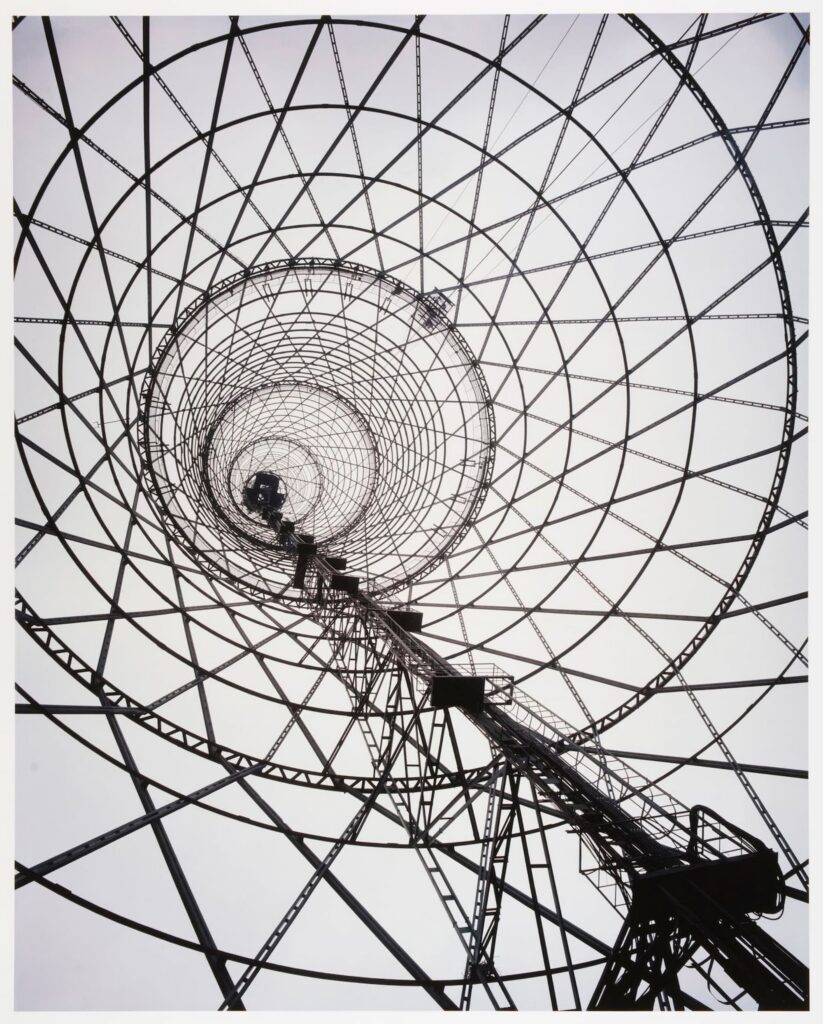
An international coalition of architects, engineers, and preservationists is calling on Vladimir Putin to halt the dismantling of Moscow’s 1922 Shukhov Radio Tower. At stake is more than an architectural landmark: Can a masterpiece of engineering survive if the very structure that makes it historic is replaced?
One of the great paradoxes of architectural preservation is unfolding in Moscow, where Russian authorities are preparing to dismantle one of the most extraordinary engineering achievements of the twentieth century in the name of saving it.
The Shukhov Radio Tower, a 485-foot-high lattice of interlocking steel designed by pioneering Russian engineer Vladimir Shukhov, has stood above Moscow’s Shabolovka neighborhood since 1922. Built in the aftermath of the Russian Revolution, the tower is a monument to structural ingenuity, material economy, and the technological ambitions of the early Soviet state. Now, more than a century later, it faces what preservationists warn could be its effective destruction—not through demolition, but through a reconstruction that would replace much of its historic fabric.
An international coalition of architects, engineers, historians, and preservation advocates has issued an urgent appeal to Russian President Vladimir Putin, demanding a halt to the dismantling and an independent assessment of the tower’s condition.
Titled An International Open Letter for the Preservation of the Shukhov Tower, the petition was initiated by British architectural photographer and historian Richard Pare, Russian architectural historian and preservation campaigner Airat Bagautdinov, and structural engineers Marc Mimram and Guy Nordenson. Addressed to Putin, with copies to Prime Minister Mikhail Mishustin, Culture Minister Olga Lyubimova, and Moscow Mayor Sergey Sobyanin, the appeal challenges the premise that the tower must be taken apart to survive.
“Its irreplaceable value lies in the authentic structure itself,” the petition declares. “A facsimile in modern materials, however careful, is a false replica, and the tower’s validity and historical significance would be lost forever.”
A Monument Built From Almost Nothing
When Shukhov designed the tower, Russia was emerging from revolution and civil war. Materials were scarce, industrial production was constrained, and the Soviet government needed a powerful radio transmitter capable of broadcasting across a vast territory.
Shukhov’s answer was a radical rethinking of the conventional steel tower.
Rather than relying on massive structural members, he employed stacked hyperboloid sections composed of straight steel elements arranged in a lattice. The resulting geometry produced remarkable lightness and strength, its curving silhouette emerging from the precise arrangement of straight members.
According to the preservation petition, even at its originally proposed height, the tower would have required only one-quarter of the steel used in the Eiffel Tower. Constructed by approximately forty workers under conditions of extraordinary scarcity, it demonstrated how engineering intelligence could achieve monumental effects with limited resources.
Where the Eiffel Tower announced the industrial power of nineteenth-century France, Shukhov’s creation suggested a different architectural future, one in which structural efficiency, mathematical ingenuity, and visual elegance were inseparable.
Its significance resides not simply in its silhouette, but in the original steel, connections, fabrication techniques, and construction methods through which Shukhov transformed an engineering concept into reality.
That distinction is now central to the fight to preserve it.
Richard Pare and the Architecture of Memory
For Richard Pare, the effort to save the Shukhov Tower is the continuation of a decades-long commitment to documenting and protecting the architectural legacy of the Russian avant-garde.
Beginning in 1992, shortly after the collapse of the Soviet Union, Pare traveled extensively throughout Russia and other former Soviet republics, photographing buildings that had remained largely inaccessible to Western historians for much of the twentieth century. His work brought renewed international attention to an extraordinary generation of architects and engineers whose experimental buildings were often neglected, deteriorating, or threatened with demolition.
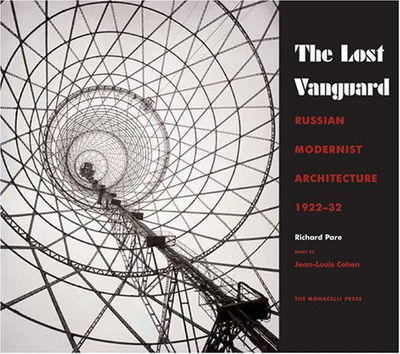
The Lost Vanguard: Russian Modernist Architecture, 1922–1932, published in 2007.
The resulting archive of approximately 15,000 photographs became the foundation for The Lost Vanguard: Russian Modernist Architecture, 1922–1932, published in 2007, and exhibitions at institutions including the Museum of Modern Art in New York and the Graham Foundation in Chicago. His photographs documented not only the formal brilliance of early Soviet Modernism but also the physical condition of buildings that had survived decades of political upheaval and institutional neglect.
Pare’s involvement with the Shukhov Tower is particularly personal. He photographed the structure from within its restricted perimeter in the early 1990s, an experience he recalled in an interview published by The New York Times on October 28. Escorted by armed security guards, he was initially concerned that the overcast weather would flatten the appearance of the steel lattice. Instead, the diffuse light revealed the extraordinary elegance of its ascending structural forms.
Pare has been involved in the tower’s preservation before. In 2014, he joined the late architectural historian Jean-Louis Cohen in preparing an international petition opposing an earlier plan to dismantle the landmark. That campaign attracted support from leading figures in architecture and engineering, including Tadao Ando, Rem Koolhaas, Elizabeth Diller, Thom Mayne, and structural engineer Leslie E. Robertson. The tower was ultimately spared.
His renewed involvement reflects a conviction that photographs and drawings, however powerful, cannot substitute for the survival of the buildings themselves. Pare’s images have helped establish the Shukhov Tower’s place in the international architectural imagination, but the current threat exposes the limitations of documentation as a form of preservation.
For Pare, the loss would be more than architectural. It would mean the disappearance of an original artifact that embodies a remarkable moment of experimentation, optimism, and technological invention.
The other initiators bring complementary expertise to the campaign. Bagautdinov has been a leading figure in the Russian effort to protect the tower, helping mobilize architects, historians, and members of the public. Mimram, a French engineer and architect whose practice explores the relationship between structure and architectural expression, and Nordenson, a New York-based structural engineer known for his work at the intersection of engineering, architecture, and design, lend technical authority to the argument that conservation should begin with a rigorous assessment of the existing structure rather than an assumption that wholesale replacement is inevitable.
Together, the four initiators frame the tower not simply as an endangered Russian monument, but as an international architectural inheritance whose preservation demands both technical expertise and cultural responsibility.
Preserving the Idea, Destroying the Evidence
The tower’s owner, the Russian Television and Radio Broadcasting Network (RTRS), maintains that deterioration makes comprehensive dismantling necessary. Its proposal calls for disassembling the structure and rebuilding it using salvaged original components and new materials.
In an October 28 report, The New York Times described the authorities’ position, including claims that restoring the original structure could cost billions of rubles. The newspaper also reported decades of inadequate maintenance, noting that the tower was last repainted in 1964.
Preservationists dispute the assumption that deterioration requires wholesale replacement. Their petition cites recent surveys indicating that the original steel retains a favorable long-term life expectancy and argues that selective repairs could preserve the tower’s authenticity.
The dispute reflects two fundamentally different definitions of preservation.
For the authorities, the priority appears to be retaining Shukhov’s structural concept and recognizable form, even if substantial original material must be replaced. For preservationists, the original structure is the monument.
A reproduction might preserve the tower’s geometry and proportions, but it could not preserve the physical evidence of how Shukhov’s achievement was realized. Original steel members, riveted connections, fabrication marks, and construction details document an engineering accomplishment made possible under extraordinary historical circumstances.
A reconstructed tower could demonstrate Shukhov’s geometry. It could not fully preserve Shukhov’s achievement.
A Change in Protection, a Change in Fate
The immediate threat follows a consequential change in the tower’s legal protection.
Following the successful 2014 international campaign, the structure received heritage protection recognizing its historic significance. The latest petition alleges that Russia’s Ministry of Culture subsequently weakened those safeguards, protecting the tower’s design concept while removing protections for its original structural materials.
The implications extend far beyond Moscow. By defining protected heritage primarily as an idea rather than an authentic physical artifact, authorities can present dismantling and reconstruction as conservation.
For preservationists, this represents a dangerous inversion of heritage protection: the legislation intended to safeguard a monument may now permit the destruction of the material that makes it historically significant.
A Rare Campaign of Public Resistance
The effort to save the tower has become an unusual example of civic mobilization in contemporary Russia.
According to the petition, a Moscow-based preservation group has spent five months organizing opposition, including a State Duma roundtable, appeals from the architectural community, and a petition attracting more than 11,000 signatures. The New York Times also reported public events, including a festival and free architectural walking tours.
The campaign is particularly striking in a political environment where opportunities for public dissent are severely constrained.
The international petition calls for suspending the dismantling, convening independent Russian and international specialists, restoring legal protection to the original structure, and developing a conservation plan that retains as much authentic material as possible.
The campaigners are not arguing that the tower should remain untouched. They are insisting that restoration begin with an independent understanding of what can be saved rather than a predetermined decision to replace it.
The Cost of Authenticity
Restoring a century-old experimental steel structure presents considerable challenges. Corrosion, inaccessible connections, aging materials, and the complexity of repairing a delicate lattice nearly 500 feet tall make conventional approaches difficult.
Structural engineer Vladimir Traush, a scientific consultant on the project, defended an approach prioritizing Shukhov’s design concept over retaining every original component, according to The New York Times.
The engineering concerns are real. But preservationists argue that the choice is not between retaining every deteriorated component and replacing the entire structure. Contemporary conservation methods allow materials to be stabilized, reinforced, repaired, or selectively replaced.
The economic argument also raises an uncomfortable question: What financial calculation can account for the permanent loss of an original engineering masterpiece?
Shukhov’s tower was an exercise in doing more with less. To replace it wholesale without first exhausting the possibilities of conservation would be a particularly bitter irony.
The Difference Between a Monument and a Replica
Although the petition warned that dismantling could begin in late October, an October 22 Interfax report outlined a longer schedule: site mobilization in late October, preparatory structural work and removal of the uppermost section in early 2027, and dismantling of the remaining sections beginning around midyear.
That timetable suggests there may still be an opportunity for independent technical review.
The international petition concludes with an uncompromising assertion: “The Shukhov Tower belongs to Russia and to the world. This original masterpiece must be conserved, not replaced with a counterfeit.”
A reconstructed tower could retain its familiar silhouette on Moscow’s skyline. It could communicate something of Shukhov’s extraordinary structural imagination. It might even be celebrated as a successful restoration.
But the original steel structure—the artifact that survived revolution, war, and more than a century of Russian history—would have been fundamentally altered or lost.
The tower has already survived one attempt to dismantle it. Whether it survives this one may depend on a simple recognition: Saving the image of a masterpiece is not the same as saving the masterpiece itself.
The petition: An International Open Letter for the Preservation of the Shukhov Tower, initiated by Richard Pare, Airat Bagautdinov, Marc Mimram, and Guy Nordenson, is addressed to Russian President Vladimir Putin, with copies to Prime Minister Mikhail Mishustin, Culture Minister Olga Lyubimova, and Moscow Mayor Sergey Sobyanin.
Read and sign the petition: https://forms.gle/Gx4UgzkaXaieXVXD7