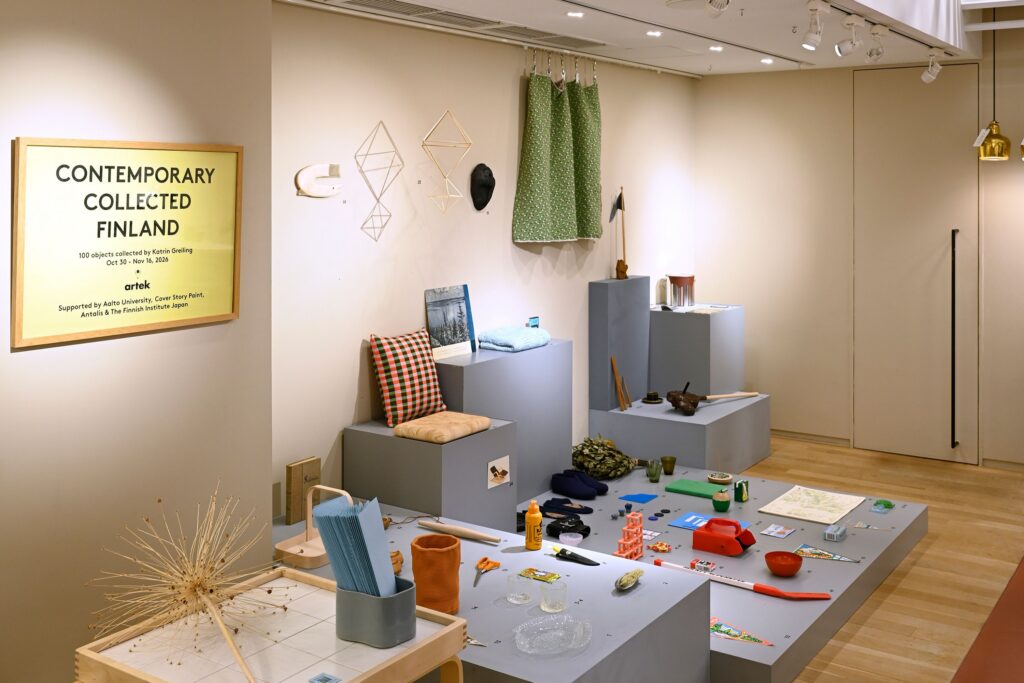
What does a Finnish cheese slicer have in common with an experimental glass sculpture, a pair of felt slippers, or a bag of salty licorice? In most design museums, probably very little. One might be celebrated as an icon of industrial design, another presented as an emerging talent’s artistic experiment, while the others would be dismissed as ordinary consumer goods, hardly worthy of a pedestal.
But at Contemporary Collected, an exhibition at Artek Tokyo in Japan, such distinctions are precisely the point of contention.
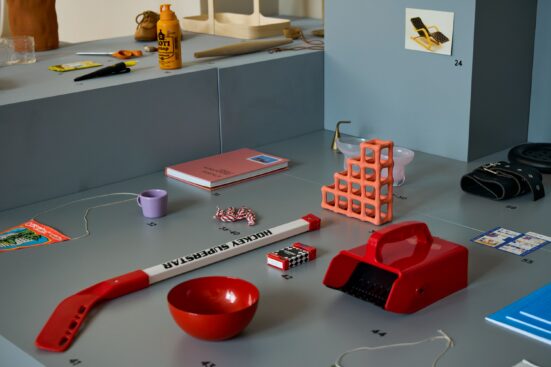
Curated by Katrin Greiling, assistant professor of interior architecture at Aalto University in Helsinki, the exhibition assembles approximately 100 objects that collectively challenge the conventions of how design is classified, displayed, and valued. There are recognizable works by some of Finland’s most celebrated designers, experimental objects by emerging practitioners, student projects, and an assortment of seemingly unremarkable things that populate Finnish daily life: mustard, mushroom knives, school notebooks, hockey jerseys, candy, and even a carton of juice.
Rather than separating the objects according to designer, historical period, cultural importance, or commercial value, Greiling has organized them by color. It is a deceptively simple curatorial strategy, one that effectively dismantles the conventional hierarchy separating the collectible from the commonplace.
The exhibition, which opened October 30 and continues through November 17, 2026, is the fourth iteration of a project Greiling began in Sweden in 2012. This edition marks the first devoted entirely to Finnish design, bringing together a cross section of the country’s material culture at a moment when the boundaries between craft, industrial production, collectible design, and everyday consumption are becoming increasingly fluid.
The result is less a conventional survey of Finnish design than an argument about how design should be understood in the first place.
The Radical Idea That Everything Deserves a Second Look
The premise behind Contemporary Collected is both straightforward and potentially unsettling: Why should the objects we encounter every day be considered less culturally significant than those carrying a famous designer’s name?
Design exhibitions have traditionally reinforced a particular narrative of progress, organized around influential figures, technological innovations, stylistic movements, and canonical masterpieces. The familiar history of Finnish design, for example, tends to revolve around Alvar Aalto, Kaj Franck, Marimekko, Arabia, and a handful of other names that helped establish the country’s international reputation for modernism.
That history is important, but it is also selective. It privileges certain forms of authorship and production while leaving much of the designed environment outside the frame.
Greiling’s approach challenges that selectivity. As she explains in her curatorial statement: “CONTEMPORARY COLLECTED brings contemporary design into conversation with the objects of everyday life, presenting emerging designers alongside established designs and familiar objects. Developed in 2012, while I was living in Sweden, the concept challenges hierarchies of significance, allowing different generations, scales and forms of production to meet on equal terms.”
That commitment to equality extends beyond the selection of objects to the way they are presented. Color, rather than reputation or chronology, becomes the organizing principle, encouraging visitors to recognize unexpected visual and material relationships.
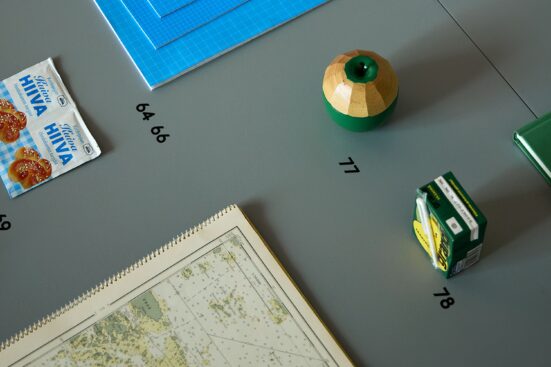
A mass-produced household implement can suddenly appear as compelling as a limited-edition sculpture. An anonymous object may reveal an ingenuity that has gone largely unacknowledged. And a student experiment can be examined alongside the work of an established designer without being relegated to a secondary category.
The approach raises an intriguing question: Is design history primarily the history of exceptional objects, or is it the history of everything humans have devised to make life possible, practical, pleasurable, and meaningful?
From Kaj Franck to a Carton of Juice
The exhibition’s object list reads like an unconventional inventory of Finnish life.
Among the more recognizable examples are pieces by Kaj Franck, one of the central figures in Finnish postwar design. His stainless-steel Scandia cheese slicer and butter knife, both dating from 1952, appear alongside his Kimara glasses, produced by Nuutajärvi in 1953. Franck’s work is particularly appropriate for an exhibition concerned with the relationship between aesthetics and everyday life. His approach to design emphasized functional clarity, durability, and the possibility that well-designed objects could improve ordinary domestic experiences.
Yet here, Franck’s celebrated utensils are not necessarily granted more prominence than a plastic berry picker or a traditional Finnish mushroom knife.
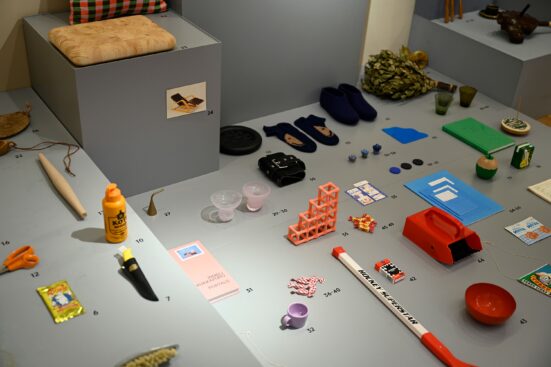
The exhibition also includes an acrylic wing from Yrjö Kukkapuro’s 1968 Perhonen lamp, an object associated with another important chapter of Finnish design history. Nearby in the collection are school notebooks in A4, A5, and A6 formats, a cassette tape featuring Finnish singer Olavi Virta, and a packet of dry yeast from Suomen Hiiva.
A postcard depicting Alvar Aalto’s Model 43 chaise longue stands in for one of the country’s best-known modernist designers, but its status as a reproduction is telling. Rather than presenting the original furniture as an untouchable masterpiece, the exhibition includes the image as another object circulating through everyday culture.
Elsewhere, an espresso cup from Arabia’s Koko collection, designed by Kati Tuominen-Niittylä and Kristina Riska in 2005, joins a Kosmos tea cup and saucer associated with Ulla Procopé and Gunvor Olin-Grönqvist from the 1960s.
The exhibition’s edible offerings are equally revealing. Fazer’s Marianne chocolate-filled candies, introduced in 1949, appear alongside Pihlaja sweets, salty licorice, traditional Koti mustard, and a carton of Grandi juice. These objects carry their own histories of graphic design, branding, packaging, and consumer behavior, even if their designers are not always recognized in the same way as the creators of furniture or lighting.
Such selections broaden the definition of design beyond the furniture showroom and museum collection to encompass the visual and material systems through which a national culture expresses itself.
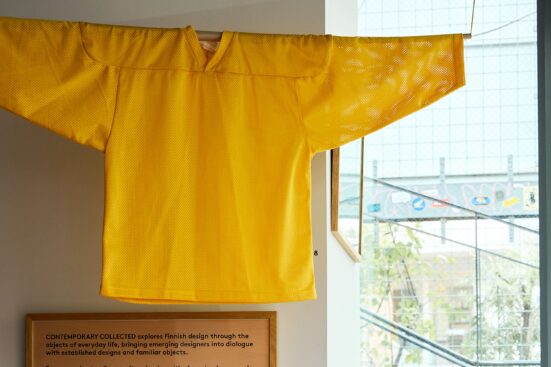
A hockey jersey, a flag from the Finnish city of Oulu, a Moomin postage stamp, or a patch from Mikkeli can communicate as much about identity and belonging as an iconic chair. Their cultural significance comes not necessarily from aesthetic innovation but from familiarity, use, and collective memory.
The inclusion of these objects also complicates the idea of national design identity. Finland’s material culture is not simply a collection of minimalist furniture, bentwood forms, and restrained glassware. It includes sports equipment, souvenirs, packaging, folk traditions, commercial products, and a multitude of objects whose meanings are shaped by daily routines.
A New Generation Enters the Conversation
If the exhibition were concerned only with elevating anonymous objects, it might risk becoming an exercise in nostalgia. But Greiling’s selection is equally invested in the present and future of Finnish design.
Students from Aalto University’s School of Arts, Design and Architecture appear alongside established practitioners and commercial manufacturers, creating a dialogue between different generations and approaches to making.
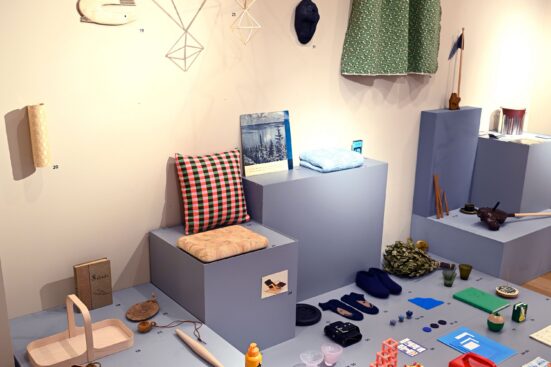
Alois Auer’s Connect with the Hidden (2025), a brush made from cast aluminum and cow hair, transforms a familiar utilitarian object through an unexpected combination of materials. The work invites consideration of the relationship between touch, function, and material expression.
Elisa Roinisto’s Wrinkled Whisky glasses (2026), developed as a bachelor’s thesis project, explore the expressive potential of colored glass. Their deliberately irregular forms challenge the assumption that drinking vessels must conform to conventional ideas of symmetry and refinement.
Annika Tuovinen’s Päre lamp (2025), created as a master’s thesis project, combines birch, cotton, aluminum, and a light source, connecting traditional materials with contemporary lighting design. Klara Sjelvgren’s terracotta Earth vase (2026) similarly investigates the expressive possibilities of a material with a long history of use.
Other student projects move between the domestic, decorative, and experimental. Helmi Mäntysaari contributes Paletti, a wool-and-cotton pillow cover, and Little Lambs, an interior textile. Petra Hanski’s Kukkia porcelain knobs bring attention to the often-overlooked components of furniture and interiors. Enni Gröhn’s Rogue Strata ceramic tiles investigate the expressive possibilities of stoneware clay, pigment, and glaze.
Shan Shan Lim’s Dissolution (2026), made from undyed wool, adds another dimension to the exhibition’s exploration of materiality, while Ellen Romi’s glass works Ear & Nose introduce a more sculptural vocabulary.
These projects suggest a design culture that is neither confined to the functionalist traditions of Finnish modernism nor wholly preoccupied with collectible objects. Instead, emerging practitioners are moving between material experimentation, craft, domestic utility, and artistic expression.
Their presence also points to the continuing importance of design education in shaping Finland’s creative landscape. By placing student work alongside objects by established designers, Greiling refuses to treat emerging talent merely as a preview of future achievement. The students’ work is presented as part of the country’s design culture now.
Craft, Industry, and the Objects Between
One of the exhibition’s most compelling aspects is its attention to the increasingly porous boundary between craft and industrial production.
Finnish design has long been associated with a close relationship to natural materials, particularly wood, glass, and textiles. But the contemporary landscape is more complicated, encompassing experimental fabrication, traditional techniques, industrial manufacturing, and small-scale production.
Among the participating companies is Vaarnii, whose Syy chopping board (2026) is made from pine. The material, deeply associated with Finland’s forests and construction traditions, becomes the basis for an object that is both practical and formally considered.
Verso Design’s Koppa tray, designed by Tuttu Sillanpää and Tuuli Burman in 2023, uses birch, another material closely linked to Finnish craft traditions. Aalto + Aalto’s Himmeli Kit (2011) draws on the traditional practice of making geometric ornaments from straw.
These objects coexist with a wooden kuksa drinking cup, a traditional rolling pin used to make Karelian pies, and a key chain made from reindeer fur. Together, they suggest that the distinction between folk craft and contemporary design may be less clear-cut than institutional categories imply.
The exhibition also includes the Kuohu bath towel (2025), designed by Maëlis Ray for Lapuan Kankurit and made from Tencel, linen, and cotton. Its presence alongside experimental textiles underscores the relationship between contemporary material research and the longstanding traditions of Finnish weaving.
More speculative approaches are represented by Julia Lohmann’s Kombuloid, made from seaweed. Lohmann’s work is part of a broader investigation into the potential of marine materials as alternatives to conventional resources. Within the exhibition, it expands the conversation from cultural heritage to the environmental and material questions facing contemporary design.
Saara Renvall’s Conversation (2022), a sculpture made from burnt birch, offers another approach to transforming a familiar natural material. Reeta Laine’s Ghostly lamp (2025), made from polyester and aluminum, occupies a different territory, demonstrating the diversity of materials and production methods represented.
The range is significant. Rather than promoting a singular aesthetic or national style, Contemporary Collected presents Finnish design as a field of overlapping practices, some rooted in tradition, others pursuing new technologies, materials, and forms of expression.
The Curious Power of Color
Perhaps the exhibition’s most provocative curatorial decision is its refusal to organize objects according to the categories visitors might expect. Instead, color becomes the primary means of establishing relationships between works, an approach supported by Finnish paint company Cover Story Paint, one of the exhibition’s sponsors. The company’s involvement reinforces the central role of color in Greiling’s curatorial vision, where chromatic relationships take precedence over authorship, chronology, or cultural status.
This strategy is more consequential than it might initially appear. Museums and galleries frequently use chronology, authorship, typology, or material to construct narratives. Such systems are useful, but they also reinforce assumptions about what belongs together and which objects deserve particular attention.
By grouping objects according to color, Greiling introduces an alternative logic, one based on immediate visual perception rather than established cultural authority.
A candy wrapper might share a visual relationship with a textile. A piece of contemporary glassware might find an unexpected companion in a mass-produced household object. A souvenir could become part of the same visual conversation as a sculptural work.
The effect is to encourage comparison without necessarily imposing a predetermined interpretation.
It also makes the exhibition accessible in a way that conventional design displays sometimes are not. Visitors do not need to know the history of Finnish modernism, recognize a designer’s signature, or understand the technical distinctions between production methods to begin making connections.
Color provides an immediate point of entry.
Yet the strategy also carries a productive contradiction. An exhibition that rejects traditional hierarchies still depends on the curator’s subjective judgment. Greiling decides which objects enter the collection and how they relate to one another. The authority of the designer or manufacturer is not eliminated so much as displaced by the curator’s eye.
That tension is part of what makes the project interesting. Rather than claiming to offer a definitive account of Finnish design, the exhibition embraces its own subjectivity.
As Greiling writes: “Each selection offers a subjective portrait of a country’s creative landscape, guided by an interest in form, colour, material qualities and innovation. Rather than defining a national design identity, the exhibition explores what is being designed, made and used today.”
The distinction matters. National design exhibitions often attempt to identify a coherent aesthetic identity, whether through materials, values, or recurring formal characteristics. Greiling’s exhibition resists that impulse, proposing instead that a country’s design culture is best understood through the diversity of objects circulating within it.
A Finnish Exhibition in Tokyo
The choice of Tokyo as the setting is particularly appropriate given the longstanding cultural dialogue between Finnish and Japanese design.
Both traditions have frequently been associated with an appreciation for craftsmanship, natural materials, functional objects, and the aesthetic possibilities of everyday life. Yet these similarities can also become reductive, encouraging an overly familiar narrative of shared minimalism and restraint.
Contemporary Collected offers a more expansive view.
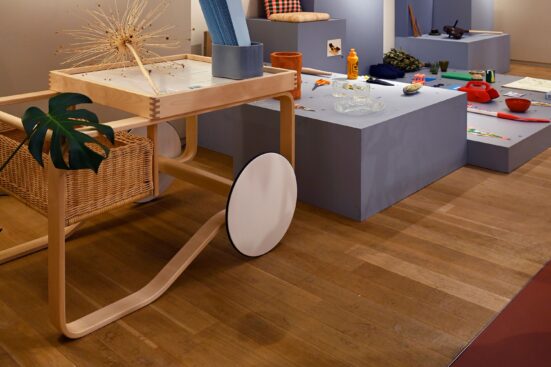
The exhibition is staged at Artek Tokyo, a 200-square-meter store occupying two levels in Omotesando, one of the city’s prominent shopping and design districts. Designed by Japanese architecture office Daikei Mills, the interior interprets Artek’s Finnish heritage through organic forms, natural materials, and references to Alvar Aalto’s design vocabulary.
The store operates as both a commercial space and a cultural venue, presenting furniture, lighting, and accessories while hosting exhibitions and collaborations that explore connections between Finland and Japan.
That dual role makes it an interesting setting for an exhibition concerned with the relationship between cultural value and everyday consumption.
Unlike a conventional museum, a design store is already a place where objects are encountered through their potential use and purchase. By introducing familiar household goods, student experiments, and collectible works into that environment, Greiling further destabilizes the distinction between merchandise and cultural artifact.
The exhibition also includes works by designers whose practices cross geographic and cultural boundaries, among them Akiko Mori, Toshiyuki Iwai, and the Helsinki-based design duo Company, founded by Aamu Song and Johan Olin. Company’s Nagano Apple Green (2024), credited to Song and made by Japanese craftsperson Sunohara, is a particularly telling inclusion, reflecting the international exchanges that shape contemporary design production.
Rather than presenting Finnish design as an isolated national achievement, the exhibition acknowledges the movement of ideas, techniques, and objects across borders.
An Exhibition Built on Collaboration
The Tokyo presentation also reflects Greiling’s own evolving relationship with Nordic design.
She developed the Contemporary Collected concept in 2012 while living in Sweden, initially focusing on Swedish design and everyday objects. The first two exhibitions in Japan were supported by Svensk Form and the late Teruo Kurosaki, whose involvement helped establish the project in the country.
In 2025, Greiling moved to Finland to join Aalto University as assistant professor of interior architecture, giving her a new vantage point from which to examine the country’s design culture. As she explains: “Having moved to Finland and joined Aalto University as Assistant Professor of Interior Architecture in 2025, I approach the country’s design culture from both within and outside its established narratives. Unique works and limited editions appear alongside industrially produced designs and everyday objects, connecting Finland’s celebrated design heritage with new voices and diverse approaches to making.”
That insider-outsider position is central to the exhibition’s character. Greiling is working within Finland’s design education system while maintaining the perspective of someone who has encountered its traditions from elsewhere.
The exhibition has been developed in collaboration with the Finnish Institute in Japan and Artek Tokyo, with support from Aalto University, Antalis Oy · Terreus, the Asko Foundation, and Cover Story Paint. Jaein Lee, a master’s student in interior architecture at Aalto University, serves as project assistant, while portions of the exhibition display were produced by interior architecture students in Helsinki.
The participation of students in both the exhibited work and the exhibition’s physical realization reinforces the project’s broader commitment to recognizing different forms of creative contribution.
What Makes an Object Worth Keeping?
At a time when collectible design has become an increasingly prominent part of the international art and design market, Contemporary Collected offers a useful counterargument to the idea that cultural significance is necessarily tied to rarity, authorship, or price.
The exhibition does not deny the importance of celebrated designers or exceptional objects. Instead, it asks whether their importance might be better understood when they are placed in conversation with the ordinary things that surround them.
A Kaj Franck cheese slicer is a compelling example. It can be appreciated as a carefully considered work of industrial design, but it also belongs to a larger history of food preparation, domestic routines, manufacturing, and changing ideas about modern living.
A school notebook, meanwhile, may lack the prestige of a collectible design object, yet it embodies decisions about paper, typography, format, color, manufacturing, and education. It is an artifact of design just as surely as a chair or lamp.
The same could be said of a candy wrapper, a hockey jersey, or a berry picker. Each reflects choices about materials, function, communication, and human behavior. Each also carries cultural associations that may be difficult to capture through conventional design histories.
There is something quietly subversive about treating such objects with the same seriousness accorded to the work of famous designers.
The exhibition also suggests a different understanding of sustainability and value. In a culture frequently driven by novelty, luxury, and the relentless production of new objects, looking carefully at what already exists can itself be a meaningful act. Familiar objects may possess qualities worth preserving, studying, or reconsidering, even when they were never intended to become collectibles.
This is not to suggest that every object is equally successful or deserving of admiration. Rather, it is to recognize that the criteria by which design is judged are neither fixed nor neutral.
Contemporary Collected makes those criteria visible by refusing to take them for granted.
Ultimately, the exhibition’s most radical proposition may be its simplest: Design is not confined to the objects we have been taught to admire. It is everywhere, from the museum-worthy masterpiece to the utensil in a kitchen drawer, the notebook in a schoolbag, or the candy purchased at a neighborhood shop.
And sometimes, to understand the design culture of a country, it may be more revealing to look at what people actually use than at what museums have decided to preserve.
In Greiling’s hands, the ordinary becomes extraordinary not because it has been transformed, but because someone has finally decided to look at it.
Exhibition Information
Contemporary Collected
Artek Tokyo
5-9-20 Jingumae, Shibuya-ku, Tokyo, Japan
October 30–November 17, 2026
Curator: Katrin Greiling
Project Assistant: Jaein Lee
Instagram: @contemporary_collected