The design industry has never lacked generosity. Architects routinely donate pro bono services. Manufacturers sponsor exhibitions and student programs. Designers lend their names to charitable causes. But it is rare for an entire ecosystem of craftspeople, fabricators, furniture makers, lighting companies, textile manufacturers, and artisans to rally around a single project—not because it promises prestige or profit, but because they believe in its mission.
That unusual act of collective giving is at the heart of Anew, a new nonprofit headquarters in New York City’s West Village designed by Rockwell Group.
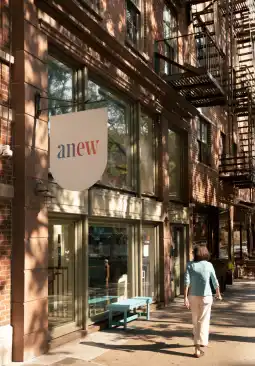
Occupying the last surviving brownstone on its block at 526 Hudson Street, the restored nineteenth-century townhouse has been transformed into a headquarters for a social-impact organization whose ambitions extend well beyond its historic walls. The building serves as an action lab, discovery center, nonprofit accelerator, event venue, retail space, café, residency program, and gathering place for social entrepreneurs working on challenges ranging from environmental sustainability to community development.
Yet the building’s most remarkable story may not be its architecture. It is how the project came together.
Rather than relying solely on a conventional procurement process, Rockwell Group assembled an extraordinary coalition of longtime collaborators who donated products, finishes, furnishings, lighting, textiles, flooring, wallcoverings, plumbing fixtures, and handcrafted objects. The resulting interior demonstrates that collaboration—not simply design—can become an architectural material in its own right.
“When we told vendors what Anew was creating, they really wanted to be part of it. We were fortunate that so many of our longtime collaborators responded with incredible generosity. There was this instantaneous and unspoken understanding that these collective contributions could ultimately help build a community. Every contribution comes with a story, and those stories make the building feel hopeful, generous, and warm. The design process ended up being as collaborative and mission-driven as Anew’s space.
“I think our experience also reflects a broader shift in the design industry, at least from what I have seen recently, where more and more manufacturers and craftspeople want to participate in projects that are invested in both material reuse and community impact,” said David Rockwell, founder and president of Rockwell Group.
His observation hints at something larger than a single project. As environmental concerns reshape material sourcing and younger designers increasingly seek purpose alongside aesthetics, manufacturers are beginning to view charitable and socially driven projects not as philanthropy alone but as opportunities to demonstrate new ways of building.
Restoring Rather Than Replacing
The project begins with an act of preservation.
Built in the 1830s, the Hudson Street brownstone represents one of the few remaining pieces of the neighborhood’s original architectural fabric. Rather than erase its history, Rockwell Group chose to preserve and reinterpret it.
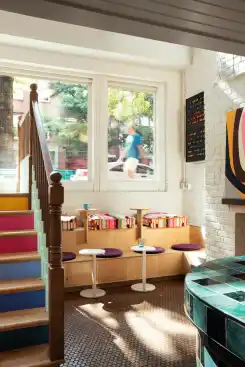
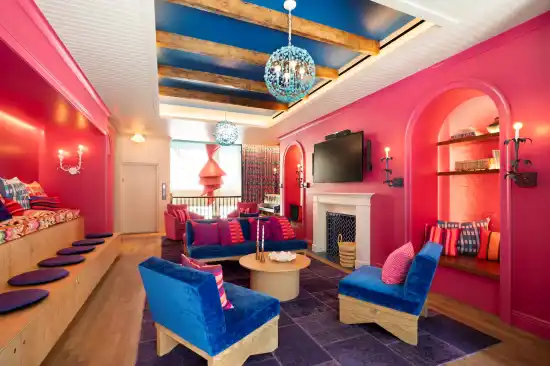
Original beams were salvaged and reintroduced into the interiors. Historic stair railings were carefully retained. Existing architectural elements were restored wherever possible before new interventions were added.
Instead of pursuing a restrained restoration palette, however, the designers embraced color.
Throughout the building, richly saturated jewel tones—emerald green, teal, fuchsia, indigo, pink, and violet—transform what could have become a conventional nonprofit office into a vibrant sequence of spaces intended to encourage conversation, creativity, and optimism.
The design reflects Rockwell Group’s longstanding belief that hospitality principles can strengthen civic and institutional environments. Comfortable lounges replace formal meeting rooms. Flexible furniture supports events, lectures, and workshops. Carefully curated objects introduce warmth and personality while reinforcing Anew’s commitment to ethical production and global craftsmanship.
Every Floor Tells a Different Story
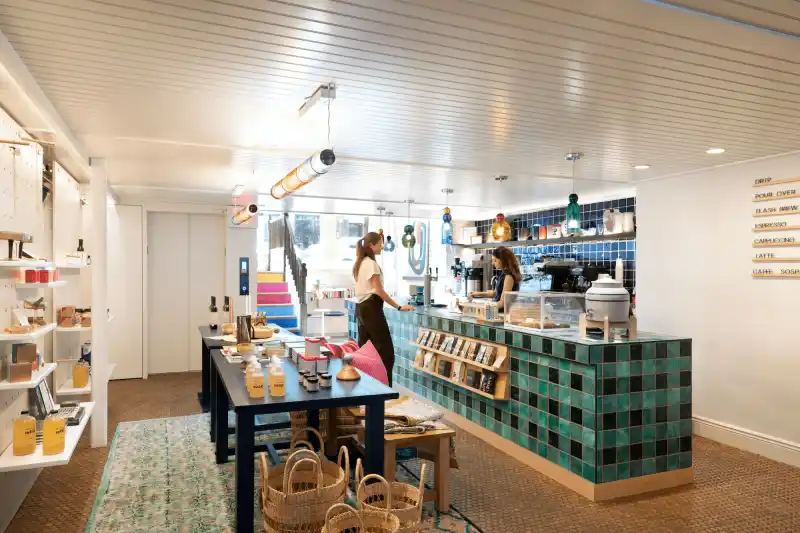
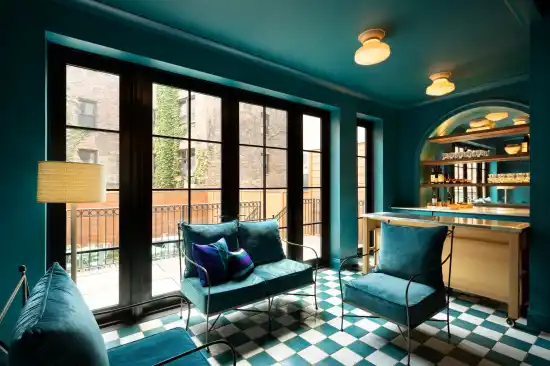
Visitors enter through the garden level, where a green-tiled coffee bar anchors a café and retail space offering ethically sourced coffee alongside sustainably produced gifts and handcrafted objects. Recycled cork penny tile underfoot and blown-glass pendant fixtures create an atmosphere that feels less like a nonprofit office than a neighborhood gathering place.
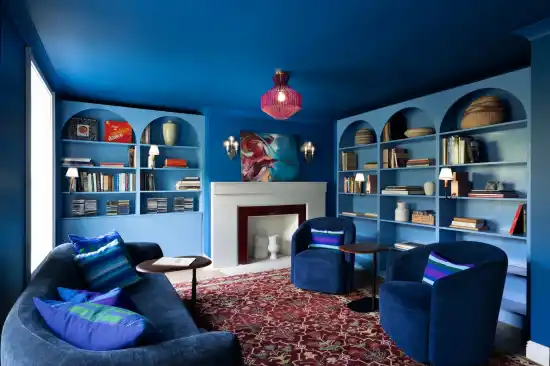
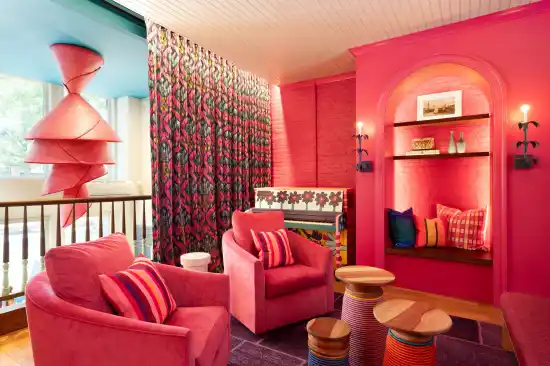
The first-floor salon functions as the building’s social heart. Deep teal and vivid fuchsia walls surround movable lounge furniture, allowing the room to shift effortlessly between lectures, workshops, meetings, and public events. Vintage Kilim patchwork rugs, Ethiopian handwoven textiles from Bole Road, donated Pierre Frey drapery fabrics, and a monumental woven pink pendant from Nigeria create an environment where craftsmanship becomes part of the building’s narrative.
A brightly painted upright piano donated through the nonprofit Sing for Hope introduces another layer of public engagement, reinforcing the idea that culture and community are inseparable.
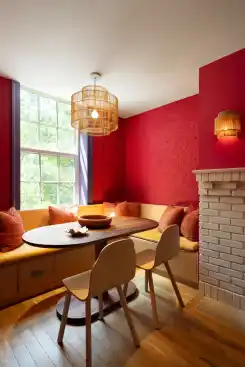
Above, the second floor serves as a residency space for nonprofit leaders and social entrepreneurs, offering flexible workspaces designed for collaboration rather than hierarchy.
The third floor combines a library with a podcast studio, where donated acoustic felt remnants from FilzFelt were repurposed into custom wall treatments fabricated by C3 Design. Nearby, wallcoverings made from recycled Indian saris reinforce the project’s commitment to adaptive reuse without turning sustainability into a visual slogan.
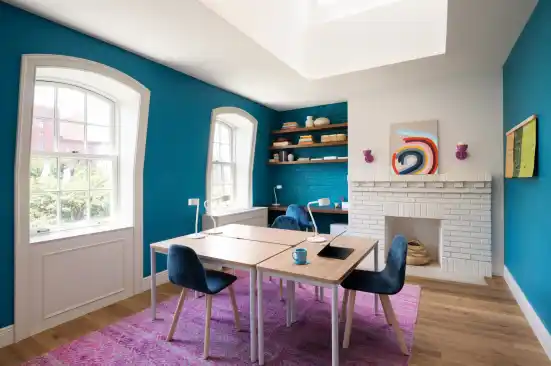
The fourth-floor loft, illuminated by skylights and wrapped in indigo Porter Teleo wallcoverings, provides workspace for Anew’s own staff while continuing the project’s rich material language.
A New Kind of Supply Chain
The list of contributors reads like a cross-section of today’s design industry.
Manufacturers including Pierre Frey, Shaw, Duravit, Gessi, Daltile, Elkay, Valley Forge, Elitis, FilzFelt, and others supplied materials and products, while companies such as Leucos, Christopher Farr, Rug & Kilim, Porter Teleo, Bole Road, Williams-Sonoma Inc., Tolix, Fabricut, and numerous artisans added furnishings, lighting, textiles, and handcrafted elements.
Individually, these contributions might appear modest.
Collectively, they suggest another possibility for design practice—one in which manufacturers become active participants in mission-driven projects rather than simply vendors responding to specifications.
That collaborative model also reflects changing attitudes toward sustainability. Instead of celebrating expensive new materials, the project demonstrates how adaptive reuse, donated inventory, handcrafted work, recycled products, and restored architectural elements can coexist without compromising design quality.
Designing for Optimism
Founded as a social impact action lab, Anew exists to support organizations developing creative responses to complex social and environmental challenges. Its headquarters therefore had to function as more than an office building.
The design encourages encounters between nonprofit leaders, neighborhood residents, entrepreneurs, artists, students, and visitors who may arrive for a coffee, attend a lecture, browse ethically sourced products, record a podcast, or participate in workshops.
Every space has been designed to support interaction.
That emphasis on flexibility distinguishes the project from many nonprofit headquarters, which often prioritize administrative efficiency over public engagement. Here, the building itself becomes part of Anew’s programming.
The architecture invites participation before visitors ever learn about the organization’s mission.
Beyond One Brownstone
The completed project arrives at a moment when the architecture and design professions are reassessing their broader responsibilities.
Conversations about embodied carbon, circular economies, adaptive reuse, and social equity have become central to practice. Yet these ambitions often remain separated into different conversations—one focused on environmental performance, another on philanthropy, another on design excellence.
Anew quietly weaves those priorities together.
Its preservation of a nineteenth-century structure reduces waste. Its donated materials extend the life of existing products while minimizing new consumption. Its handcrafted furnishings celebrate global artisanship. And its collaborative procurement model demonstrates how manufacturers, designers, artists, and nonprofit organizations can pursue a shared civic purpose.
Whether this approach becomes a template for future projects remains to be seen.
But in a profession often defined by competition—for commissions, awards, and recognition—Anew suggests another possibility: that architecture can become stronger when success is measured not only by what is designed, but by how many people choose to build it together.