
By all conventional measures, infrastructure is where architecture goes to disappear. Wastewater plants, juvenile justice centers, and landfills are typically designed to be invisible—functional, necessary, and deliberately overlooked.
Kate Diamond has spent a career doing the opposite.
The American Institute of Architects announced today that Diamond, FAIA, LEED AP, would receive the 2026 AIA Award for Excellence in Public Architecture—one of the profession’s clearest signals that something fundamental is shifting in how architects define public work.
Diamond, who serves as Civic Design Director at HDR, has built a portfolio that refuses the quiet anonymity of infrastructure. Instead, her projects insist that the systems underpinning daily life—water, justice, waste—should be legible, accessible, and even inspiring.
Her work suggests a provocative idea: the most important architecture today may not be cultural icons or luxury towers, but the civic systems we’ve historically tried to hide.
Rewriting What Counts as Architecture
The AIA’s citation frames Diamond’s work as “transformative,” highlighting her ability to advance “environmental sustainability, social equity, and civic trust through public architecture.”
That framing is not accidental. It reflects a growing recognition that architecture’s influence is shifting away from singular objects and toward systems—networks of infrastructure that shape everyday life at scale.
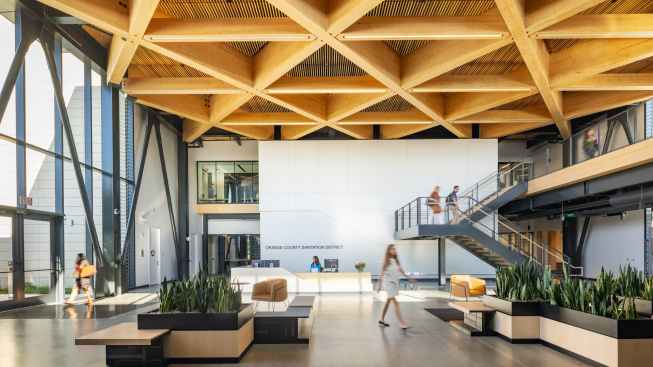
Orange City Sanitation District Headquarters. This design represents both a cost-conscious public investment and commitment to beautiful, high-performance stewardship, serving as a transformative standard for future infrastructure facilities. Photo: Dan Schwalm, © HDR
Diamond’s projects consistently challenge the assumption that public buildings must be purely utilitarian. Instead, they operate as hybrid spaces: part infrastructure, part civic stage.
Take the Orange County Sanitation District Headquarters. Rather than treating wastewater infrastructure as something to conceal, the project makes it visible—integrating net-zero energy strategies, biophilic design, and public access. The building doesn’t just process waste; it communicates how that process works, turning environmental performance into a form of public education.
The implication is subtle but radical: sustainability isn’t just a technical achievement—it’s a cultural one.
From Landfill to Landscape
Perhaps the clearest expression of Diamond’s approach is the Puente Hills Environmental Justice Center, a project that reclaims one of the largest landfills in the United States and transforms it into a public park and community resource.
Where conventional practice might have capped and concealed the site, Diamond’s work reframes it as a place of engagement—an active landscape that acknowledges its history while proposing a different future.
It’s a project that collapses categories: infrastructure becomes park, remediation becomes education, and environmental justice becomes spatial experience.
In doing so, it advances a broader argument embedded throughout her career—that architecture can operate as a tool for both environmental restoration and social repair.
Designing for Systems, Not Objects
Across her portfolio—courthouses, transit facilities, water infrastructure, and justice-centered environments—Diamond approaches each project as part of a larger civic system.
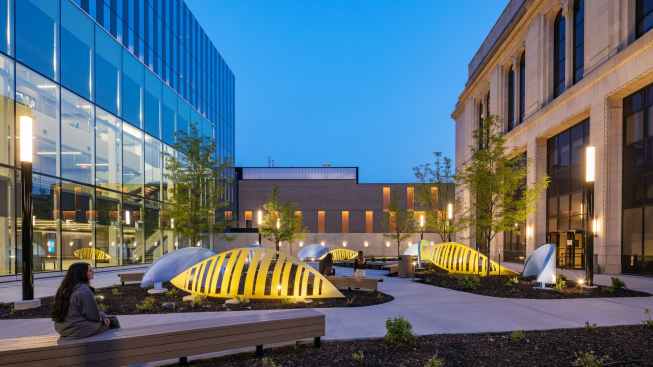
Douglas City Juvenile Justice Center. With spaces for education, counseling, and family engagement, this transformative project provides a restorative and uplifting environment for youth, staff, families, and the broader community. Photo courtesy Dan Schwalm, © HDR
Her work on the Douglas County Juvenile Justice Center, for example, reimagines what a justice facility can be. Rather than reinforcing punitive environments, the project emphasizes restorative, human-centered design, aiming to improve outcomes for both users and communities.
This shift—from control to care, from containment to engagement—mirrors broader changes in how institutions are being rethought across the United States.
What distinguishes Diamond’s work is not just its ambition, but its consistency. The same principles—performance, beauty, and long-term value—are applied whether the project is a courthouse or a wastewater facility.
“Sustainable design is not an added feature, but a foundational principle embedded from the outset,” the AIA notes in its announcement.
The Politics of Public Space
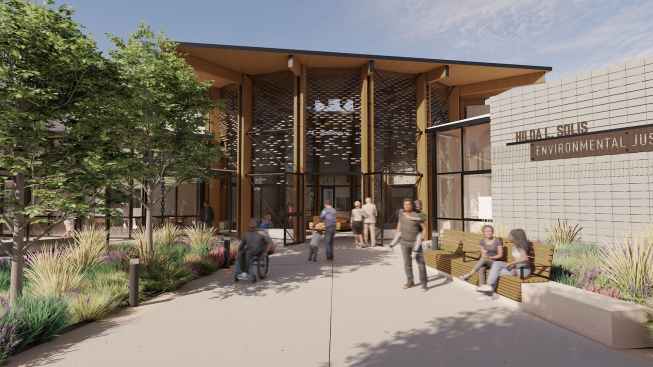
Kate led a multidisciplinary team to transform what was the second-largest landfill in the U.S. into an attractive, inclusive park—with a “first-of-its-kind” net zero Environmental Justice Center. Rendering courtesy HDR.
Diamond’s influence extends beyond individual projects into the policies and standards that shape the built environment.
She has contributed to early sustainable design guidelines that helped inform national standards and has remained an active voice in climate-responsive design. Her leadership within AIA Los Angeles—including serving as its first woman president—signals a parallel commitment to institutional change.
That dual role—designer and advocate—is increasingly central to the profession. As climate pressures intensify and public trust in institutions fluctuates, architects are being asked to engage not just with buildings, but with governance, policy, and public perception.
A Different Kind of Legacy
It’s tempting to frame Diamond’s award as recognition of a single career. But it also reads as something larger: a validation of a different model of architectural practice.
One that prioritizes infrastructure over iconography.
Systems over objects.
Public value over private spectacle.
Her work demonstrates that architecture can “ignite inspiration, foster education, and drive meaningful change,” according to the AIA.
That may sound like familiar rhetoric. What’s different now is where that ambition is being applied—not to museums or skyscrapers, but to the overlooked systems that quietly sustain civic life.
In that sense, the award doesn’t just honor Kate Diamond. It signals a broader realignment of the discipline itself.
The future of architecture, it suggests, may not be what we see.
It’s what we’ve been taught not to notice.