
Project Description
Blaibach is a village in the German state of Bavaria, near the border
with the Czech Republic. Like other communities in the region, it faces a
declining population and an increasingly vacant town center as people
leave the area for the lure of larger and more modern cities. Enter a
government revitalization program, and Munich-based architect Peter
Haimerl, who has remade Blaibach into a cultural magnet with a new
concert hall that, at 200 seats, can hold fully one-tenth of the town’s
population.
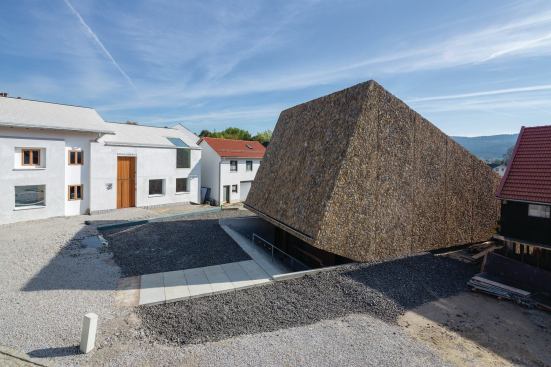
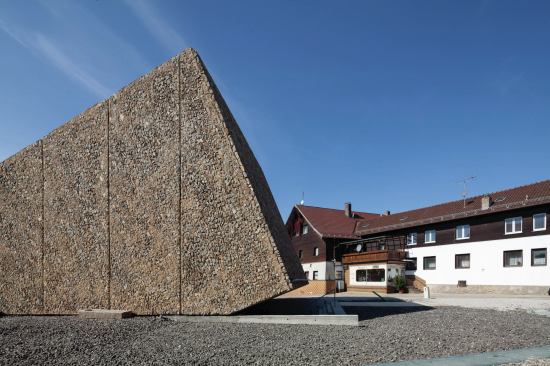
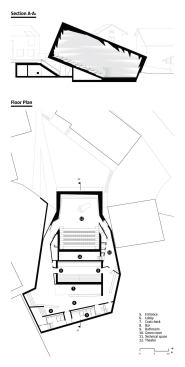
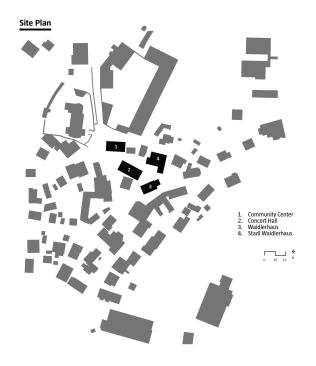
But visitors looking for the concert hall might have to look twice: For
fear of overwhelming the village square, Haimerl placed the bulk of the
building below grade, save for a tilted, cubic granite block (which
contains the upper rows of seats) that projects from the ground plane.
To that end, “the concert hall itself is a sculpture,” Haimerl says. The
architect selected a specific cut of rough granite to clad the volume
because “the old houses in Blaibach were all built from this material,”
he says.
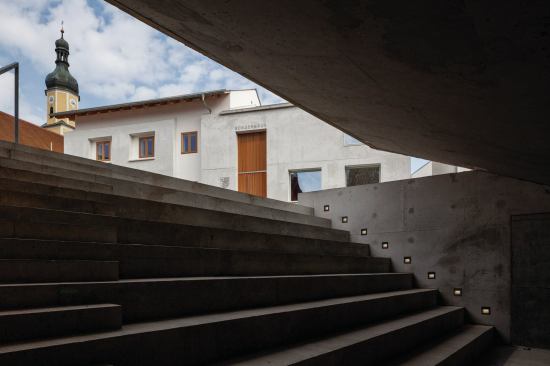
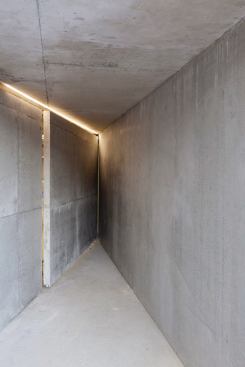
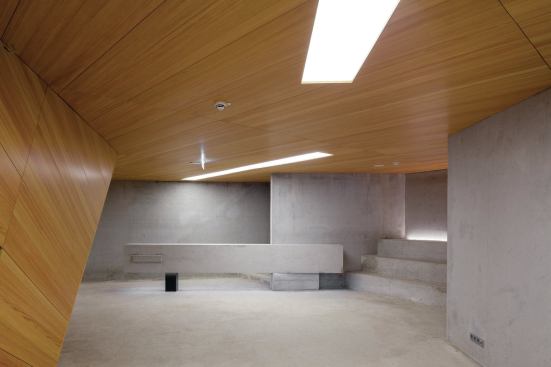
A concrete staircase on the exposed underside of the tilted block leads
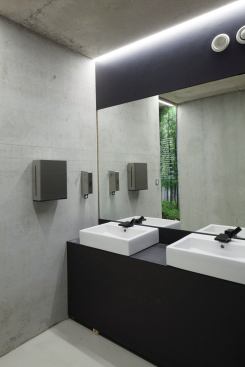
to a subterranean lobby, which features a bar, coat check, and
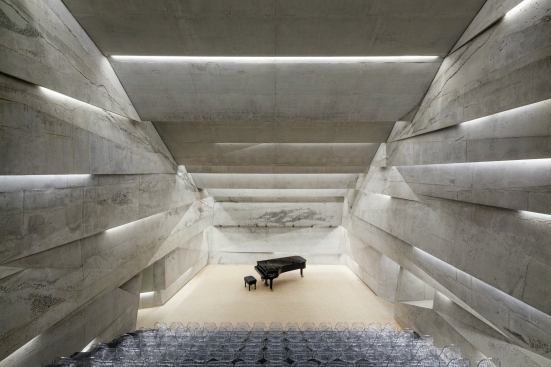
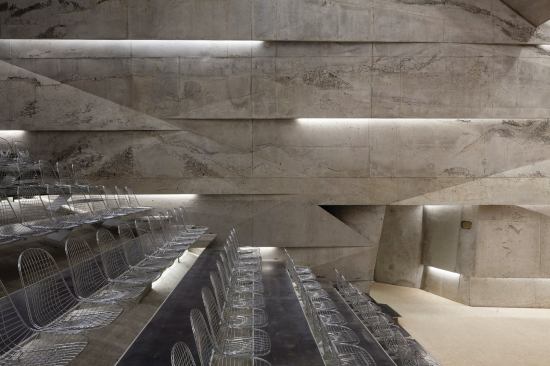
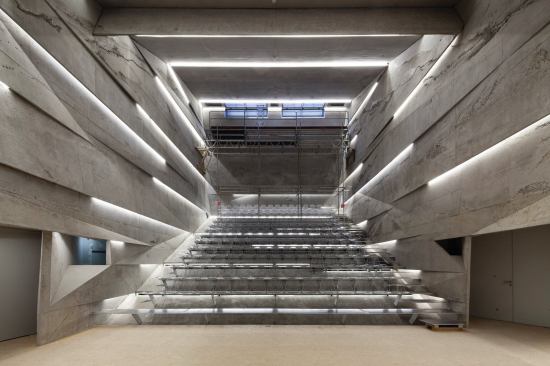
restrooms beneath a wood ceiling plane. But the main event is the
concert hall itself: an entirely concrete space that is acoustically
fine-tuned for classical music.
“Concrete is the best material for good acoustics,” Haimerl says. “What
you need is a very hard surface, and a few areas where you dampen the
sound. People are using wood, but it is not the best material because it
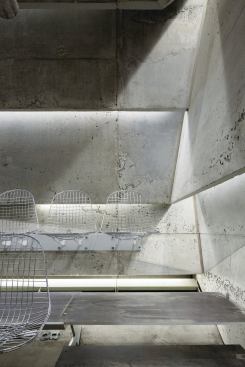
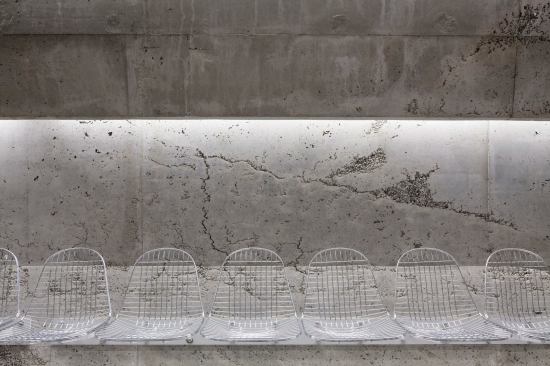
is not stiff.” The concrete here is a lightweight mix with recycled
glass aggregate that results in a rough textured surface—“like paper,”
the architect says.
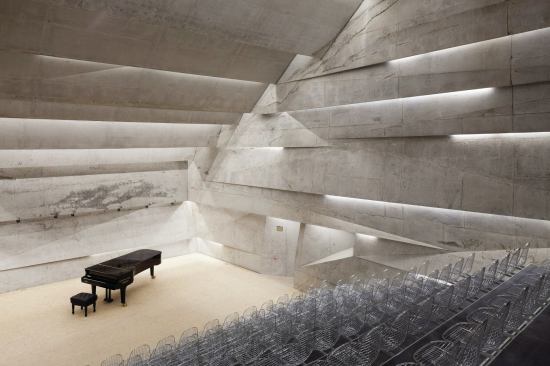
Haimerl’s team worked with acousticians to determine the ideal shape to
best modulate sound, which resulted in a pleated ceiling and walls.
Working with an automotive fabrication team to execute the delicate
formwork, Haimerl oversaw the process to pour the concrete in place,
with tubing for radiant heating, LED light fixtures, and other utilities
embedded directly within. At their deepest point, Haimerl says, the
walls measure 60 centimeters thick, and at the most delicate edges of
the pleats, the concrete is as thin as 5 centimeters. Another set of
tubes in the concrete help to modulate the bass tones, resulting in a
balanced acoustic experience.
“I wanted to show that classical music doesn’t have to be shown in a
heavy, textile-filled environment,” Haimerl says. And so far, the public
seems to be responding enthusiastically to his alternative aesthetic.
The architect has also designed a community center and renovated a
farmhouse house in Blaibach, and the performances in the new concert
hall have all sold out. —Katie Gerfen