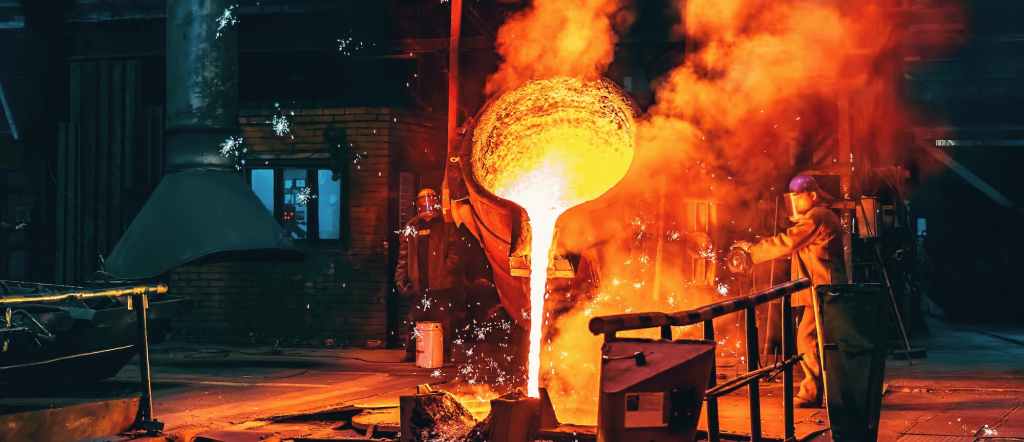
Like concrete, steel has a carbon problem. The much-discussed energy-intensive cement production accounts for roughly 8% of global CO2 emissions. Steel production is responsible for nearly the same amount. The good news is that steel, just like concrete, is on a path to decarbonization.
A new generation of steelmaking processes promises to reduce steel’s carbon footprint measurably. (The focus is on reducing the carbon emitted—not the carbon contained within the material.)
As The Economist recently reported, companies like Electra, Boston Metal, and Hertha Metals have set their sights on iron production, developing methods to separate iron from raw ore using less energy than is expended in typical processing.
The first two firms employ versions of “electrowinning,” an electrolytic method, to liberate iron from its ore. In contrast, Hertha Metals has developed a chemical-reduction approach to separate the iron, using a single-step electric arc furnace (EAF) to convert it into molten steel.
While these developments are notable for their individual process improvements, they also point to a future industry that is more modular, flexible, and electrified. Traditional blast-furnace-reliant steelmaking demands significant capital investment and continuous operation.
In contrast, many new technologies offer the advantages of more nimble, small-scale deployment and compatibility with the intermittent power intrinsic to renewable energy sources. In this way, such developments align steel production more closely with contemporary energy systems.
This transformation is already occurring at an industrial scale. Sweden’s HYBRIT initiative aims to supplant coal-based production with renewable hydrogen generation. Developed by SSAB, LKAB, and Vattenfall, HYBRIT aspires to create the world’s “first fossil-free steel,” eliminating one-third of Sweden’s steel industry’s CO2 and ten percent of the nation’s emissions.
HYBRIT technology emits water vapor rather than CO2 and is already implemented in pilot projects for building construction applications.
Sweden’s Stegra has similarly established fully integrated steel manufacturing in Boden with a “giga-scale electrolyzer.” The new plant combines renewable power generation, green hydrogen, and digitized operations capable of producing millions of metric tons of steel annually—with a savings of more than 7 million metric tons of CO2 emissions compared with traditional methods.
In the building construction industry, changes in design and the construction ecosystem promise to further augment these impressive metallurgical advances.
For example, the proliferation of EAF technology, which already has a significant role in steel recycling, represents a shift from centralized to distributed organization. EAFs are more nimble than traditional blast furnaces and can be deployed closer to construction sites.
Digital fabrication platforms such as Trimble’s Tekla PowerFab enable close coordination between design, detailing, and fabrication to streamline workflows and reduce material waste. Directly integrating BIM data and fabrication promises to minimize the inefficiencies and errors that have long plagued building construction, while reducing the carbon footprint associated with such waste. Design for manufacture and assembly (DfMA) strategies extend this high-performance model via prefabrication. Companies like DPR Construction have developed engineered-to-order (ETO) systems that optimize labor and material resources, minimize economic and environmental costs, and maintain high quality.
These changes in the steel and construction industries present both challenges and opportunities for architects. On one hand, the proliferation of new methods and certifications increases the inherent complexities of material selection and specification. Not all “green steel” is created equal, and the carbon footprints of materials vary depending on energy sources, production methods, and supply chain ecosystems. On the other hand, the increased availability of low-carbon steel enables measurable improvements in building life cycle accounting without fundamentally changing structural systems.
In addition, these changes welcome a reconsideration of architecture’s relationship with industry. While architects have largely operated at a distance from material fabrication processes, the shift toward modular, electrified, and digitally integrated approaches challenges this separation, inviting architects to assume a more engaged and collaborative role in shaping the fossil-free material systems of tomorrow.