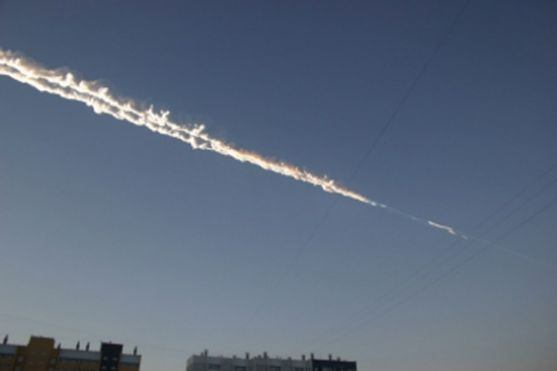
These days, we catch miracles on CCTV. Last week, when a meteor broke up over Russia and its debris rained down over the trans-Ural region, countless security cameras, construction documentation devices, police car surveillance cameras, site monitors, and who knows what other devices caught the blaze of light streaking across the sky before disappearing into countless pieces. You could see the flash, the streak, and the light that filled the grainy pictures with a moment of pure glow.
What the cameras did not catch was the sonic boom, loud enough to shatter windows all across the region and cause hundreds of casualties. It reminded me of when I have been in earthquakes: the one thing you are not prepared for is the sound, so like what I imagine the voice of God to be. For those of us who are not religious, the idea that the Annunciation, the star guiding the Magi, and countless other portents were actually celestial events we can now not only explain, but document, it is not new.
What is amazing to me is the spread of surveillance devices that caught this event in what is such a remote area. Big Brother is always everywhere watching you, and nothing escapes his gaze. Not only that, but science fiction movies prepared us for the event so that it seemed staged. What is beyond our comprehension is caught, tethered, and familiar.
I was also reminded of a piece that the art museum I direct just acquired: one of Chris McCaw’s “Sunburn”s. The artist makes these pieces by leaving his camera aperture open during the course of a day, so that the sun burns an arc in the antique silver gelatin paper he uses. Ours shows the sun rising and setting over the Bay Area, the contours of human habitation visible as shadows in front of the emphatic slice of the sun seeming to plunge into the ocean.
The daily miracle has turned into art; a motion that we can explain by science has become what appears to be the gesture of the artist’s hand, slicing through reality in the manner that Modernists have been doing with palette knives and buildings for the last century or more. I was also reminded of the fall of Icarus. Was that the son of the early scientist actually falling from heaven, his failure lighting up the sky above Russia, or disappearing behind the Golden Gate Bridge? Of course it was not, although we will never know for sure.
All our technology only shows phenomena, without explaining or excusing them. All our science explains, but does not make palpable what it postulates. We can know and we can experience, but only art can bring those together, and then only through intimation or hints.
The blaze across Russia remains a awe-inducing event, no matter how many cameras recorded it. However high we soar to explain, we crash down again as the ineffable becomes an effect, a momentary interruption in that which we survey. I was reminded, lastly, of W.H. Auden’s great poem, “Musee des Beaux-Arts.” Something amazing happened, and we turned it into fodder for YouTube. Now we have already forgotten it, though I hope somewhere, somehow, some artist will, like Brueghel and then Auden, tease this miracle out and away from the deathly embrace of electronic eyes:
About suffering they were never wrong,
The old Masters: how well they understood
Its human position: how it takes place
While someone else is eating or opening a window or just walking dully along;
How, when the aged are reverently, passionately waiting
For the miraculous birth, there always must be
Children who did not specially want it to happen, skating
On a pond at the edge of the wood:
They never forgot
That even the dreadful martyrdom must run its course
Anyhow in a corner, some untidy spot
Where the dogs go on with their doggy life and the torturer’s horse
Scratches its innocent behind on a tree.
In Breughel’s Icarus, for instance: how everything turns away
Quite leisurely from the disaster; the ploughman may
Have heard the splash, the forsaken cry,
But for him it was not an important failure; the sun shone
As it had to on the white legs disappearing into the green
Water, and the expensive delicate ship that must have seen
Something amazing, a boy falling out of the sky,
Had somewhere to get to and sailed calmly on.
—W.H Auden, Musee des Beaux-Arts, 1938